


Down News examines the arguments around the case for replacing or retaining the light beam at St John’s Point
Just like the debate over the Hunting Bill in the Northern Ireland Assembly, the controversy of the future of the sweeping beam at St John’s Lighthouse too is a scenario where there is little middle ground and strongly help positions at either end writes Jim Masson ©.
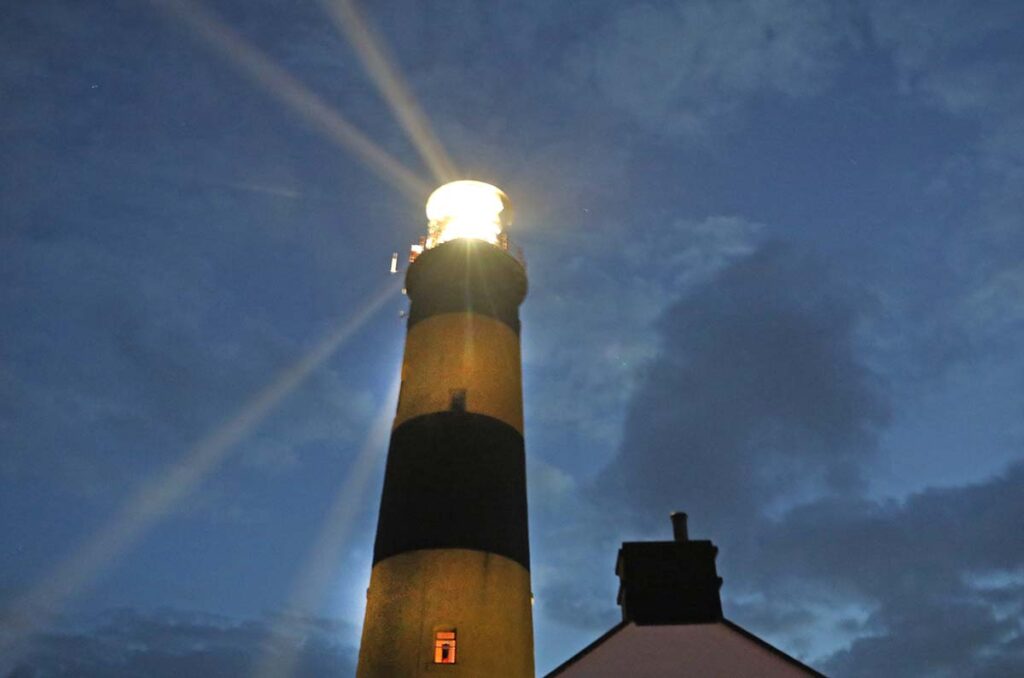
In recent years the proposal by Irish lights to significantly modify and modernise the Fresnel light system has been seen by local campaigners as ‘a step too far’ encroaching on the rights of local residents and visitors, and quite simply impinging of their cultural and heritage experiences of the local population through generations.
Irish Lights argues that it is operating within all the planning guidelines and regulations and while it recognises sensitivities around the proposed changes, its main aim is to primarily establish and maintain navigation aids for seafarers.
Down News therefore is looking at the arguments for and against the removal of the Fresnel light at St John’s Lighthouse and sets out:
* 1) the proposal from the Commissioner of Irish Lights (CIL) submitted to the Planning Service.
• 2) the arguments from CIL.
• 3) the case for the opposition group Lecale Lightkeepers.
It is understood that given the very detailed nature of some of the technical issues, a full analysis cannot be conducted at this stage, but it is important in the run up to a planning decision to understand the broad approaches of both camps and their arguments.
The proposal from the Commissioner of Irish Lights (CIL) submitted to the Planning Service.
The Planning Department in a Neighbour Notification Letter wrote the following in early June 2026 describing the proposal by Irish Lights:
The Proposal:
“Listed building consent is sought for proposed works at St. John’s Point Lighthouse. The proposed works are required to ensure the continued safe and reliable operation of the lighthouse. The project includes the retention of the rotating Fresnel lens and flash character of the light while allowing the removal of mercury and diesel generation from the lighthouse.
“The existing Fresnel Lens, will continue in operation by installing a mechanical rotational ball-bearing race below the lens, replacing the mercury used in the existing rotation system. The mercury will be removed from the site for responsible disposal by a specialist contractor.
“It is intended to replace the existing light-source with a low-energy LED light-source, this will enable the replacement of the existing back-up diesel generator and fuel storage with a back-up battery system to be used in the event of mains electrical failure.
“The existing emergency lights will be replaced with new full-range emergency lights, Sealite SL-300 lights or equivalent, which will only be exhibited in the unlikely event that all other systems fail.
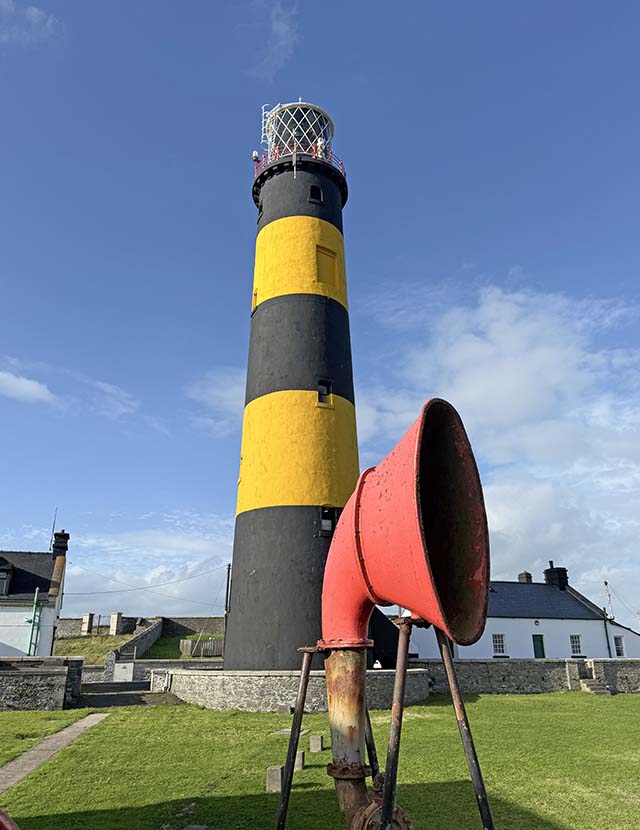
“The proposal contains a range of ancillary works including the removal of existing electrical cabinets, the relocation of the disused Fog Signal Emitter from the balcony to the Fog Signal Compressor Room (to the southern part of the site), localised repairs to the tower lath and plaster where defective. Any source of damp ingress to the tower will be investigated, if tower lining is beyond repair it will be removed to expose natural stone construction.
“The existing entrance gate to be repaired if possible, or replaced with similar gate in the existing green colour manufactured using wrought iron and steel in accordance with the original construction methods. The ladder located outside the lantern will be secured in place to provide inadvertent rotation.” (additional Information submitted).”
***
2) Irish Lights Update On St John’s Point Lighthouse Project Proposals
Irish Lights has issued an update on the St John’s Point Lighthouse project to Down News, reaffirming that its statutory remit is the safety of navigation delivered through a national network of Aids to Navigation. St John’s Point is a Category 1 General Aid to Navigation, required to meet international standards and operate with 99.8% availability.
It means the lighthouse must be working almost all the time with only a tiny margin for any downtime or interruptions. The current system is now 27 years old, beyond its 20‑year design life, and increasingly unreliable. Ensuring its continued safe performance for mariners is Irish Lights’ foremost responsibility, and this context underpins all decisions and communications relating to the capital project.
To meet Irish Lights’ obligations as the authority responsible for safety of navigation at sea, this capital project must proceed in the interest of mariner safety. Significant deterioration has occurred since May 2024, resulting in multiple periods of downtime caused by generator failure, continuous mains failures affecting the old optic control cabinet, discharge lamps requiring manual resets, battery charger failure, breakers tripping, and issues with electrical isolation.
These failures all directly linked to the age and condition of the installation undermine the lighthouse’s performance as a Category 1 Aid to Navigation and present increasing risk to mariners, to Irish Lights technicians, and to the tower itself.
The project will upgrade electronic and control systems, remove the mercury hazard while retaining rotation of the historic Fresnel lens, install a low‑energy light source to support battery backup and eliminate the diesel generator fire risk, provide full‑range emergency lighting, and renew mechanical and electrical systems to ensure long‑term reliability.
Trials of similar lighthouse structures have been carried out successfully, demonstrating that the engineering solution is proven, reliable and capable of delivering the performance required at St John’s Point.
The upgrade works were originally planned to commence in 2015 but were deferred following local concerns about the installation of a modern equivalent and the removal of the rotating Fresnel lens.
Following a series of constructive public consultations, Irish Lights invested significantly in a mechanism that would allow the existing First Order Fresnel lens and rotating beam to be retained, while fully complying with international best‑practice Aids to Navigation standards. This included the development of a successful pilot solution on Tory Island.
Ahead of submitting the Listed Building Consent (LBC) application, Irish Lights undertook further consultation with local communities and media outlets. This included a public consultation event in November 2024, a heritage‑centred event for local stakeholders, and briefings to political, community and media representatives.
A project briefing leaflet was issued, and Irish Lights participated in radio, print and television interviews. Engagement with local communities has been ongoing, thorough and comprehensive.
Irish Lights’ commitment to St John’s Point extends well beyond the operational requirements of the tower. Through the Great Lighthouses of Ireland initiative, Irish Lights is actively exploring ways to attract visitors, interpret the site’s heritage and strengthen its role as a destination.
The May 2024 workshop Exploring Options for Future Tourism Development and Visitor Experiences associated with St John’s Point Lighthouse, Co Down at Castle Ward brought together Tourism NI, Newry, Mourne and Down District Council, the National Trust, the Irish Landmark Trust, local heritage bodies, hospitality providers and the Lecale Lightkeepers.
Participants identified a shared ambition to interpret the area’s maritime heritage, position the lighthouse as a gateway to slow travel across the Lecale peninsula, and ensure any future development is sensitively managed, sustainable and community‑led. St John’s Point’s heritage and visitor potential also formed part of Irish Lights’ successful Shared Island funding application, and Irish Lights will continue this work in partnership with Tourism NI and the Council.
Since submitting the LBC application, Irish Lights has responded to Council requests for further information, met twice on site with the Department for Communities Historic Environment Division (HED), and undertaken a detailed review of all objections raised. This work ensures that matters raised are fully addressed ahead of the planning decision.
Irish Lights remains fully engaged in the LBC process and has submitted extensive heritage, biodiversity and technical information to support the planning authority. While some public commentary has included inaccurate claims, the facts are clear:
- the rotating lens is being retained;
- the light characteristic will remain as close as technically possible to the existing one;
- the proposed range reduction is fully in line with IALA international standards and has no impact on the effectiveness of the lighthouse as an Aid to Navigation.
Irish Lights remains committed to safeguarding navigation, protecting heritage, and supporting the long‑term potential of St John’s Point as both a working lighthouse and a valued coastal landmark.
All information on the project is available on the NI Planning Portal (Application Reference: LA07/2025/0008/LBC) and see information about CIL on the Irish Lights website.
Current light system and the use of mercury
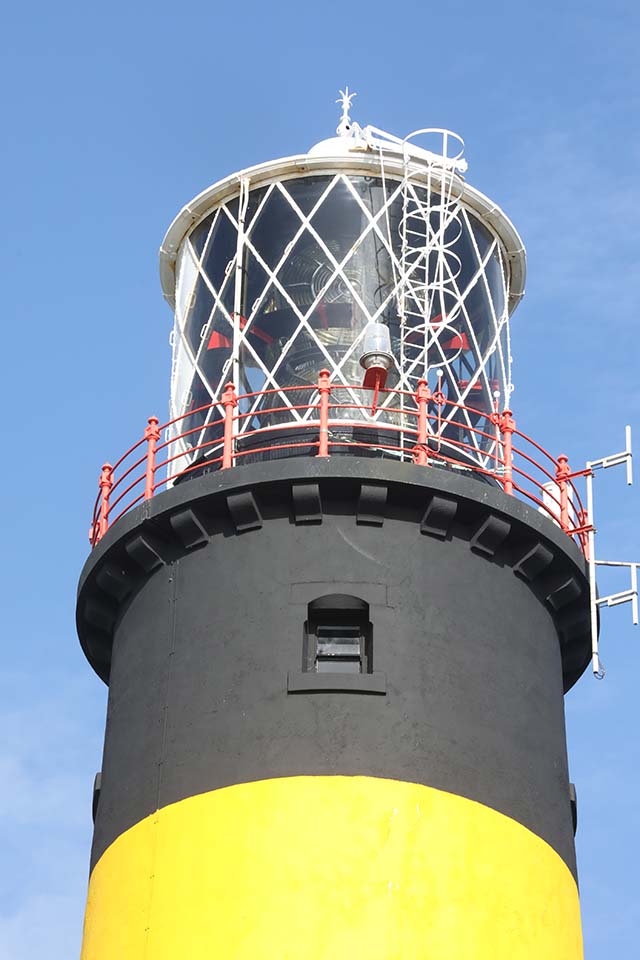
The lighthouse contains around 30 litres of liquid mercury in the bearing that supports the lens. Mercury is now recognised as a highly toxic substance, and in warm weather it releases vapour that can pose a serious health risk to anyone working inside the tower. There is also a risk of a spill if equipment fails or if the lighthouse is damaged by lightning, fire or severe storms.
Modern safety standards no longer permit mercury in operational systems, so Irish Lights is removing it and installing a safe, modern bearing system to protect people, the environment and the long‑term future of the lighthouse.
Another important issue is the availability of mercury. The lighthouse optic contains mercury that can gradually evaporate over time and, although topping up is only required infrequently, the system cannot be maintained indefinitely without access to replacement mercury and specialist servicing.
This process, or cleaning the mercury, was in the past carried out by Irish Lights and subsequently by a specialised contractor. However, there is no longer any legal avenue for Irish Lights to source mercury, in Ireland or the United Kingdom. As such Irish Lights cannot maintain the system.
How the LED light will operate as an aid to navigation
The new LED will sit inside the existing rotating Fresnel lens and will produce the same flashing light pattern that mariners already recognise. It simply replaces the old high‑energy metal discharge lamp at the centre of the lens. The lens continues to rotate as it always has — the only change is the light source, which is now modern, efficient and standard across lighthouse authorities.
Vessel’s use of radar as a navigational aid
In parallel with significant advances in satellite navigation and electronic charting, physical marine aids to navigation such as lighthouses, buoys and beacons continue to play a vital role in keeping mariners safe at sea.
International Maritime Organization (IMO) standards recognise that modern navigation should be resilient and not rely solely on satellite-based positioning systems, which can be disrupted by technical failures, cyber-attacks or signal interference.
Physical aids to navigation such as St. John’s Point provide an independent visual reference that helps mariners confirm their position, identify hazards and navigate safely between ports and harbours. Under the International Convention for the Safety of Life at Sea (SOLAS), coastal states including the UK have a responsibility to provide aids to navigation where this is justified by the level of marine traffic and navigational risk.
While these aids to navigation support large commercial ships covered by SOLAS, they are equally important for commercial and recreational fishing vessels, leisure craft and other smaller vessels, many of which operate close to shore and rely heavily on lighthouses, buoys and beacons for safe navigation.
Other lighthouses using LED lights
Across the Irish Lights network, LED has become the standard because traditional filament, halogen and metal‑discharge lamps are increasingly difficult to source and support, as the marine lighting sector has moved towards LED technology. LEDs also use far less energy, last significantly longer, and reduce environmental impact.
As a result, 75% of lighthouse light sources are already LED, and the remaining sites are transitioning. All Irish Lights buoys now use LED technology, reflecting modern best practice and ensuring a reliable, efficient and sustainable AtoN service around the coast.
***
3) The Case Set Out By A Spokesperson For The ‘`Lecale Keepers’
The campaigners’ case is primarily cultural and heritage-based, although they reinforce it with environmental, navigational and economic arguments. Their case will depend on whether they can back up their arguments with objective data and evidence to satisfy the Planners in the decision-making process.
The campaign began in January 2015. The late Henry Henvey, a former lightkeeper at St John’s Lighthouse said to the campaigners that he had seen changes to other lights and ‘feared the worst’ for St John’s Lighthouse, adding that he felt under pressure as he could not challenge is employers especially as he has lived at the lighhouse being born (and eventually died) there. So just before he passed away, he ‘commissioned’ campaigners from Killoughan Ardglass to ensure the sweeping beam did not experience unnecessary modernisation.
Eileen Peters, spokesperson for the Lecale Lightkeepers, said their central claim is that the lighthouse’s heritage value lies not merely in the tower or the Fresnel lens as physical objects, but in the whole living experience of the lighthouse.
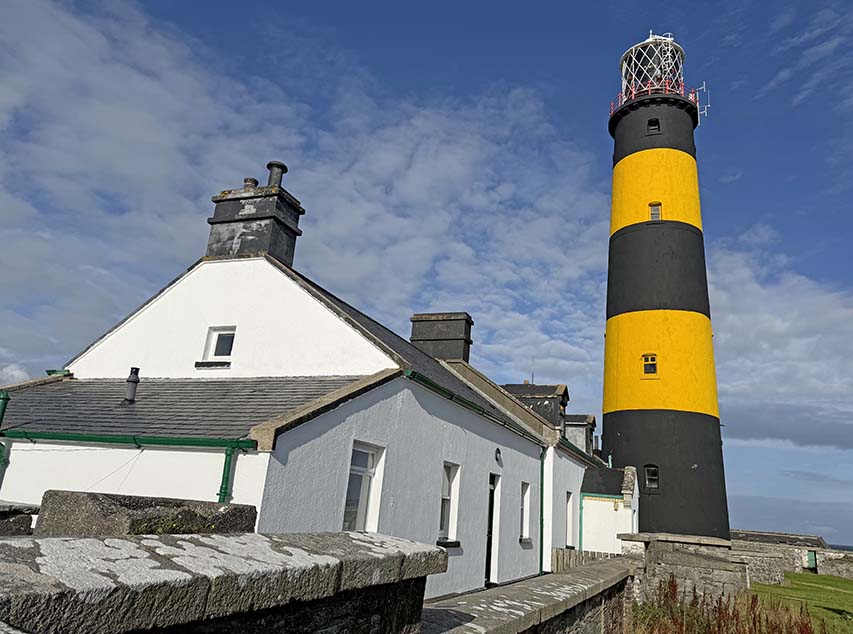
A committee was formed and called a public meeting in March 2025 with the help of local politicians. All parties were in support of retaining the sweeping beam.
The self-funded group has visited Dail Eireann and spoken to politicians at Leinster House, and has the support of singer Van Morrison.
Several public meetings were held. At Easter 2015, protesters blocked workmen who had come to change the light with coverage on Sky News. Soon after, a local politician said that CIL had pulled back on their efforts to replace the light.
The Lecale Lightkeepers has carried out a substantial body of research and have visited many of the main lighthouses around the Irish coast including Rathlin, Tory Island, Arranmore and Loop Head.
They maintain that the large batteries required to manage the proposed new systems have been known to leak and give off toxic fumes.
The campaigners have sought records of each and every time that Rathlin and Tory lighthouse shave required maintenance and repairs since their installation.
The campaigners say that they had hoped that CIL would find a technical compromise, but as yet a satisfactory solution has not emerged.
And the campaigners say that tourism will be affected by a change to LED lighting as one case (cited a Guardian newspaper), the LED light experience is inferior to the sweeping beam.
A summary of their arguments on preserving the light system at St John’s Lighthouse :
The cultural dispute is therefore really about what “preserving” a lighthouse means:
- A distinctive part of County Down’s night-time landscape. The broad sweeping beam has been visible across Lecale and the wider coast for generations. Campaigners regard that recurring sight as part of their local identity and collective memory.
- Living maritime heritage. The Bourdelles–Fresnel apparatus is still performing its original function. Replacing its mercury-bearing system and present lamp would, they argue, turn an authentic working technology into something closer to a preserved historic shell containing modern machinery.
- Continuity with fishing and coastal communities. The beam represents generations of fishermen, sailors and lighthouse keepers and the lighthouse’s role in bringing people safely home. It is therefore treated as part of Lecale’s social history, not simply as an architectural monument.
- Rarity and irreversibility. Campaigners describe St John’s Point as one of the last operational examples of this type of sweeping light. Once altered, they say, its particular character and historical continuity could not genuinely be recreated.
- Sense of place and tourism. They believe the functioning historic beam gives the lighthouse greater cultural and visitor value than a conventional modernised lighthouse would, with potential for heritage tourism during evenings and the quieter winter season.
- These themes appear explicitly in the campaign’s petition and in the group’s museum work documenting photographs, artefacts and local stories. The official exhibition description emphasises how the lighthouse shaped the Lecale coastline and its communities.
| Campaigners’ view | Irish Lights/Historic Environment view |
|---|---|
| Heritage includes the quality of the sweeping beam, original operating system and community’s experience of it. | Heritage can be protected by retaining the historic lens, rotation and flash pattern while modernising the light source and bearing. |
| Changing the mechanism changes the identity and authenticity of the lighthouse. | The proposed works are largely reversible and preserve the important physical fabric. |
| The beam itself is intangible cultural heritage. | The material historic apparatus is the principal conservation concern. |
Irish Lights says its proposal would retain the rotating Fresnel lens and its distinctive flash character, while replacing the mercury bearing with a mechanical bearing, the lamp with a lower-energy LED and the diesel backup with batteries. The Historic Environment Division accepted that approach subject to conditions, including keeping older equipment on site for interpretation.
Campaigners also cite reduced light range, possible effects of white LED light and mechanical noise on wildlife, reliability, and tourism. But those are supporting strands.
The emotional and intellectual heart of the campaign is that the sweeping beam is itself a piece of County Down’s culture—a familiar, functioning connection between place, people and maritime history—not merely light produced by interchangeable equipment.
The Lecale Lightkeepers are currently having meetings with the Historic Environment Division and Planning and they have set out their table why they think the HED consultation response is inadequate in defining the heritage asset, the sweeping beam and the St John’s Lighthouse too narrowly.
One key argument from the campaigners focuses on the growing international development of “international practice shows that continued navigational use and conservation of mercury-float apparatus are compatible.” They cited Cape Bryon and Norah Head in Australia as examples where the Fresnel optics and mercury floats are working aids to navigation.
The bottom line for the campaigners is: the case for LED claims must be proven, not assumed.
***
Interestingly, a number of political parties too have backed the campaigners publicly. However, there is an Assembly election next May and a local council election, and this may input in some shape or form into the thrust of the public arguments as the long-drawn out affair reaches a hiatus at the planning committee of Newry Mourne and Down District Council (the date of which is yet to be confirmed.)
There are many areas where the discussion can get very detailed, but the above is a general position depicted of the positions of CIL and the Lighthouse Keepers. At the moment, they are poles apart and are at loggerheads.
Down News will investigate aspects of this further, but it begs the question, will the parties agree to defer this planning decision until after the Assembly and Council election next May 2027 ?
Or will they try and steer it through a planning decision during the Christmas and Summer holiday breaks when the public focus lies elsewhere ?
***
(Jim Masson/DownNews © 2026.)