


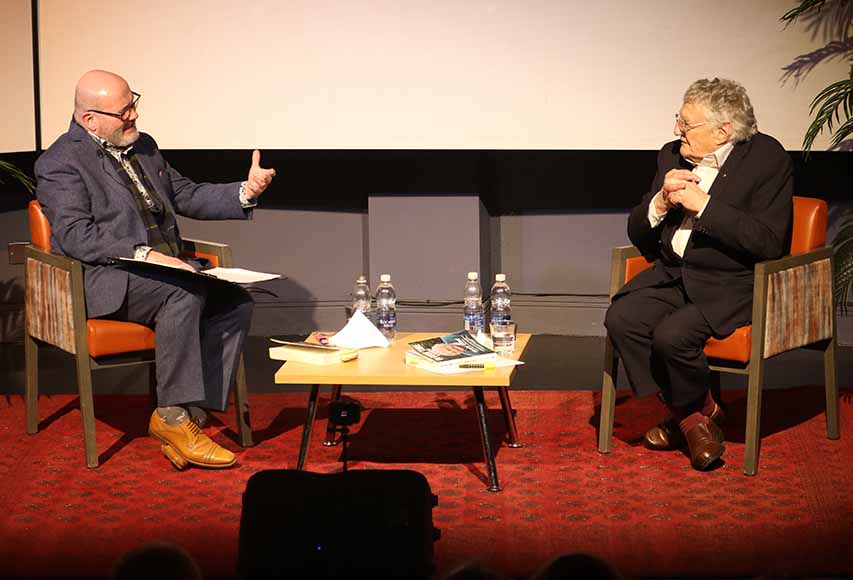
Peace Process facilitator Rev Harold Good talks about his memoir ‘In Good Time’ at the St Patrick Centre in Downpatrick
The Rev Harold Good has carved his name in Irish history as one of key facilitators who managed to bring the Provisional IRA and loyalist factions into face-to-face discussions which eventually led to the Good Friday Agreement in 1997 and the subsequent decommissioning of arms.
Along with the late Fr Alec Reid, a Catholic priest, the Methodist Minister Harold Good, who was born in Derry, worked tirelessly on his mission for peace and often at great risk to get the opposing factions into dialogue.
“In Good Time” is a memoir co-written by award winning journalist and broadcaster Martin O’Brien. And it was the main point of focus at the chat to an enthralled audience in the St Patrick Centre in Downpatrick on Thursday 13th February (2025).
His father, a reverend preacher in the Methodist church came from Cork, but his mother was from County Armagh. He said initially he never thought of training to be a minister but when he took the step and never regretted it.
The Rev Good rose above the sectarian division, above the ethos of what the Rev Ian Paisley was creating in the 50s, and shaped his own ecumenical approach to life.
With many accolades under his belt such as being leader of the Methodist Church in Ireland, a director of Corrymeala Community, he also served as the chaplain in Belfast’s Crumlin Road jail i(1973 to 79).

(Photos: Jim Masson/DownNews©).
He recounted a dinner he had in Buckingham Palace which lasted an hour and a half sitting next to Queen Elizabeth as she wanted to seek his views on her proposed visit to Ireland. Following the dinner some members went into a lounge and had coffee and spoke in conversation with the Duke of Edinburgh who was undecided about Rev Good’s religious intentions.
“But the Rev Good assured him in a challenging conversation that he was one of the “joyous” protestants”, and at that moment the penny dropped with the sceptical Duke and they raised their coffee cups in a mutual understanding.
Joking aside, he said to the audience: “I now know now what the Queen kept in her handbag… it was dog biscuits for her Corgis. When we were set to move from the dinner table, the Corgis appeared. That was the signal to retire to the lounge.”
In the early part of the conversation between Martin O’Brien asked him what he thought of St Patrick. He replied: “Well, my father did a sermon on St Patrick and had to do a lot of research to understand what he was about. He said to me, ‘What have I got myself into here!’ jokingly. Interestingly, this year in the Shankhill there will be a St Patrick’s parade which is a real sign of progress.
“We were never opposed to the idea of St Patrick, it’s just that he did not figure much in our work.”
But it was in Indianapolis in the USA that he cut his teeth after qualifying as a minister and served as a hospital chaplain in the 60s. His ministry took him close the the black community and it was there that he developed his sense of social justice.
Speaking in the Chapter in ‘In Good Time“, ‘The World as a Parish‘, he discussed he meeting with Nelson Mandela and said on a return trip from India, that he met “Nelson Mandela at the Triennial Conference of the Methodist Church of South Africa. Mandela was then not just the world’s best known Methodist but arguably our planet’s greatest moral voice.”
This meeting took place just after he represented the Irish Churches at the Synod of the Church of North India having served as president from 2000-1. This was after his retirement from several ministries in his church when he took on a more international role.
With a growing international reputation, Rev Good was also involved in the arms decommissioning process of FARC in Columbia and ETA in the Basque Country in Spain.
But the Rev Good explained that he had acquired an acute insight into Irish politics and life explaining that one of his grand-fathers had been in the RIC, and the other an active loyalist involved in storing rifles for the UVF.
He also recounted the story of his wife’s family who owned a shoe shop in Waterford. One day the shop was picketed because they were asked to sign the anti-treaty. They had refused. They did moonlight shoes to customers but eventually were discovered, and their shoe shop was set on fire.
So he said that when he arrived in Waterford, he was told whatever you say, “Don’t mention De Valera.”
When Martin O’Brien asked Rev Good what he thought of Donald Trump, Good delved back into history. “I remember Barry Goldwater back in the 60s, thinking if he get’s in as president we are all doomed. The Civil Rights struggle was taking off then in the US and people were openly talking openly about racism.
“This taught me the meaning of the word ‘grace’,’ seeing the death of the hopes and aspirations of the black community. This was all just months before the Civil Rights started over here in around April 1968.
“Back then I thought I was coming back to Ireland to a ministry in Waterford but in fact I ended up in the Shankill as the Troubles were heating up with Bombay Street etc. I can remember seeing about a hundred protesters being hosed in Lurgan – people were being treated just like vermin.
“It was not even a violent protest. They were exercising their civil rights. I knew then there was something very wrong. This was putting petrol of the flames. It was a defining moment for me, and for the Troubles.”
Rev Good reflected on seeing the Rev Ian Paisley for the first time in the 50s. It was just off High Street in Belfast and he was 16. “Paisley wore a black coat and was followed by his faithful to a square just of the main road. He read a page tore it off his book and threw it in a fire, roared a few words, then a small band surged up. Then he did this again… and again.”
There is an interesting chapter in the book on Ian Paisley. He describes Paisley’s early days contrasting with his more peaceful accord later in his life after he served as First Minister with Martin McGuinness and Deputy First Minister.
You can buy “In Good Time” here.
Paisley appeared on the scene in the 50s and came in like a lion but went out like a lamb as he had made a close friendship with Sinn Feín’s Martin McGuinness taking politics to a new and different place.
When the Rev Good met McGuinness in 1996 just after the PIRA ceasefire, he said he needed to get to know him as a central actor in the enfolding process. He said that “It was important to give public recognition to the ceasefire.”
In the Methodist Church there was a Council for Social Responsibility and the Rev Good had seen it as his moral duty then to facilitate the coming together of these stands for a more peaceful society.
Under the cloak of darkness, Good had brought Jeffrey Donaldson representing loyalism and Martin McGuinness together at his kitchen table on a number of occasions to establish dialogue between the two camps. He had earned the trust of both sides in the conflict.
Along with Fr Alec Reid, the Rev Harold Good oversaw many arms decommissioning events around 2005 when weapons and explosives were put beyond use.
Good was reaching out in an all-embracing ecumenism, which cautiously won over the republicans and loyalists.
“Now we are 27 years on from the Good Friday Agreement and 20 years after decommissioning. I think now on where we are at as a community.
“We are in a different place now. Life has changed. But we are still on a journey that’s unfinished. We learn as we go. It can at times be painful with one step forward and two back. We all have something to bring to the table. We need to hear and heal with an open mind.
“The future is going to be different from what some people may hope for. We need to think of a plan that works so we don’t have to use the pretext that there is no tomorrow,” added the Rev Harold Good.
You can buy “In Good Time” here.