



GAA President Jarleth Burns Unveils Stone Of GAA founder who was born in Cargagh near Downpatrick
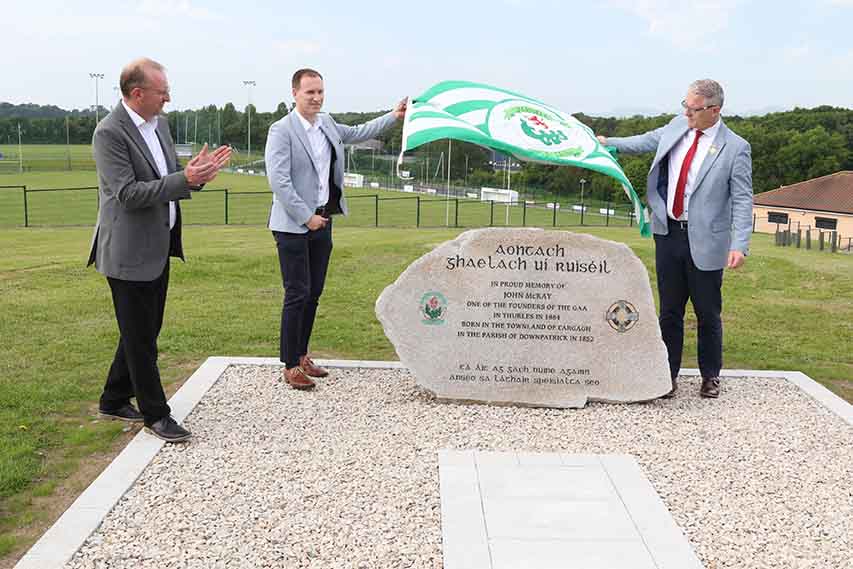
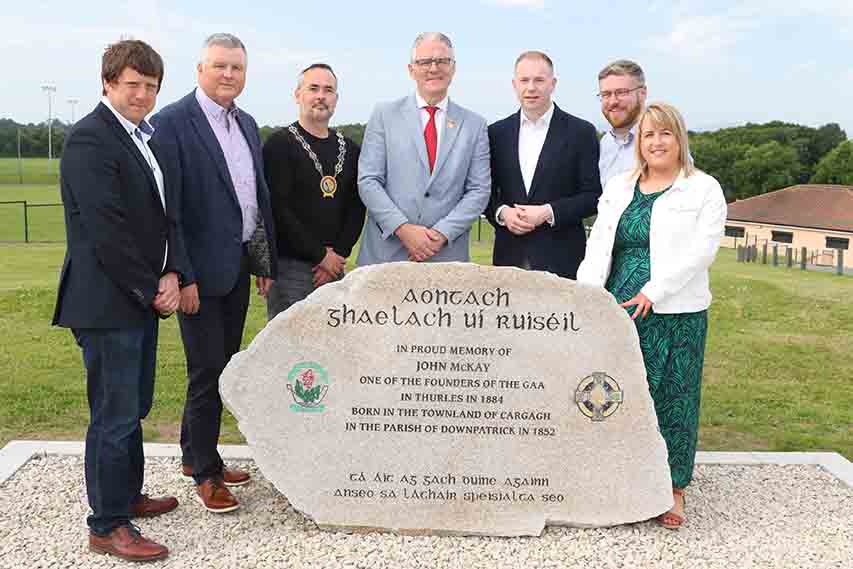
Former Armagh star Jarlath Burms, the current Irish GAA president, visited the Downpatrick Rusell Gaelic Union today (Friday 20th June 2025) for a breakfast talk to a packed clubhouse and also to unveil a memorial stone for one of the GAA founders, John McKay.
Jarlath Burns is a well-known face in the Gaelic sports world and in the media, and he captained the Armagh team to an Ulster final in 1999 and was on the winning side of two McKenna Cups. Once he retired from play, Jarlath became involved in the management of the GAA in local, county then national roles.
In 2000 he was the first players’ representative coming up through the GAA ranks to be on the Central Council and got involved in the development of the GAA through the Scór, anniversary committee and medical and welfare committee and chaired the standing committee on playing rules.
His rise through the ranks reached its zenith in February 2024 when he became the 41st GAA president.
The GAA president was welcomed on arrival by RGU chairman John Murphy. After an introduction by MC Paul McErlean (Antrim), Donal McAnallan gave a history of John McKay, a founder member of the GAA from the parish of Cargagh in the Downpatrick area.
John McKay rose through the ranks of the growing GAA following that first meeting in the Hayes Hotel in Thurles in 1884.
David said: “Up until 2009, the history of those who had formed the GAA was lost. John McKay attended the first meeting in 1884, A County Down man. He was born in Cargagh a few miles from Downpatrick. He seems to have been a key figure in those early days.
“He travelled over Munster in a voluntary capacity. It does raise the question, why was he so involved in promoting the GAA development.
“He came from a humble abode, lived in an old famine house, and played a role in Irish history. He lived in Belfast for 5 years and left a lasting legacy as a key figure in this early group who brought the GAA vision to life.”
There was a discussion too on United Irishman Thomas Russell, born in Cork, who the Downpatrick RGU is named after. Russel’s father and brother were officers in the British army, and he himself joined the army and served in Belfast to later change his political thinking and befriended Wolfe Tone.
Russell became very involved in the Society of United Ulstermen. At one time previously he had been appointed as a magistrate serving in Dungannon. However, he resigned following a practice of the court asking a person’s religion first before proceeding with the case.
Russell was eventually jailed for his political activities and by 1803 was involved in another insurrection. He had gone to the rescue of Robert Emmett and was himself captured. He was tried and executed by hanging and beheaded at the front gate of the present Down County Museum, then a gaol. He is buried in the Church of Ireland graveyard in Church Street in Downpatrick.
The Downpatrick Russell Gaelic Union is located at Thomás Russell Park.
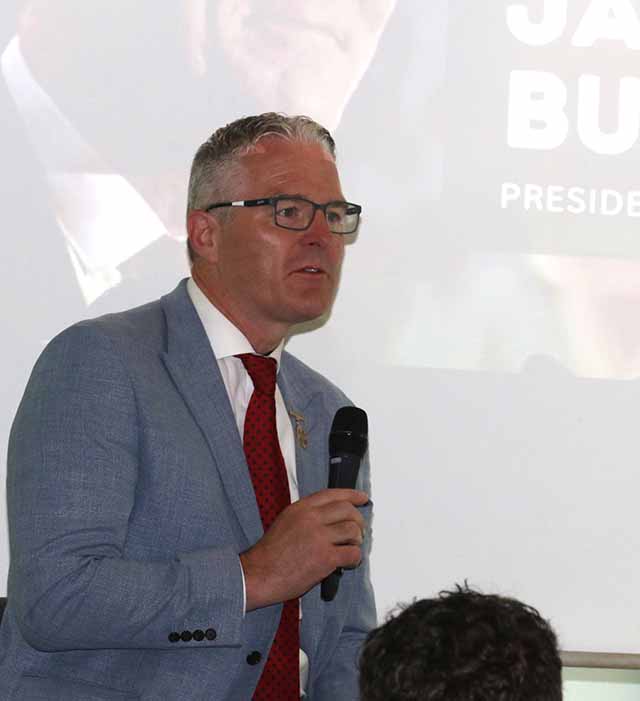
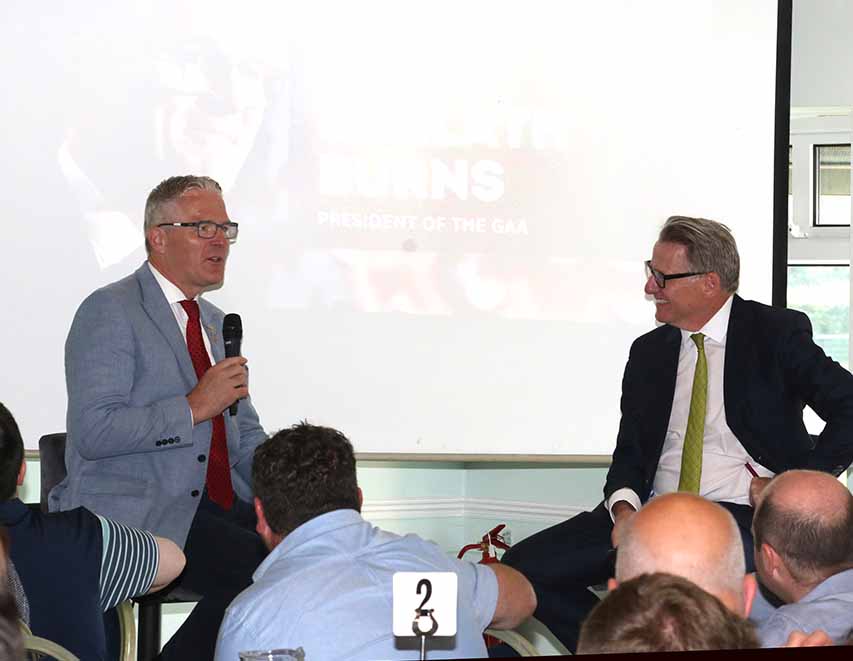
Jarlath Burns Gives A Breakfast Talk At Downpatrick RGU
In his introduction, GAA President Jarlath Burns described a final at Croke Park as “70 minutes of hell”. He summed up the aspirations and anxieties, the hopes, dreams and fears and the pure drama of a championship final.
He paid particular attention to the late Senator Maurice Hayes who introduced training to the county teams. And Jarlath also acknowleged the important role the Downpatrick RGU has played in setting up a full-time coach for three Primary schools in Downpatrick.
John Wilson, RGU Chairman, said in his initial address: ” Our Future Stars programme is designed to provide consistent quality coaching and promotion of the RGU and the ethos of the wider GAA to our young and diverse population.”
There was a fundraising effort to support the Future Stars Project (see below) and the MND Association. Chris Deegans won the £150 draw and generously re-donated the money back into the pot.
And Jarlath mentioned local players Barry Breen playing in the final in 1991 and also Conor Dagen who played for the RGU as a full back.
Jarlath grew up in Silverbridge, County Armagh, and played for the Armagh Harps. He said that he chose in the early 70s to focus on sport for his development while a number of his peers were involved in other activities. He said “I was proud to be Irish and to expand my talents in the field of sport.”
Having served in various offices, he eventually was appointed as President in 2004 for a three year term and was aware of the key changes that needed to be addressed within the GAA and the game itself.
“I had to do something with the rules of the game. I needed to create space for forwards to attack and score.”
He acknowledged that the game has opened up more now. “I was glad to see an end to a foul giving an advantage to the opposing team. Being able to play on quickly has helped a lot. A good scorer can turn a game round.
‘It is good to see Down starting now to build up momentum again in the championship matches. The CCC are now doing a great job in making the game more attractive to spectators – attendances are well up.”
Addressing the question of what it means to be an amateur athlete, Jarleth said: “We are working on a blueprint at the moment and we have to complete it to create a balance within in the GAA for the future between hurling, ladies sports and football.”
Jarlath also discussed the importance of the development of Casement Park in West Belfast and asked for a show of hands. The main consensus was a larger stadium to accommodate more attendees. And he acknowledged that all stadiums have issues around planning and size referring to Wembley, the Arsenal stadium and even Croke Park.
“We hope there is a deal between Sinn Fein and the DUP, but we expect other sports too to also seek funding. The GAA is constrained as to what it can fund. already there are other multi-million projects across Ireland in the pipeline. We are waiting to see if we can get a boost up to £62 million.
But Jarleth explaied the reality – he said that after a big match, Ulster GAA chairman Brian McEvoy receives many letters from women complaining about poor toilet facilities. And catering for the spectators too needs to improved.
“Croke Park costs around €16 million a year to run. The pitch is cut twice every day every day by six men. It is the best pitch in Ireland. Like other big stadiums around the country it is not without its risk.”
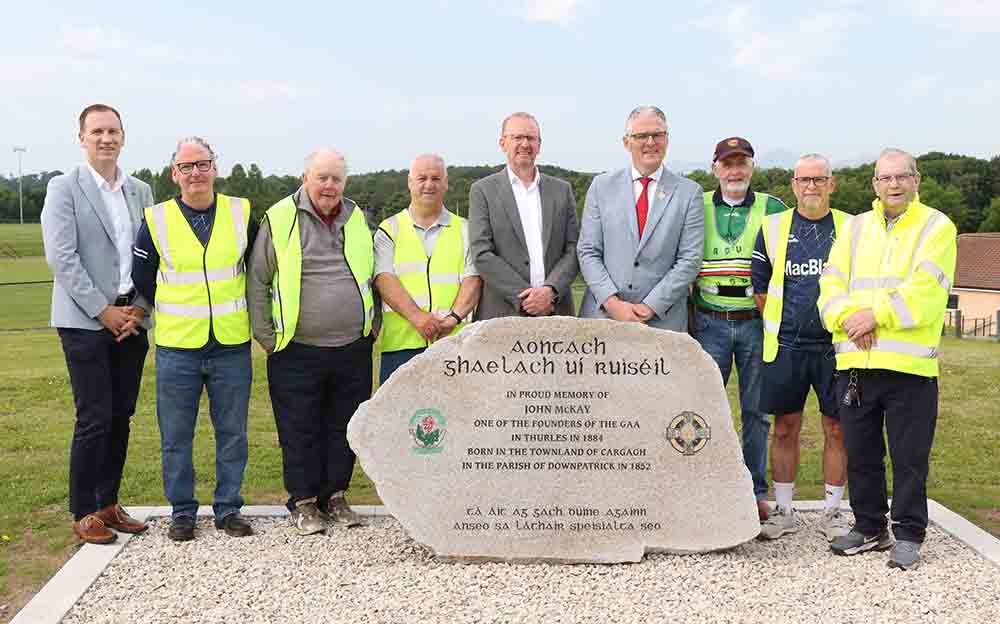
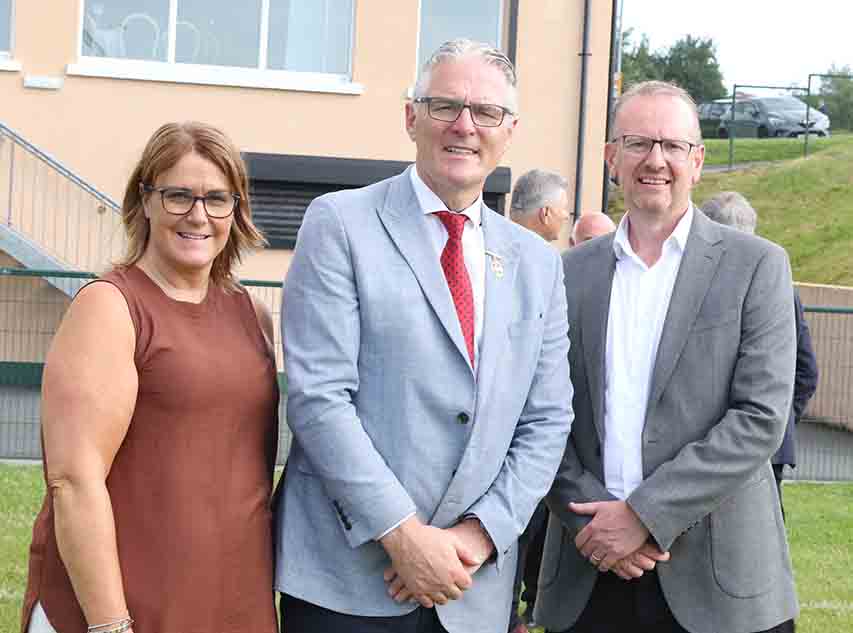
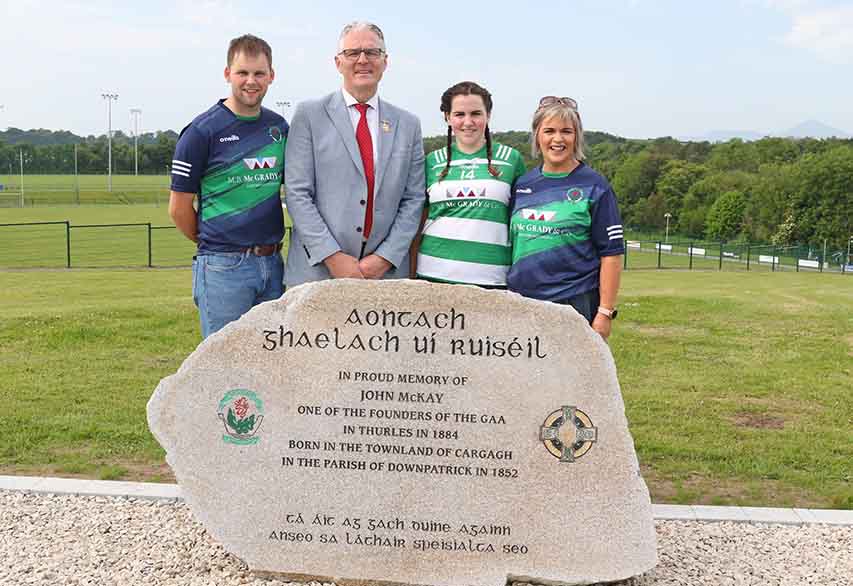
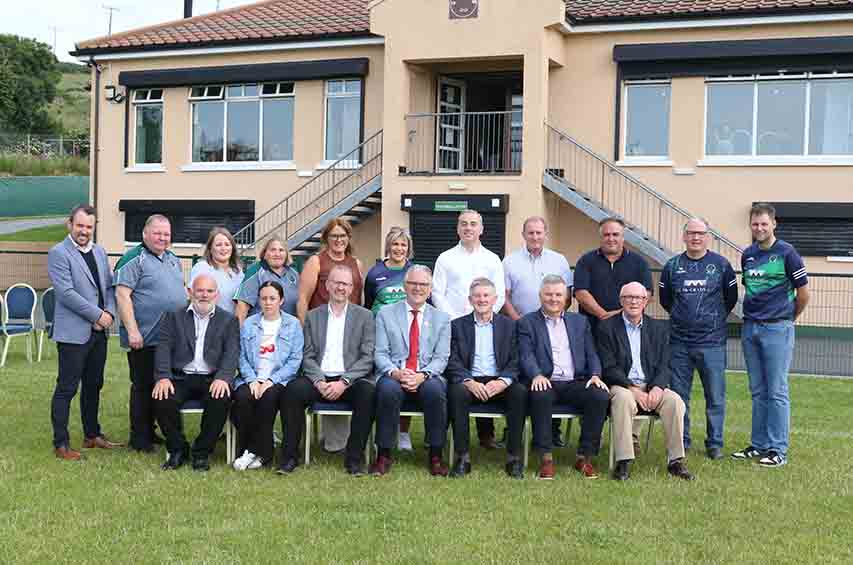
Ending his visit, Jarlath Burns unveiled the memorial stone inside the entrance to Páirc Tomás Ruséil in the morning sunshine and then posed for a few photos with guests for the morning, including the sponsor for the morning Mal McGrady, the volunteers, club management, and local politicians.





)