



Playboy of the Western World.
A review by George Fleeton.
 SIXTEEN months ago the reimagined Lyric Theatre Belfast launched a new phase of its illustrious life, which had begun in 1968, with a superb production of Arthur Miller’s playxa0The Crucible,xa0hisxa060 year oldxa0chef-d’œuvre, reviewedxa0herexa0on DownNewsxa0xa0on 07-05-2011.
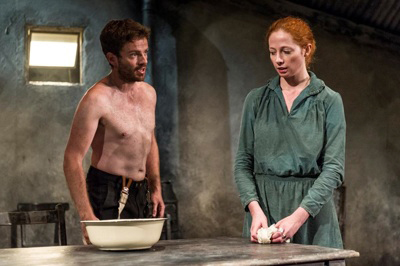
That production had been directed by Conall Morrison,xa0who returned this monthxa0to openxa0the Lyric’s autumn/winter seasonfor 2012xa0with a robust andxa0resounding staging of J M Synge’sxa0The Playboy of the Western World, first seen,xa0heardxa0and unappreciated, inxa0the Abbey Theatre Dublin in 1907.
Today this playxa0oftenxa0has toxa0face fiercely into a wind of shallow criticism which labels it as stage-Irish, paddy-whackery,xa0full of splenetic lallygaggers and scofflaws,xa0celebrating wanton drunkenness and brawling.
Whereas the Lyric production under review does foreground those elements of the text, it is worth pausing to consider some of the deeper concerns of Synge’s mind at the time lest we forget that thisxa0capitalxa0Irish drama is as important to our understanding ofxa0Celticxa0oralxa0culturexa0as anything written about their mythical pastxa0for Greek audiencesxa02,250xa0years agoxa0by Aeschylus, Sophocles or Euripides.
For Christy Mahon, and Pegeen Mike, reach out to us on the modern stage as credible shades of Prometheus,xa0Œdipus,xa0and Medea,xa0each giving expressionxa0toxa0what had never previously been expressed, in languages that had never before been heard or spoken in thexa0publicxa0arena of the theatre.
All theatre comprises writing, performing and witnessing.
Witnessing is crucial to its efficacy, because theatre, like murder or marriage, only works if you see it: it only happens if you are there.
To witness a production today, ofxa0this century-old play, is to see and hear the compassion with which Synge looked upon his peasantxa0inspirations, frequent contact with whomxa0had moulded his imagination.
It is the truthfulness of his observations then that impresses us now.
Synge had learnt much from Jack Yeats.
Both of them had personally witnessed the depths of poverty in the western world of Mayo – Yeats drew and painted it, Synge described it inxa0his essays and plays.
We know that Synge was perturbed on his many visits to the Aran and Blasketxa0islands and had found that those communities had so much to give and were yet so unfulfilled.
There is an explanation for this that might help our understanding of Synge’s wider vision for his play.
The native spirit of late 19thxa0century west ofxa0Ireland, with its attendant civilisation, had been broken by hunger and emigration, and the country had grown old without maturing.
There was a loneliness created by thesexa0economic andxa0social setbacksxa0and the ineffable sadness of this – as reflected in story, song, poetry and music – was a denying force, working against personal and communalxa0self-fulfilment.
Synge witnessed all of this, andxa0determined toxa0do his limited best to set down the character of the people about him so that some record of their compromisedxa0scramble,xa0on the most hostile edge of Europe,xa0might live after them,xa0‘for the like ofxa0us will never be again’, asxa0Tomás Óxa0Criomhthain wrote on the last page ofxa0The Islandmanxa0in 1929.
Thexa0dramaturgy ofxa0The Playboy of the Western Worldxa0deals equally well with thatxa0mostxa0fascinating enigmaxa0in all performance art (as identified by Aristotle – more thinker than playwright – for whom form andxa0contentxa0were the inseparable constituents of allxa0drama):xa0namelyxa0thexa0chasm which exists betweenxa0appearance and reality, today referred to as the romance of illusion, that is, do we live by the dream orxa0byxa0the fact? – as in Pegeen Mike’s line, addressing Christy,
…xa0the blow of a loy (has) taught mexa0thatxa0there’s a great gap between a gallous story and a dirty deed.
It was here that the Lyric production scored well. And the search for identity, as a basic plot concept, was also well treated, especially Christy’s curious, comic but credible odyssey from ploughboy to potboy to playboy.
He searches for and finds more than Pegeen Mike; he finds himself and she is ultimately no more than the catalyst in the painful process of his discovery of self, as he transcends his frightened, inarticulate former persona and blossoms into a real man.
She forsakes him, because he tried to repeat the very patricide which had attracted herxa0to him in the first place and she, forsaking him, loses him.
From among a cast that consistently caught so much of the poetry, music and irony of a western world receding into romantic history, Orla Fitzgerald and Patrick Moy stood out, their experience lending backbone to the whole piece and their performances were nicely balanced by the ensemble playingxa0ofxa0Bríd Ní Neachtainxa0and Lalor Roddy (the Widow Quinn and Old Mahon), with all the other parts constituting a fine Greek chorus.
The use of the pause was split-second sharp, although the night-to-dawn transition, Act 1 to Act 2, was very flat.
But the energies consumed throughout, particularly in the physicality of the final father/son struggles, were impressive.
‘Praise youth and it will prosper’ goes the Irish proverb, whichxa0just aboutxa0sums up a piece of theatre that risks becoming an ageing, anachronistic melodrama.
This is not art house theatre,xa0after all,xa0yet who among the critics in 1907 would have thought it possible to stand Sophocles’xa0Œdipusxa0on its head and to write successfully about a lad cast out,xa0not for having killed his father,xa0but for having bungled the job?
As the newspaper editor remarks, in John Ford’s last significant westernxa0The Man who shotxa0Libertyxa0Valancexa0(1962): ‘This is the West, sir. When the legend becomes fact, print the legend.’
George Fleeton writes independently on arts and culture and teaches opera and cinema in higher education.