


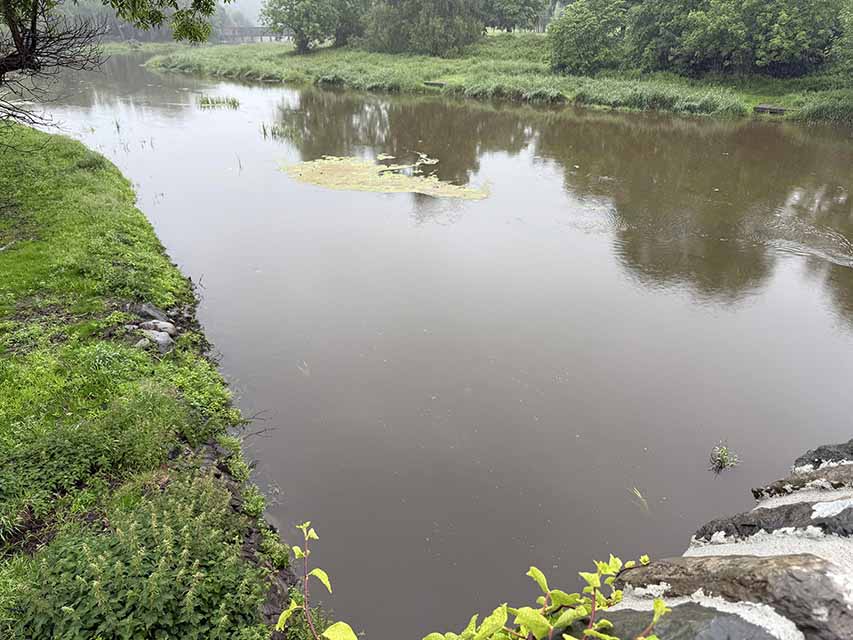
River Quoile turns brown at the height of the heavy rain recently
- Editor’s comments
- NI Water explains
- DAERA Minister
Last week I drove over the Quole Bridge at Downpatrick and was taken aback by the pronounced brown colour of the river.
There could indeed be a number of explainable reasons for this, but my concern was there sewage finding its way into the river course writes Jim Masson.
As someone who believes that the lower Quoile ie the Pondage Area is a jewel in the crown in Downpatrick, I was amazed and had to examine matters further. And again after observation, looking up the river from the Belfast Road bridge towards Inch Abbey, there was no sign of bird life, no fish rising, or even a wayfaring rat in sight.
It was void of life. Perhaps a few bacteria maybe. The section upstream from the Belfast Road bridge certainly does not support significant biodiversity through “good status” as far as I can see.
In situations like this, there needs to be pollution monitoring on-going to ensure that not only public health but the health of the flora and fauna is protected.
But I’m not confident that the present infrastructure is 100%. But it’s generally accepted that the sewage system across the North needs an overhaul. But of course in these financially challenging times the ideal is far removed.
So, I asked NI Water what was happening in the river and the reply is printed below. As you will see, I accept there may have been discolouration due to clay etc, however, the fact that sewage is still finding its way into the River Quoile again is deeply concerning.
I know many local residents and the angling community are also concerned at the river becoming the dumping ground for sewage. But I suppose its better than than having more flooded buildings and businesses. But it’s robbing Peter to pay Paul.
Maybe we should be asking our politicians where they stand on the setting up of an Environmental Protection Agency – with teeth.
Lough Neagh is an environmental disaster that should have been avoided. But the lack of political will speaks volumes.
Without being a prophet of doom, is Strangford Lough likely to degrade with all the pressures from its various rivers, drains and ditches that drain into it ? Will it become the next Lough Neagh ? I sincerely hope not.
The river Quoile seems to be holding back a load of silt that should by nature be finding its way downstream… but that is into Strangford Lough where there are mussel and oyster beds (an aquaculture industry) and these bivalves choke with too much particulates i the water. Already the native horse mussels have declined drastically, but over-harvesting may also have been a partial actor there.
The situation is very complex, and moving, but as a community living and working next to the eriver Quoile, we have to ask, are government departments doing enough ? Or just treading water ?
NI Water Responds To Down News Inquiry
A spokesperson for NI Water said: “Water in rivers and streams will regularly turn brown following heavy rain due to run off from fields and streams.
“Storm water from our combined sewer overflows is not normally brown in colour as it is primarily made up of rainwater and household wastewater (i.e. water from washing machines, showers etc).
“During the heavy rain on Saturday 14th and Sunday 15th June, our assets operated as they are designed to do. On Saturday 14th June, our Storm Pumping Station at Market Street pumped storm water for approximately half an hour. This would have been storm water from the heavy rain at that time and not sewage.
“On Sunday 15thxa0June, Downpatrick WWtW storm tanks discharged for a short period of time during the prolonged rainfall.xa0 This asset is regulated by NIEA and has a consent to function in this way during periods of heavy and/or prolonged rainfall.xa0 xa0It is designed to prevent flooding of homes and businesses in the area.xa0 Storm overflowsxa0primarily operate as a pressure relief valve.xa0
“During periods of heavy rainfall, there will be some raw sewage contained in wastewater that spills from a storm overflow. This is heavily diluted and will be further diluted when it enters adjacent water bodies which are themselves also receiving large volumes of additional rainwater.
“The NI Environment Agency (NIEA) set specific consent standards for each of our storm overflows to protect the receiving waterway.”
***
DAERA Publishes Its 3rd River basin Management Plan
Department of Agriculture, Environment and Rural Affairs (DAERA) has published the third cycle River Basin Management Plan (RBMP) 2021 – 2027.

The plan gives an overview of Northern Ireland’s water bodies, environmental objectives for 2027, and provides information about the Programme of Measures for the third cycle RBMP to address the pressures acting upon the water environment.
Minister Muir said: “Publication of the plan fulfils an overdue statutory duty and is further to on ongoing and tangible action set out in the Lough Neagh Report and Action Plan and the Environmental Improvement Plan for Northern Ireland.
“It is important to acknowledge that, owing to the absence of Ministers and functioning institutions, significant time was lost, and this plan is now being published towards the end of the third cycle, which runs from 2021 to 2027.
“Whilst we continue to deliver the actions within this Plan, focus is already upon the development of the fourth cycle plan, which must be ambitious and progressed in consultation with stakeholders in a timely manner.
“It is only by working together that we, as a society and a community, can both minimise and ultimately reverse the damage that has been done. It is my vision that our water bodies are at ‘good’ status or better and support biodiversity and a sustainable economy, contributing to the health and well-being of everyone.”
The key measures outlined in the plan relate to the reduction of nutrients. Other measures relate to chemicals and pesticides, abstraction, fisheries and morphology, invasive alien species, forestry and waste and contaminated land.
Download the third cycle River Basin Management Plan 2021 – 2027.