DAERA Brings In Restrictions After Two Cows in Bangor Are Tested Positive for Bluetongue Disease
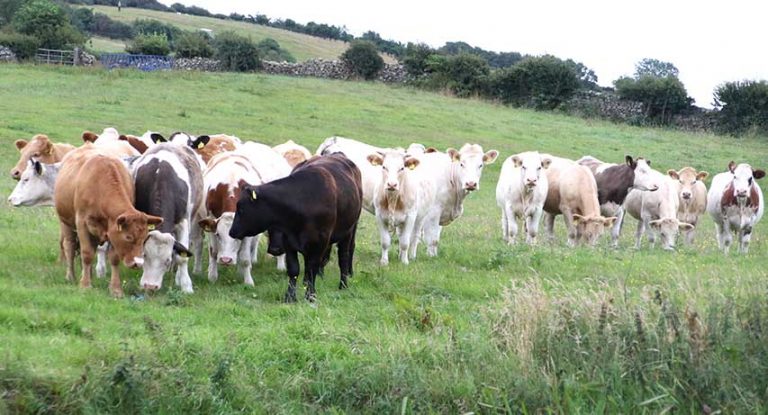
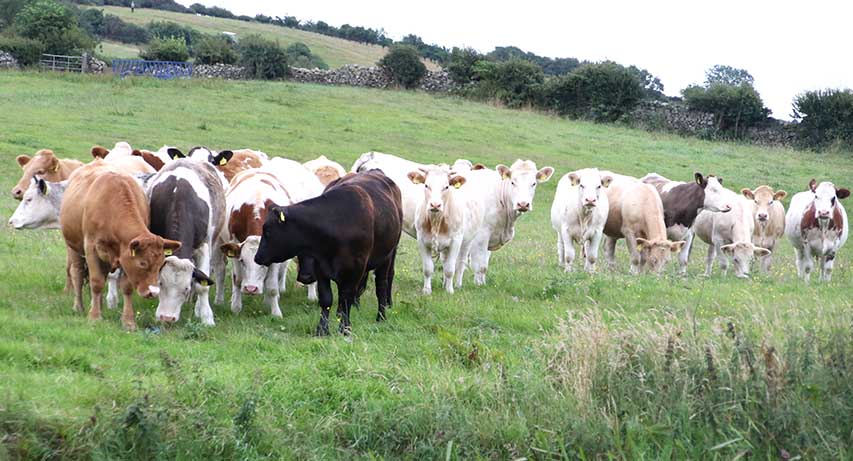
DAERA vets are investigating the suspicion of Bluetongue virus at a holding near Bangor in Co Down.
Results from DAERA’s active surveillance for Bluetongue have indicated the presence of the disease in two cows. Robust disease control measures have been implemented.
A 20km Temporary Control Zone (TCZ) has been introduced effective from 21.00 on 29 November 2025.
Moves of susceptible species (cattle, sheep, goats, deer and llamas/alpacas) on or off premises within the TCZ are now prohibited whilst officials carry out further investigations. Moves direct to slaughter are permitted under a general licence available on the DAERA website.
DAERA Minister Andrew Muir said while the suspect cases are of great concern, it is essential all producers impacted by the control measures play their part in limiting the potential for further spread of the disease.
Minister Muir said: “While there was always a potential for Bluetongue to arrive here, given its prevalence in GB and the EU, we must now do all we can to protect our livestock and limit the spread of the disease.
Farmers across County Down are advised by DAERA to keep an eye on their livestock for any signs of the Bluetongue disease which is unpredictable and highly infectious.
“That is why, as a result of the Disease Control Framework for the virus we launched in June, DAERA has moved rapidly to ensure disease control measures are put in place.
“Members of the public should be reassured the virus does not have any impact on people or food safety.
“In the face of these suspected cases, my officials are taking all the necessary steps to protect the agri-food industry. I urge everyone in the industry to play their part as well and especially appeal to those in the Temporary Control Zone to follow the restrictions.
“My department is working closely with all stakeholders, including colleagues in GB and the Republic of Ireland, to monitor the situation.”
Bluetongue is primarily transmitted through biting midges and affects cattle and sheep as well as goats, deer, llamas and alpacas. Biting midges are most active from April to November and the potential for spread depends on climatic conditions and wind patterns with lower temperatures significantly reducing the risk.
While the virus does not have any effect on people or food safety, it can have a devastating impact on animals infected and trade.
The Chief Veterinary Officer, Brian Dooher said: “Bluetongue virus is unpredictable and can spread rapidly through and between flocks and herds.
“Colleagues have been preparing for a possible incursion of this disease and have been working closely with our colleagues in the Republic of Ireland to ensure a co-ordinated response in tackling any incursion.
“I would urge all farmers to ensure they source their animals responsibly. The spread of Bluetongue could have a significant impact on livestock and the rural economy.
“Furthermore, all livestock owners should remain vigilant for signs of the disease.
“It is imperative that keepers report any symptoms immediately to their vet, local Divisional Veterinary Office or to the DAERA helpline on 0300 200 7840.”
BTV-3 was first detected in the Netherlands in September 2023 and has spread across Europe since then with confirmation of the disease in the east of England coming in November 2023.
Additional advice on BTV-3, including the clinical signs can be accessed here
***
Butler Urges Farmers to Stay Alert Amid First Bluetongue case in Northern Ireland
Ulster Unionist Agriculture Spokesperson and Chair of the Stormont Agriculture Committee Robbie Butler MLA has responded to reports of a suspected case of Bluetongue in Northern Ireland.
Robbie Butler said: “The news of a suspected case of Bluetongue virus in County Down is a deeply worrying development for our farming community.
Robbie Butler MLA has welcomed the DAERA measures to try an control the spread of Bluetongue.
“This disease poses a serious risk to animal health and could have significant implications for our agri-food sector if not contained swiftly.
“I welcome the decisive action taken by the Department of Agriculture, Environment and Rural Affairs in introducing a 20km Temporary Control Zone around the affected area.
“These measures are essential to limit any potential spread and protect our livestock industry.
“We have already seen the suspension of direct movement of all live ruminants and camelids from Great Britain to Northern Ireland and the EU, which was a necessary step.
“Now, our focus must turn to containment. I strongly encourage all farmers to fully cooperate with the restrictions in place and to remain vigilant.
“Questions now arise as to how this suspected case has occurred, and it is vital that we get clear answers to reassure farmers”
Comber Rec Drop Their Guard And East Belfast Lands Knockout Punch In Last Kick Of The Border Cup Semi-Final
The NAFL,
Border Cup Semi-Final,
Venue: Blanchflower Stadium, 26 11 25,
Final Score: East Belfast 2 2 Comber Rec (East Belfast won on 4-2 penalties after extra time.)
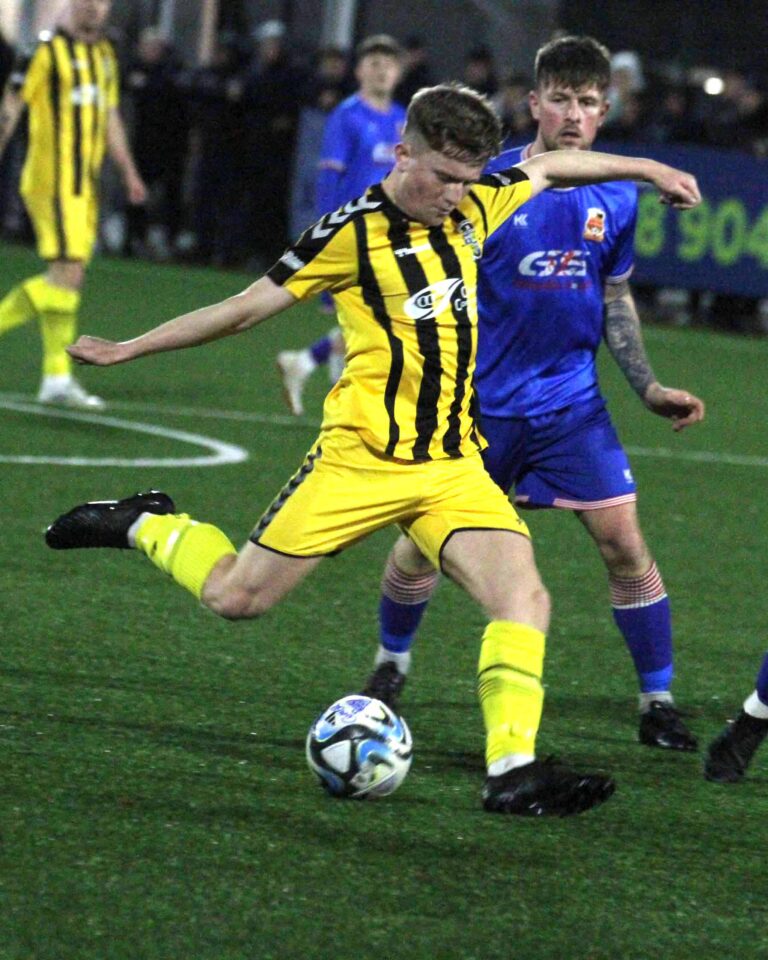
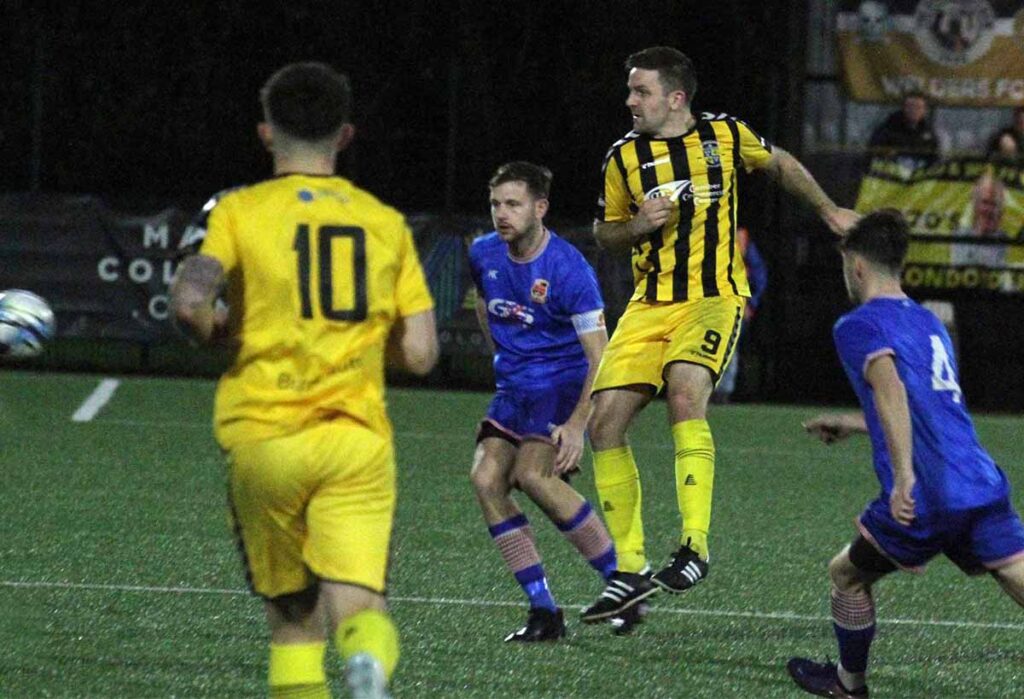
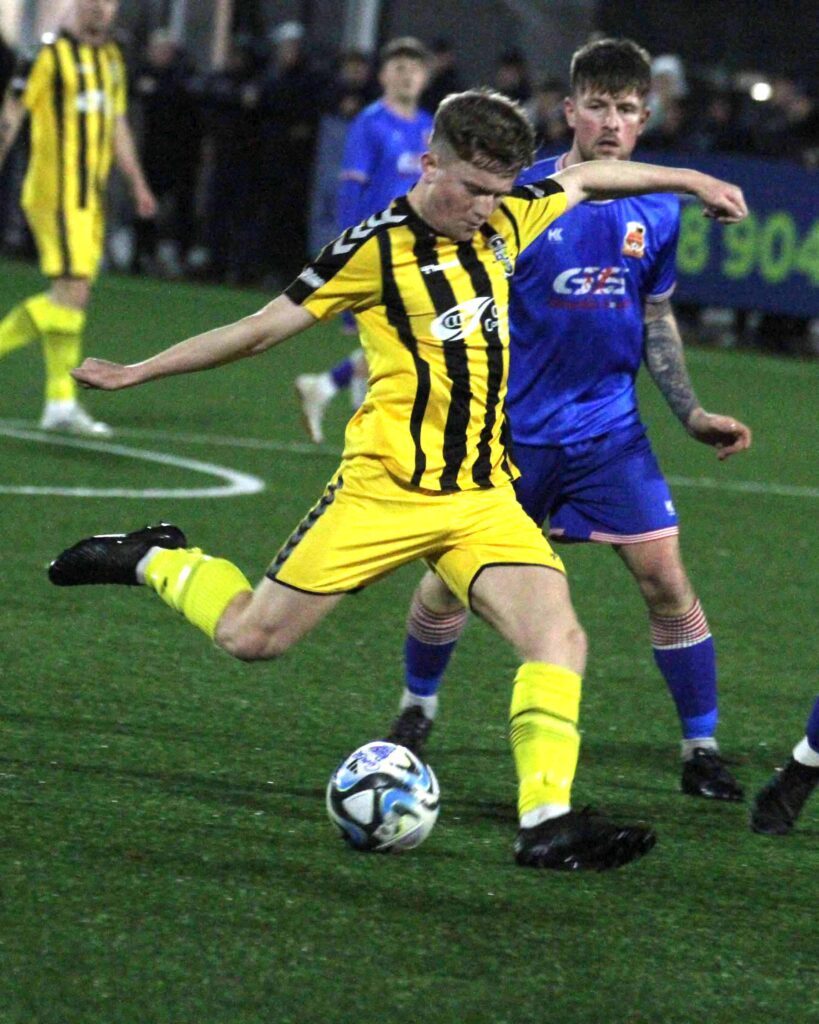
This was a showdown between to Premier Divison rivals and Comber Rec for most of it looked in charge. The attacking duo in the Comber front line of Dylan Donaldson and Dylan Wilson make a number of great charges at the East Belfast goal and eventually after Comber pressing early, James Sofley received the ball in the box and sent it to the back post beating keeper Scott Mashal.
The match trundled on with a number of opportunities presenting for Comber. On one occasion a volley rebounded off a defender and Donaldson was almost on it to score number two for Comber but Mashal got there first.
Wilson was making some great run down the right wing and crossing well. Then Chris Murray got possession and ran at the East Belfast box and unleashed a solid strike but it rose inches over the bar.
Again Murray hit another corker of a volley to the back post it it went wide again.
But East Belfast did make a few charges at the Comber goal but Corey Pollock managed to keep everything well under control. Lewis McCullough did manage a long volley but that sailed over the top bar.
Taylor Evans was looking most likely to score for East Belfast having made some good moves.
The match ran on with both teams working hard but Comber still looked the more dominant.
Dylan Donaldson battled through the match and scored Comber’s second goal.
As the second half started East Belfast piled on the pressure but they were well held by the Comber defence.
As the match progressed Dylan Wilson received a bad cit to his head and a bandage had to be applied but he opted to play on.
It was never-the-less a tight match so far with only one goal. And Comber probably felt they were home in a boat when they got the dying embers of the full time BUT fate raised its ugly head and in the last minute of time, Kyle Woods scored for East Belfast to force teh match into extra-time.
From a throw in, Dylan Donaldson rocket the ball on target into the East Belfast net to the jubilation of Comber.
But as Comber hung on East Belfast made a number of surging attacks and finally Daryl Evans headed the ball home for East Belfast to make the score 2-2 in the last minute of extra time.
The match hung in the balance and it came to the final kick of the match and Comber’s bogeyman Evans scored putting East Belfast through on 4-2 penalties after drawing 2-2 after extra time.
It was a bitter pill to swallow for Comber Rec who had the match in the bag on two occasions.
From the 94th minute to 110th minute, East Belfast received 4 yellow cards which shows that their game had tightened up against Comber becoming more physical.
East Belfast will now go and meet Derriaghy FC on the 27th December in the final of the Border Cup.
Comber’s Dylan Wilson received a head injury late in the game.
East Belfast: 1 Scott Mashal (GK) 2 Bradley Porter 3 Lewis McCullough 4 Jack Kinner 5 Taylor Evans 6 Rhys Kelly 7 Paul Waite 8 Daryl Evans (C) 9 Jayden Withers 10 Kyle Woods 11 Nathan Clarke 12 Brandon Lindsay 14 Kyle Flynn 15 Noah Mitchell.
Comber Rec: 1 Corey Pollock 2 Natthew Gibson 3 Brandon Nelson 4 Lex Walker 5 Stuart Moore 6 Dylan Donaldson 7 Dylan Wilson 8 Simon Hanna (C) 9 James Sofley 10 Matthew Tumilson 11 Christopher Murray. Subs: 12 Christian Irvine 14 Stephen Fleck 15 Elliot Wilson.
Misogyny must be challenged at all levels says Downpatrick Down News blogger Helen Hastings
All I want for Christmas is… well, it’s not misogyny anyway.
‘Quiet, quiet piggy’ These are the words that cut straight to the heart of every intelligent and consciously aware woman on the face of the planet this month writes Down News blogger Helen Hastings.
It wasn’t just the further illumination of the toxicity at the core of the White house; it was also another nail being slammed into the metaphorical coffin that our place in this world has become.
The woman in question stood for everything that Trump despises and fears; an intelligent woman who sees straight into the rotting heart of the world he wants to create.
It wasn’t even the word ‘Piggy’ that had us squirming at first, before that word even dropped from his mouth the words ‘Quiet, Quiet……’ and the wagging of a chubby index finger was enough to challenge the strongest of female stomachs.
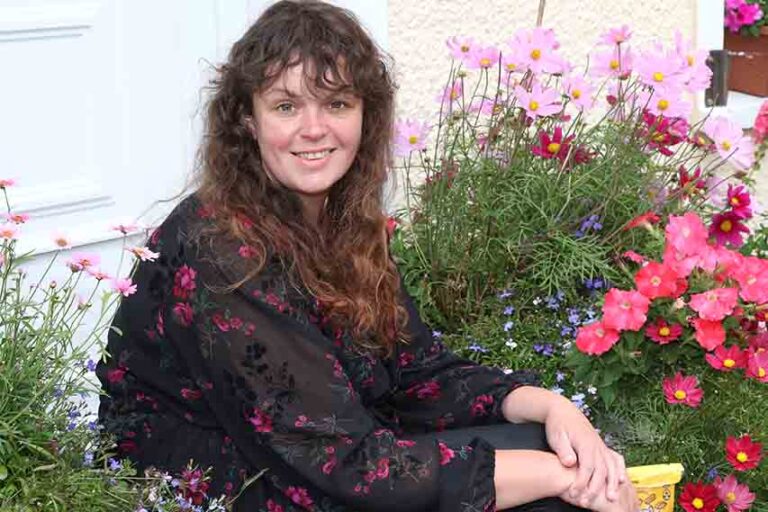
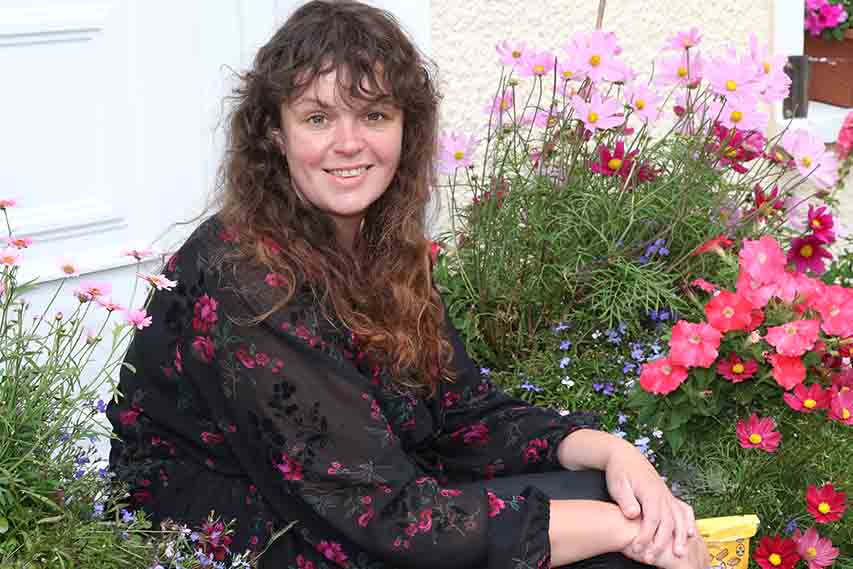
Helen Hastings from Downpatrick challenges misogny and fears it is increasing.
It would be easy for us to dismiss the incident as political drama, just another thing happening in American politics.
But there’s no getting away from it, misogyny’s foothold is getting stronger and stronger every day in global society and it’s a monster of a terrifyingly insidious nature.
Earlier this year, Northern Ireland was announced as being statistically the most dangerous country in Europe to be a woman. It felt like a twilight zone experience; I had gone to sleep in a country I knew and loved and woken in a dystopian land that Margaret Atwood could write another book about.
I’m not a mother but I wondered in that moment how it must feel for any parent looking at their daughter and hearing ‘most dangerous country in Europe…’ I tried to imagine the panic-stricken battle I might feel within; trying to instil safety in my daughter whilst trying not to create a paranoid world around her fuelled by my own fears as a parent and the horror stories that the media presents on a daily basis.
The most terrifying attribute of this modern misogyny epidemic is not just how it presents itself courtesy of the most powerful men in the world but how it has become normalised, expected, taken for granted, just one of those things.
This is where where the danger has been lying all this time, in our forced but quiet acceptance, the normalisation of a world where we are not safe or respected anymore.
And what effect does this have on our mental health?
We are always told to be strong as woman, to stand up and be counted, to strive for our place on this planet but how can we do that with a straight face when every positive step we take is driven off the path by contradiction? Sometimes this latest war on feminism feels like a wake.
It’s the death of everything we have fought for and stood up for, and the legacy left to us by women like the suffragettes is lying in tatters.
If you are a woman who has struggled or continues to struggle with self-worth and confidence, this latest wave of media fuelled misogyny can be a particularly damning and toxic brand.
And what if you are someone who has been a victim of any kind of abuse at the hands of a male? Where do you turn? Where exactly feels safe in a world that seemingly entertains a real-life Handmaids Tale on a daily basis?
We see misogyny being glamourised every day, dressed from head to toe in power, so what can we do? What can we say to each other? What can we say to ourselves? What can we say to our daughters?
Ok, so repeat after me………’THIS IS NOT NORMAL OR ACCEPTABLE AND I AM ENTITLED TO BE AND FEEL SAFE.’ There that’s it.
Sadly, it’s all I’ve got right now in my feminist arsenal but I feel it’s one of the most important things we have. As I said earlier, the danger is in normalisation.
When we recognise words or actions as unacceptable, disrespectful or derogatory we are recognising our place in this world, we are recognising our identity as human beings and most importantly we recognise our self-worth.
We don’t just call out misogyny to prove a point, we call out misogyny because we are striving to feel safe.
One thing I want to do though before I sign off is to make a special mention to all the beautiful, strong and kindly men there are out there.
Not just the courageous fathers raising strong daughters, but all men like my own father who understand the real essence of power.
They understand that genuine power goes hand-in-hand with kindness and love, respect and dignity.
And most importantly of all? These men understand that real power would never wag its index finger and instruct a smart woman to be quiet.
Dr Conor Patterson Elected New President of Newry Chamber
Newry Chamber has elected a new president at their recent AGM.
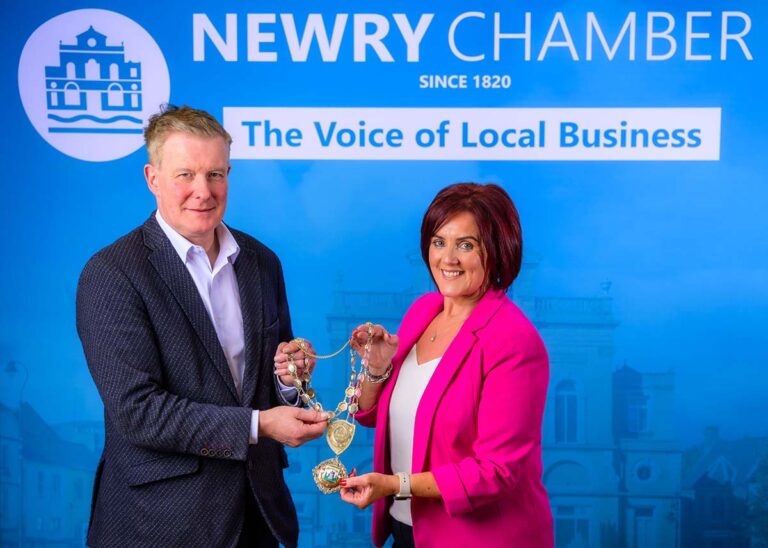
Dr Conor Patterson has been elected to serve as the new President of Newry Chamber of Commerce & Trade at their Annual General Meeting on Thursday 27th November at Enterprise House, Newry, taking over outgoing President, Edwina Flynn whose remarkable two-year term comes to an end.
Conor is the Chief Executive of Newry and Mourne Co-operative & Enterprise Agency and has been actively involved in the economic regeneration of Newry and Mourne and the Northern Ireland/Republic of Ireland East Border Region since the mid-1990’s.
In taking over at the helm of Newry Chamber for the second time, having served two years in the role from 2009-2011, Conor becomes only the third person in the Chamber’s long and rich 205-year history to serve more than one term as President, following in the footsteps of William V. Hogg and Eddie Mackle.
Outgoing Chamber President, Edwina Flynn handing over the Chains of Office to the New President, Dr Conor Patterson who was elected at this year’s AGM.
The Chamber represents over 325 businesses and organisations from right across the Greater Newry Area,
Gary Digney, Restructuring & Recovery Partner at AAB Group will remain in post as Vice President, with Tracy Rice, Head of Business Engagement at Southern Regional College being elected as a second Vice President after changes to the Chamber’s Articles of Association were unanimously passed at the AGM.
Mairead McParland, Director at the Canal Court Hotel & Spa was elected as the new Treasurer who will replace outgoing Treasurer, Kieran Grant, Finance Director at Warrenpoint Harbour Authority.
Along with Mairead, David Holmes, CEO of Warrenpoint Port, Liam Devine, CEO of Clanrye Group, Elizabeth O’Connor, Director of People & Governance at MJM Marine and Gary Rocks, Senior Solicitor at Patterson & Rocks Solicitors were all elected to the Chamber Board of Directors, replacing outgoing Board members, Julie Gibbons, Emma Mullen, Kieran Grant, Cathal Austin and Jerome Mullen who was appointed as an Honorary Board Member, following his 37 year involvement with the Chamber.
In addition to the new appointments to the Newry Chamber Board, Caroline Willis, Finance Director at Shelbourne Motors, Ronan Callan, Director of Operations at The Exact Group, Rachel Mearns, Managing Director at Concept Occupational Health and Przemek Parulski, Co-Founder of DxF Engineering will all join the Chamber Council which consists of 23 local business representatives which feeds into the Chamber Board of Directors.
In his acceptance speech, Dr Conor Patterson, President of Newry Chamber said: “I feel extremely honoured to be appointed as President of Newry Chamber of Commerce & Trade, for the second time.
“It is a real privilege to be asked to lead, this historic Chamber, one of Ireland’s oldest and most respected Chambers, representing business in the Greater Newry Area since 1820.”
“I would like to thank outgoing President, Edwina Flynn for her deep commitment, positive energy and phenomenal leadership over the last two years and her ability to meet all challenges head on with her trademark positive outlook.
“Edwina worked day in and day out to ensure that our region had a seat at the decision-making table at a local, regional and national level and that the Chamber was a real catalyst for change, a promoter of progress with a positive vision for Newry.”
“I am looking forward to working with our CEO, Michael Savage and the impressive Chamber team. There are undoubtedly challenging times ahead as we face into an uncertain new year. However, I’m optimistic. The Chamber has never been in a stronger position with an active and engaged membership of 325 businesses. During my presidency, I promise to do my best to represent and support our members and the other key stakeholders in Newry with whom it is essential that we work collaboratively.”
Preparing for your annual MOT can feel daunting, especially with London’s busy streets and tight schedules. Many drivers worry about unexpected failures or last‑minute repairs, but with the right preparation, passing your MOT in London becomes much easier. A bit of planning ahead can save you time, money, and needless stress.
Before heading to the test centre, it helps to understand what inspectors typically check. Surprisingly, many MOT failures come from small faults that could have been fixed at home. Taking just a few minutes to look over your vehicle can make a big difference. Book your MOT London today and let Elite Directensure your car meets all standards. Securing an appointment early ensures your MOT London test runs smoothly and gives you confidence that your vehicle is in safe hands.
Lights are one of the most common reasons vehicles fail their MOT. Take a moment to test your headlights, indicators, brake lights, and number plate lights. Replacing faulty bulbs is quick and cheap. It also greatly improves your chances of passing your MOT in London without complications.
2. Inspect Tyres and Tread Depth
The minimum requirement for tyre tread depth is 1.6mm in the central three-quarters of the tyre. Checking for uneven wear will also help to know whether or not it is necessary to get alignment done first. Good maintenance of the tyres not only increases safety but also helps in making sure your MOT London test does not raise preventable issues.
3. Check the Windscreen and Wipers
Minor chips or cracks in the windscreen, especially in the driver’s line of vision, may result in failure. Ensure your wipers do not have splits or wear and tear so they can clean the windscreen effectively. Visibility is a necessary component to pass an MOT.
4. Test Interior Features
In your car, make sure the horn is operating, the seatbelts are fastening without any problem, and the dashboard warning lights are going off as expected. If any warning light, for example, ABS, airbags, or the engine, is on, then the test will fail automatically. By making sure that everything works, you can easily pass the test.
5. Keep Up with Regular Maintenance
One of the best ways to avoid MOT problems is regular servicing throughout the year. A properly maintained vehicle has fewer unexpected issues, and with a higher chance of first time passes. Regular maintenance not only helps your car last longer but also prevents unwelcome surprises when it’s MOT time.
By following these five pieces of advice, you will be able to take your MOT confidently and be exempt from the common mistakes that a lot of London drivers make. Just a little preparation can be very helpful in making your yearly test go smoothly, without any stress, and achieving success.
Forestry Service keeps a close eye on tree disease in Northern Ireland trying to maintain a healthy tree population
Larch trees across Northern Ireland have been faced with a deadly fungus for the past several years.
A spokesperson from the Forestry Division said: “Phytophthora ramorum is a fungal-like pathogen which can cause damage to some forest tree species, primarily larch, and is commonly referred to as ‘larch tree disease’.
“It was first confirmed in larch in Northern Ireland in 2010, previously present in Great Britain and wider Europe.
Since 2010, tree felling of significantly affected larch areas was undertaken by Forest Service on its estate and by third party woodland owners, due to the classification of ramorum as a regulated quarantine pathogen.
A healthy Larch tree. Disease has decimated the larch tree population along with some other species over the past 10 years.
“Harvesting of these affected areas contributed to mitigating the speed of spread of the disease over that time frame.
“The affected areas harvested continue to be managed as woodlands, including their regeneration with alternative disease tolerant species.
“Due to the extent of the presence of Phytophthora ramorum, becoming widespread in the environment across NI, it became legislatively classified as a non-quarantine pathogen since 2022.
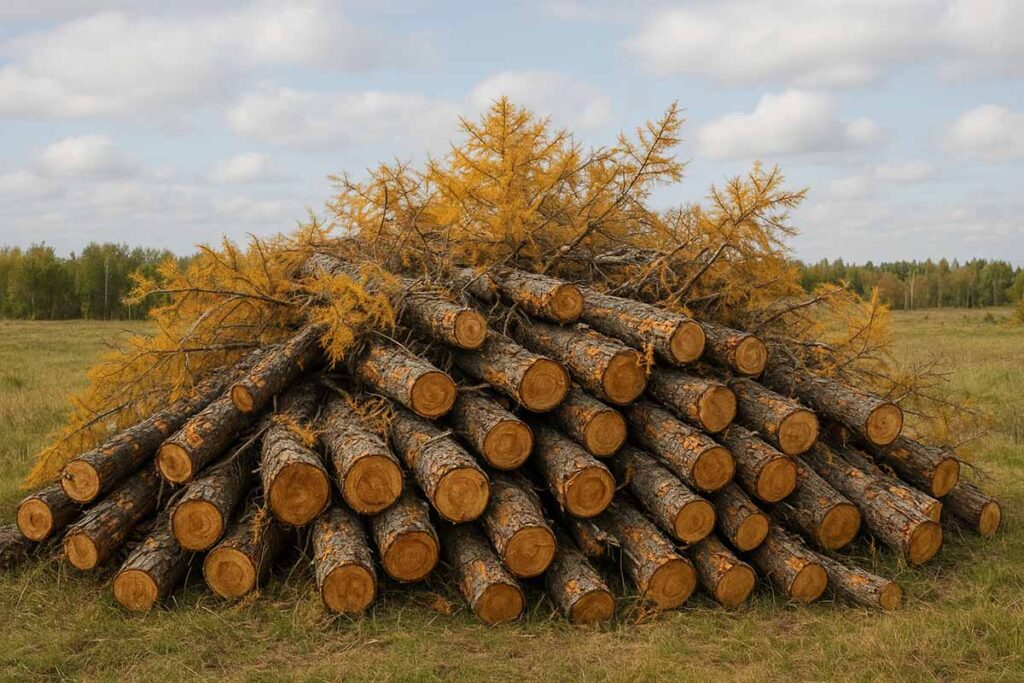
Diseased larch trees felled to prevent the spread of the fungal disease.
“Whilst larch trees remain vulnerable to the spread of the disease, they represent a minor component of all tree species across Northern Ireland’s woodlands and forests.
“However, the harvesting of disease affected areas can have a significant visual impact at a local level until the woodlands become re-established, usually within five years.
“Forest management plans and operations are developed in conjunction with a wide range of stakeholders and interest groups and include careful consideration of the impacts and opportunities for wildlife species and habitats.”
What species inhabit larch trees and woodland ?
A wide range of birds, animals use larch trees or larch woodland. These species are all present in NI and are commonly associated with coniferous or mixed woodland where larch is included.
Birds
Seed- and cone-eaters
Siskin
Lesser redpoll
Common crossbill – occasionally breeds in NI when cone crops are good.
Insect-feeding woodland birds
Coal tit – strongly associated with conifer stands.
Blue tit & great tit – forage among needles for caterpillars and other insects.
Goldcrest – feeds on tiny invertebrates on larch shoots.
Treecreeper – hunts insects in larch bark crevices.
Chaffinch & robin – feed on ground in larch-dominated woods.
Raptors and larger birds
Buzzard – uses mature larch for perching; occasionally nests in mixed plantations.
Sparrowhawk – hunts in and around larch stands.
Tawny owl – will nest in cavities or use older larch as roost cover.
Mammals
Red squirrel – eats larch cones, particularly in western NI where conifer plantations are common.
Pine marten – increasingly widespread; hunts in larch woods rich in undergrowth.
Roe deer – present in many regions (especially Antrim/Down); browse young larch shoots.
Wood mouse & bank vole – use the ground layer in larch woods for foraging and cover.
Bats (common pipistrelle, soprano pipistrelle) – use the relatively open canopy structure for feeding on midges.
Insects (especially moths)
Northern Ireland hosts many conifer-associated moths that use or feed on larch:
Larch pug (Eupithecia lariciata)
Larch beauty (Semiaspilates aberrata)
Larch tortrix (Zeiraphera griseana) – occasionally a defoliator
Pine carpet, grey pine carpet, and other conifer moths that will also use larch
Case-bearer moths
Bark beetles (various species) using weakened or dead larch
Aphids, including larch woolly adelgid
These insect communities help feed tits, goldcrests, bats, and woodpeckers.
Fungi & Lichens
Common in NI’s larch stands:
Larch bolete (Suillus grevillei)
Fly agaric (Amanita muscaria) – frequently under larch
Conifer polypores (bracket fungi on old or fallen stems)
Various lichens – especially in clean-air upland sites such as the Mournes and Sperrins
Ground Flora Under Larch in NI
Because larch is deciduous in winter and lets in more light, the following plants often thrive beneath it:
Bilberry
Heather
Bracken
Wood sorrel
Foxglove
Moss-rich ground layers that support invertebrates and small mammals.
Newry Mourne and Down District Council Launches £4.5m Local Economic Partnership ActionPlan
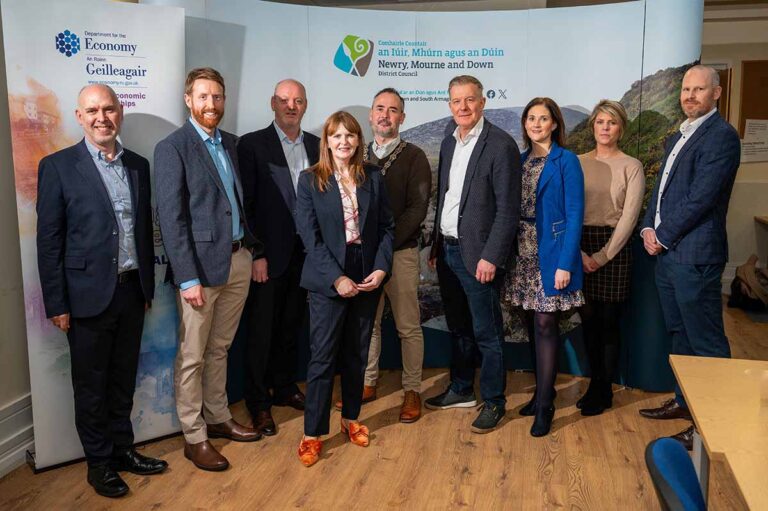
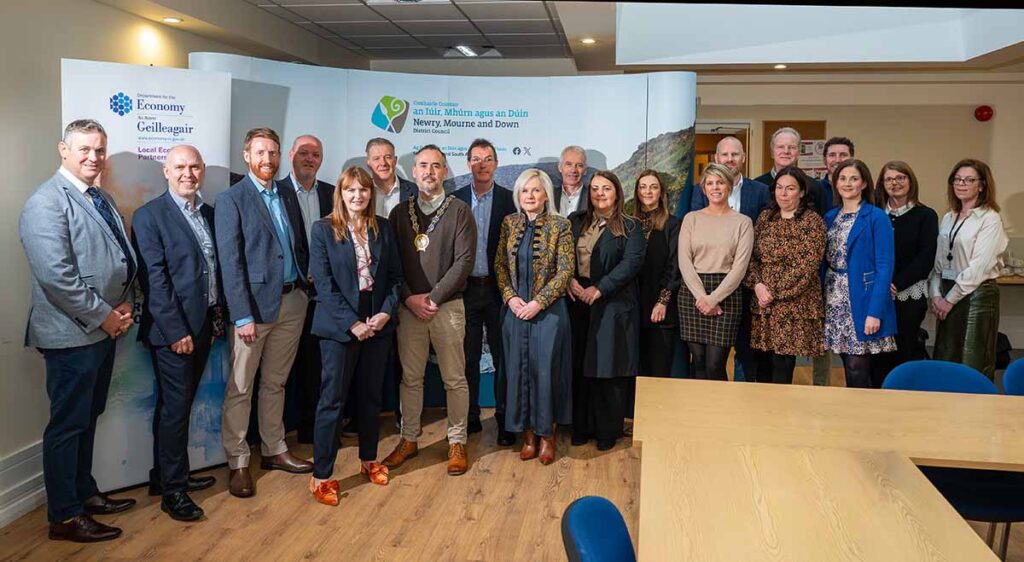
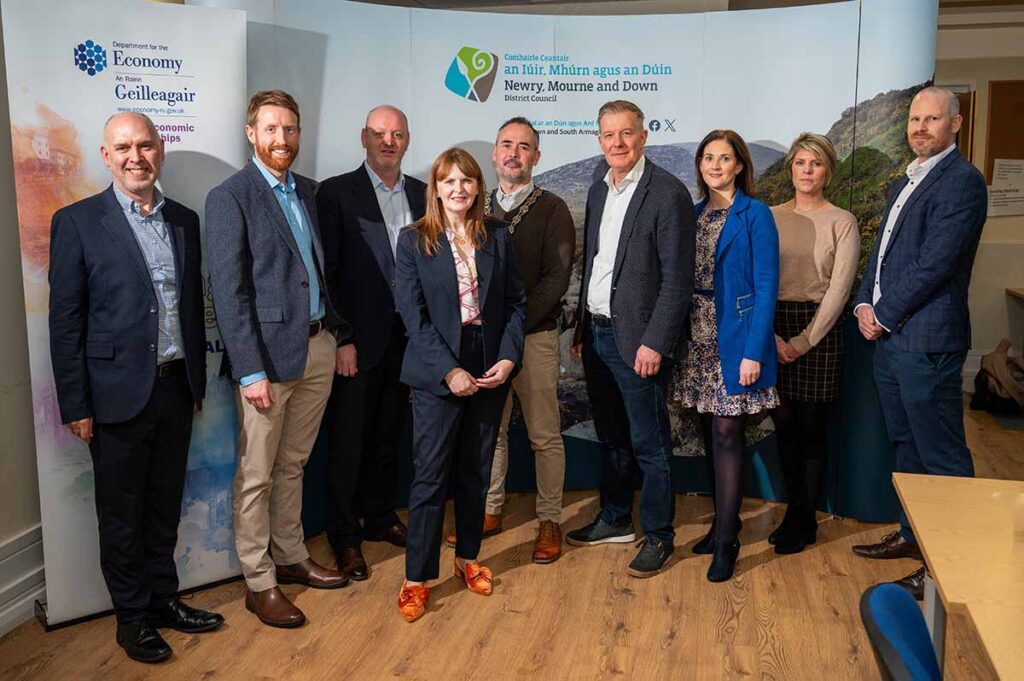
The Minister for the Economy joined Newry, Mourne and Down District Council (NMD) at a Local Economic Partnership meeting where the council formally commenced delivery of its Local Economic Partnership Action Plan, becoming the first council in Northern Ireland to do so.
The Council’s Local Economic Partnership was formed on 27th January 2025.
The aim of the Partnership is to deliver on the Department for the Economy’s Regional Balance Fund which focuses on creating good jobs, increasing productivity, improving regional balance and decarbonisation.
Members of the Newry, Mourne and Down Local Economic Partnership with Dr Caoimhe Archibald, Minister for the Economy and Newry, Mourne and Down District Council Chairperson, Cllr Philip Campbell.
Economy Minister Caoimhe Archibald said: “Local Economic Partnerships set out a new strategic approach to economic development, locally led and with a mission to deliver on regional balance.
“I firmly believe local issues require local solutions. I look forward to seeing the delivery of this action plan that will have a positive economic impact as we move forward.”
After welcoming the Minister, Newry Mourne and Down District Council Chairperson, Councillor Philip Campbell, thanked the Minister and the Department for their support and funding and said: “We are proud to be the first council in Northern Ireland to begin delivering through the Local Economic Partnership Action Plan.
From left: Martin Graham, Tourism NI; Alistair Quinn, Invest NI; Conor Mallon, Chair of the Local Economic Partnership and NMDDC Director of Economy, Regeneration and Tourism; Dr Caoimhe Archibald, MLA, Minister for the Economy; Newry, Mourne and Down District Council Chairperson, Cllr Philip Campbell; Conor Patterson, Newry and Mourne Enterprise Agency; Amanda Smyth, NMDDC; Emma Bohill, Down Business Centre, and John McKibben, Invest NI.
“This plan has been co-designed with our key stakeholders to strengthen productivity through targeted mentoring and grants for businesses and social enterprises.
“Through our new Commercial Property Revive and Reimagine Grant, we will drive local economic activity, attract new businesses and create space for existing enterprises to grow.
“We will also work closely with the Department for Communities to ensure we maximise every available funding opportunity.
“Another aspect of the plan will see us working with the partners to boost awareness and adoption of AI across the local business community.
Councillor Campbell also highlighted the Council’s ambition on sustainable tourism. He added: “Our district is proud of its tourism offering, to ensure we maximise on our offering we will support the Mourne Gullion Strangford Geopark Sustainable Tourism Network.
“This will play an important role in advancing our ambition to become a sustainable tourism destination.”
Councillor Campbell paid tribute to members of the Local Economic Partnership for their commitment and contribution in developing the Action Plan, adding that she looks forward to seeing the projects progress in 2026.
The long-awaited budget is a missed opportunity suggests some of the commentators
There has been a cool, muted reaction to today’s budget delivered by Chancellor Rachel Reeves. She had little room to move to find ways to try and stimulate the economy struggling recently on minimal growth.
Retail NI Reaction To Chancellors Budgettoday (26th November 2025)
Reacting to the Chancellors Budget statement, Glyn Roberts, Chief Executive of Retail NI said: “This Budget is a missed opportunity to stimulate growth in the economy and address the huge burden of the cost of doing business in Northern Ireland and throughout the UK.
Glyn Roberts, Chief Executive of Retail NI.
“An inflation busting rise in the Living Wage so soon after last years huge increase and the National Insurance hike will be a heavy blow to struggling independent retailers and small businesses.
“Retail NI does welcome the £16 million funding to create a Northern Ireland business concierge and trade resolution centre to sort out complex disputes with the Windsor Framework.
“A considerable number of our members are experiencing difficulties receiving product lines from GB suppliers and we hope that this will address this problem”.
***
FSB says budget must be followed by serious, pro-growth measures
Responding to today’s Budget, Tina McKenzie, Policy Chair of the Federation of Small Businesses, said: “Today’s tax-raising Budget shows the peril of a continuing economic doom loop – we must not be in the same place again next year, with more tax hikes to balance the books due to a lack of economic growth.
Tina McKenzie, Policy Chair of the Federation of Small Businesses (FSB), pictured with Prime Minister Keir Starmer at the launch of the Small Business Plan in August 2025.
“The tax burden at a record high is the cost of failure to get growth and trim spending.
“Hikes to dividend tax mean the Government continues to make investing in your own business one of the least tax-friendly things you can do with your money.
“Plans to charge employers for supporting pension savings are a bad idea. The business rates measures will not help small firms and High Streets nearly enough.
“We need the Government to follow this Budget through with serious, pro-growth measures that restore the confidence small businesses need to grow, invest and hire.
“Ministers must now bring forward pro-business, pro-growth policies. Otherwise, we’ll be back at square one, stuck in the same rut we were in last year.
IHT transferable threshold still not good enough, says UFU
Following today’s Autumn Budget announcement, including the change to inheritance tax allowing the £1 million Agricultural Property Relief (APR) and Business Property Relief (BPR) threshold to be transferable between spouses, the Ulster Farmers’ Union says Northern Ireland will still be hit hardest due to its owner-occupied farming structure and land prices.
The minor change will bring APR and BPR into line with existing inheritance tax legislation, and will not prevent lasting damage to many family farms across Northern Ireland.
UFU president William Irvine said: “Today’s Autumn Budget announcement puts UK agriculture in a better position than it was in this morning, but by no means is it a fitting solution, especially not for Northern Ireland.
“This transferable threshold is the smallest change that Government could have made. We lobbied for this transferable threshold as one of a package of measures, but this change on its own is quite frankly, not nearly good enough.
“We repeatedly highlighted over the past year when engaging relentlessly with political figures locally and nationally, that because of NI’s unique owner-occupied farming structure and land prices, farmers here are disproportionately exposed to IHT changes.
UFU President William Irvine.
“This has not changed, even with the transferable threshold introduced. Northern Ireland family farms will still be the most severely affected in the UK.
“Government has belittled and dismissed our efforts and concerns by making only one slight change to its decision at last year’s budget, one that should have been there to begin with.
“It does not have any significant benefit for Northern Ireland and with no further protections for family farms, local farmers will be the ones to bear the brunt of Government’s unjust decisions.
“Amendments to the Finance Bill is the final opportunity for proper and suitable changes to be made on the inheritance tax proposals and we are urging the Labour Government to see sense and do what is right, not only for local farm families but for the UK population.
“What happens to local farms, the businesses that produce the high-quality food we all need to survive, affects us all in more way than one and we are now much too close to the wire.
“The Government must amend the Finance Bill urgently to prevent irreversible damage to the family farm model.”
The UFU will host a post-budget information webinar for members on Tuesday 2 December, 7:30pm – 9:00pm. You can sign up to attend, using the following link:
Autumn Budget doesn’t go far enough to invest in public services and boost growth says O’Dowd
Finance Minister John O’Dowd has responded to the Chancellor’s Autumn Budget.
Commenting Minister O’Dowd said: “Ahead of the Chancellor’s Budget I have consistently called on Westminster to support families, workers and small businesses.
“I welcome the removal of the two-child limit, which will help lift thousands of children out of poverty here – something I have been calling for.
Finance Minister John O’Dowd.
“I also welcome the Chancellor’s decision to increase both the Minimum Wage and the Living Wage, important steps that will support our lowest-paid workers.
“However, freezing income tax thresholds will hit working families who will have less disposable income to spend in our local businesses.
“The Chancellor had an opportunity to ensure those with the broadest shoulders carried more of the burden – but she didn’t go far enough.
“There was little in today’s budget to support economic growth and for small to medium businesses. Despite calls to support our hospitality industry by reducing the VAT rate – these calls went unanswered.
“The budget further strengthens the need for fiscal devolution. My Department will now intensify work to progress this.
Following the Autumn Budget the Executive will receive £370 million of additional funding over the Spending Review Period with £240 million of this for day-to-day spending and £130 million for capital.
Minister O’Dowd added: “While additional funding for public services is welcome, the reality is stark: following today’s announcements we will only receive £18.8 million in additional funding this financial year.
“This falls far short of what is needed to support the delivery of front line public services.
“I am committed to working in partnership with my Executive colleagues to prioritise and agree allocations in the December Monitoring Round.
“I will move quickly to bring forward a multi-year budget for Executive agreement – one that will shape our public services for the years ahead. This will give departments the certainty they need to plan on a longer-term and more strategic basis, creating the conditions to drive much needed transformational change in the delivery of our public services.
“While financial challenges undoubtedly remain, I stand ready to play my part in supporting workers, families and businesses with a multi-year budget that is focused on Doing What Matters Most.”
***
IoD: Budget policies fail to lift the UK’s growth prospects
Responding to the Autumn Budget Statement delivered by the Chancellor of the Exchequer, Anna Leach, Chief Economist of the Institute of Directors, said:
“Whilst this Budget further increases the tax burden on business, it is partially offset by some helpful measures.
“We welcome the funding for the Youth Guarantee and the full funding of SME apprenticeships for those eligible under 25, which will support young people in their careers.
“The decision not to converge the two rates of Landfill Tax will also be a relief to the construction sector.
“We also welcome the more than doubling of the headroom against the fiscal rules. This will help calm the frenzy of speculation which has surrounded fiscal events.
“The decision to only assess performance against the fiscal rules once a year may also contribute to greater stability in policy making.
“But the leaking of policy choices in the run-up to this Budget is of grave concern.
“It has contributed to substantial declines in business and consumer confidence, with real impacts on economic activity.
“This Budget does not substantively change the UK’s growth outlook, however – the OBR judge that none of the policies announced have a material impact on GDP. Public spending is higher, and business investment even lower than before.
“The scaling back of National Insurance relief on pension contributions – even while the government has launched its Pension Commission – will undermine retirement savings and the very investment pools that we need, as well as heaping further costs on employment.”
***
Swann Slams Autumn Budget as ‘Failure for Workers and Rural Communities’
Ulster Unionist MP Robin Swann has responded to the Chancellor’s Autumn Budget, conveying deep concern over its impact on households, businesses, and farm families across Northern Ireland.
Highlighting what he sees as fundamental shortcomings, Mr Swann warns that behind the headline figures, the measures announced will place additional strain on workers and rural communities.
Robin Swann MP said: “This budget fails across so many sectors and levels, while it looks on the surface to support workers, it is the multiple tax rises across so many sectors that will be felt.
UUP MLA Robin Swann.
“The freeze on tax thresholds for another two years will see more people and families now liable for tax when they hadn’t been before.
“Farm families across the country and especially in Northern Ireland have been abandoned by this Chancellor as there was no movement on the Farm Family Inheritance Tax.
“This is despite all the farm lobby’s campaigning and engagements, and despite all the other U-turns, this is the one that the Government unfortunately didn’t perform.
“While the £370m Barnet consequential is a welcome uplift, the Finance Minister has said he is £400m short this year alone, so this doesn’t even touch the sides.
“The £16.6 million Internal Market Package, which seems to include the £2.25 million for Intertrade UK, to be spread over three years is an acknowledgment of the challenges businesses face under the Windsor Framework.
“But it alls far short of addressing the real problem, trade divergence, so rather than sort the issues, money is being spent on systems and structures.
“Until this Government faces the reality that Northern Ireland operates under different rules than the rest of the UK, businesses will continue to struggle with uncertainty and extra costs.
“Support services help, but they do not remove the structural barriers created by the Framework.
“The details of the Treasury Red Book will now be scrutinised to see what impact it will have in homes and business.”
NI Water update to Newry Mourne and Down District Council
NI Water recently presented to Council representatives with important updates on investment in the area and highlighted areas where wastewater capacity constraints are impacting new development and the economy within the District.
The presentation outlined an innovative approach to unlock capacity within the Newry catchment to facilitate development over the short to medium term.
The Council heard that the success of the scheme is dependent on advanced monitoring technology to pinpoint where unwanted rain, river and seawater enter the combined sewer system and engagement with companies to reduce their high strength trade effluent discharges.
It is an example of how NI Water is adapting to the significant capacity constraints by working to find possible solutions within its current reduced capital funding allocation.
The team stressed, however, that this is only a temporary solution, and substantial funding is required to ensure that Newry catchment can remain open in the longer term.
Investment was the theme throughout the presentation. The current reductions in allocated budget during our current 6-year business planning period (Price Control) and for 2025/26 have had a significant impact in the Council area and NI Water warned this is set to continue.
At the presentation Dr Stephen Blockwell, Head of Investment Management with NI Water, emphasised that all eyes must be focussed on the forthcoming next Price Control period for NI Water (PC28).
Newry Mourne and Down District Council heard the latest updates from NI Water for the South Down area.
He explained that a fully funded NI Water over the next series of Price Controls is the only way for wastewater infrastructure to recover from decades of under-nvestment and support economic development.
Dr Blockwell added: “A fully funded NI Water is essential for it to provide critical infrastructure to underpin the Council’s goals for housing, economic growth and environmental protection.
“Without urgent change to the wastewater system, Northern Ireland and the South Down District faces persistent and worsening pollution and reduced attractiveness for investors and slower business development.”
An overview was provided of key PC21 investments being progressed such as the £8 million base maintenance investment in Annsborough WwTW, £9.5 million Newry WwTW base maintenance project,£4.5 million Aughnagun Water Pumping Station for drought mitigation and the £7.5 million Fofanny to Alt Water Trunk Main project which will address a critical water supply risk.
Further information can be found on the council website at:
Aggravated Burglary Leads To Police Appeal in the Conlig area of Newtownards
Detectives are appealing for witnesses after an aggravated burglary in the Conlig, Newtownards area on Tuesday night, 25th November. Detective Sergeant Gray said: “We received a report just after 11.30pm that four masked men had forced their way into a residential property on Main Street by smashing the front door. They then attacked the occupant with weapons including a claw hammer.
“He sustained serious injuries including a number of suspected fractures and open wounds. He remains in hospital for treatment but, thankfully, the injuries aren’t believed to be life-threatening at this time.
“The four men are described as being aged in their twenties, wearing all black and balaclavas.
“We are keen to speak to anyone who may have seen men matching this description in the area.
“We would also like to hear from anyone who may have relevant CCTV, doorbell or dashcam footage. The number to call is 101, quoting reference number 1675 25/11/25.”
A report can also be submitted online using the non-emergency reporting form via: