

McWhinney’s Sausages Gets £2.2Million Boost

McWhinney’s Sausages invests £2.2m to increase productivity and growth

Economy Minister Dr Caoimhe Archibald has announced that Bangor-based McWhinney’s Sausages is investing £2.2 million in new equipment to increase productivity and automation.

McWhinney’s will significantly increase production capacity by introducing a new spiral freezer and automatic packing line, which will help the company grow its exports and develop new products.

Visiting McWhinney’s factory at Balloo Industrial Estate in Bangor, the Minister said: “This investment will allow McWhinney’s to double its capacity, automate key processes and boost productivity.

“I welcome the company’s ambition to grow exports, enhance sustainability, and expand sales across the island.
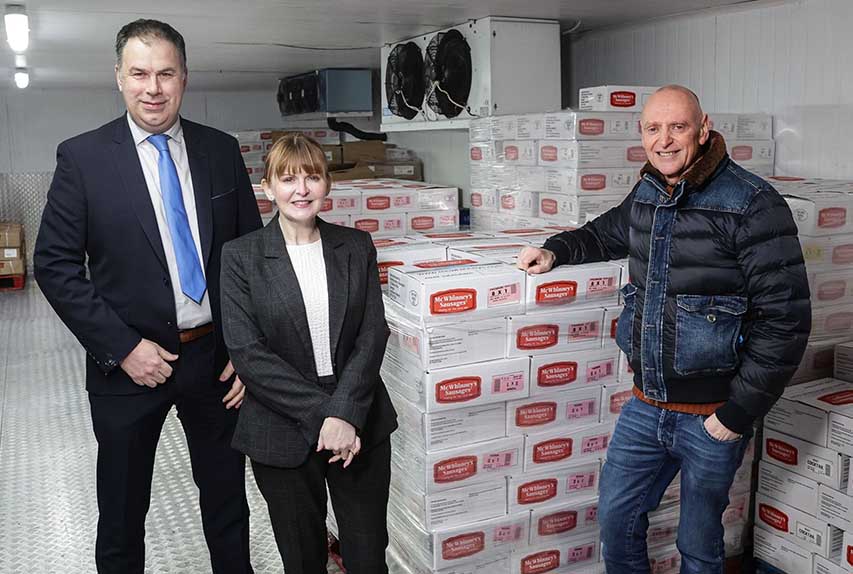
Pictured at McWhinney’s Sausages in Bangor are (l-r) Brendan McGuigan, Director of Advanced Manufacturing and Engineering at Invest NI, Economy Minister Dr Caoimhe Archibald and Kevin McWhinney, Managing Director at McWhinney’s Sausages.  The company, with the support of Invest NI, is investing £2.2 million in new equipment to increase productivity and automation.

“McWhinney’s is a long‑established part of our agri‑food sector, and this investment will support jobs and economic activity across the Ards and North Down area.”

McWhinney’s is a sixth-generation family business which supplies a range of high-quality sausages to fish and chip shops, hospitality venues and outdoor catering industries based locally and in Britain.

Kevin McWhinney, Managing Director at McWhinney’s Sausages, said: “Our new equipment, supported by Invest NI’s Agri-Food Investment Initiative, marks a significant step for our business.

“A new spiral freezer will allow us to re-purpose our existing freezer into a dedicated retail packing line, enabling us to enter the retail market.

“This will significantly increase our turnover, help us to increase innovation and open up new opportunities in the Republic of Ireland and further afield.

“Since we moved to Bangor in 1994, we have focused entirely on wholesale business. It’s exciting to revisit our retail roots on an increased scale and serve the public directly as we did since 1898.”

Invest NI has offered McWhinney’s Sausages £612,000 towards the investment through its Agri-Food Investment Initiative (AFII).

Brendan McGuigan, Director of Advanced Manufacturing and Engineering at Invest NI, said: “McWhinney’s significant investment in new equipment and automation will enable it to increase productivity, to meet supplier demand, grow its exports and boost sustainability.

“As well as increasing sales in the ROI market, our trade team is helping the company to explore new European markets such as Spain. The company’s increased output will help it to capitalise on these opportunities and create room for further product innovation as its automation increases.”

As part of the project, McWhinney’s will introduce environmentally-friendly equipment and fully recyclable packaging. The company also plans to create four new jobs over the next two years, including a Floor Supervisor, Sales Executive, and two Production Operatives.

Iain Joannides, Head of Regional Business for the Eastern Region at Invest NI, added: “We’re helping businesses in the Ards and North Down Borough Council area such as McWhinney’s to boost operational efficiencies and take the next step in their export journey.

“Ultimately, this helps local companies become more profitable and competitive to benefit the local economy.”


    Aaron On A Real Learning Success Path At SERC

    Real Learning At SERC Puts Aaron On Path To Success

    A young man now working at South Eastern Regional College (SERC) Downpatrick Campus says he has come full circle since enrolling there as a student straight from school.  

    Aaron Casement graduated last year with a higher education qualification, delivered at the college, and now supports other hospitality students to achieve their ambitions in culinary arts.

    Twenty-nine-year-old Aaron from Downpatrick was among the first cohort to graduate from SERC with a Foundation Degree in Culinary Arts (accredited by The Open University) in September 2025. 

    Aaron Casement from Downpatrick was one of the first to graduate from SERC with a Foundation Degree in Culinary Arts (accredited by The Open University).

    He gained the qualification through studying whilst working part-time as a catering assistant in SERC’s College Kitchen restaurant, preparing and serving food to students, staff, and the local community who often drop in for coffee or lunch. He is now also lecturing at the college.

    Aaron would recommend SERC, and its emphasis on real learning for real life, to anyone considering their pathway into higher education: “My time at SERC fully prepared me for the role I’m in today. I first encountered the college through their school links programme, while I was at school in Crossgar.

    “After GCSEs, I enrolled on Level 2 Professional Cookery followed by both Level 2 & Level 3 Patisserie and Confectionery at the college’s Downpatrick Campus. Teaching has always been one of my aspirations, and I am proud to have progressed onto SERC’s part-time lecturer register.  

    SERC Downpatrick Campus delivers real learning for real life.

    “The mix of hands-on experience, professional standards, and industry-focused teaching gave me the confidence and skills to step into both support and now a lecturing role. 

    “Coming to college has given me the confidence to keep progressing – I plan to continue my studies by completing a Level 6 award to achieve my full degree.”

    Higher education opportunities at SERC range through degrees, foundation degrees, Higher National Diplomas (HNDs), Higher National Certificates (HNCs), and professional courses up to postgraduate level. You can also choose a Higher Level Apprenticeship, allowing you to earn while you learn.

    The college is a partner institution of Liverpool John Moores University, The Open University, Queen’s University Belfast, and Ulster University, and delivers BTEC qualifications through Pearson. You can see the full range of courses available in the SERC Higher Education Prospectus 2026.

    Library facilities at SERC support learning.

    The college focuses on real learning for real life, with courses taught by lecturers with industry experience and in professional standard facilities.  

    Students are encouraged to demonstrate their abilities in skills competitions, and courses include work placements,  with some opportunities to travel abroad.

    SERC also offers a substantial network of support services, including pastoral care, dedicated support for student carers, an active Students’ Union and an award winning careers team.

    Yearly course fees are lower than those of universities and student finance advisors are available at SERC to advise you on fees and possible funding.

    As Aaron Casement confirms, SERC is committed to supporting students to achieve: “Whether you are fresh out of school or returning to education later in life, SERC provides the support and opportunities to help everyone succeed. 

    “The mix of hands-on experience, professional standards, and industry-focused teaching certainly gave me the foundation I needed. 

    “I am proud of how far I have come. SERC has been a huge part of that journey, and I would encourage anyone with a passion or goal to take that same first step – you never know just how far it might take you.”

    SERC celebrates the success of our Higher Education students with a graduation ceremony at the Waterfront Hall in Belfast each September. The college is very proud that the achievement rate for our full-time Higher Education students is consistently over 98%.

    In addition, approximately 60% of full-time students achieved higher grades on their qualifications in 2025.

    Apply for SERC HE full-time courses through the UCAS platform:

    www.ucas.com

    or via the SERC website for full-time or part-time courses, including Higher-Level Apprenticeships at:

    www.serc.ac.uk

    Four Down Greeway Projects Get Over £1Million

    Kimmins announces over £1m for seven greenway projects

    Infrastructure Minister Liz Kimmins has announced funding of over £1m to support three councils to deliver seven active travel projects and County Down is to receive support for four projects.

    • Newry, Mourne and Down District Council is to receive feasibilty and design support for three greenways at Newry to Poyntzpass; Downpatrick to Ardglass Greenway and Ballynahinch ‘Spur’.
    • Belfast City Council – Sydenham Greenway -to develop the feeder greenway through Alderman Thomas Patton Park to provide a connection from the Holywood Road.

    Announcing the investment, Minister Kimmins said: My Department wrote to councils earlier this year inviting them to submit proposals for greenway projects to be considered for 50% capital funding support.  

    “I am delighted to now issue letters of offer to deliver seven projects within the council areas of Belfast City Council and Newry, Mourne and Down District Council, and Derry City and Strabane District Council. 

    Growing Greenways across Down: The Comber Greenway was extended in 2021 to run from Belfast Road, Comber, to Portaferry Road, Newtownards.

    “This funding, totalling £1.05m,  will be used to help these councils deliver on their priorities for active travel and builds on my commitment to support councils to realise their ambitions and to develop their longer term plans for greenways.  

    The Minister added: “Creating cleaner and greener connections is one of my Department’s seven Foundations for a Better Future and I want to focus on delivering positive change for people, the economy and the environment which will build the foundations for a better future.

    “By working together, we can create cleaner and greener connections that are aligned with regional needs and priorities.

    “Creating spaces that encourage more people to consider walking, wheeling and cycling for their shorter everyday journeys is not just good for the environment but is also beneficial for our physical and mental wellbeing.”

    The Department for Infrastructure will provide funding for these schemes spanning the 2025/26 and 2026/27 financial years. All proposals will be subject to public expenditure processes, before final funding is agreed.

    The funding is for 50% capital funding of the total costs with the other 50% to be met by councils/other sources.

    Abbey Way Newry Lighting Scheme On Way

    Infrastructure Minister Kimmins announces street lighting scheme for Abbey Way, Newry

    Infrastructure Minister Liz Kimmins has announced that a £200,000 street lighting replacement scheme on Abbey Way, Newry has commenced.

    Infrastructure Minister Liz Kimmins has announced a £200,000 street lighting scheme for Abbey Way Newry will be completed by the end of January.

    The street lighting scheme will extend along Abbey Way from Margaret Street to the junction at Kilmorey Street.  The scheme will see the replacement of 30 street lighting columns, underground cable network and the installation of modern energy efficient LEDs.

    Minister Kimmins said: “This is a substantial investment for the Newry area which will deliver significant benefits for residents and road users.

    “The investment demonstrates my commitment to investing in and improving our road network, which is vital for connecting our businesses and communities.  

    “I would like to thank residents, local businesses and commuters for their patience while this essential infrastructure work is carried out.”

    The Department has carefully programmed the work operations and traffic management in order to minimise inconvenience to the public.

    All work involving lane closures will be carried out during off peak times Monday to Friday between 09:30 – 16:00. Some delays may be expected and additional time should be allowed when planning any journeys.

    Subject to favourable weather conditions, the works will be substantially complete by Friday 30 January 2026, however the Department will keep the public informed of any change.

    Tune In To The Newry Inaugural Piano Festival

    Inaugural Newry Piano Festival coming on 6-8th February 2026

    • Three days of classical and jazz concerts, leading Irish and British musicians, family events and masterclasses

    The inaugural Newry Piano Festival takes place from 6-8 February 2026, bringing together leading pianists from Ireland and Britain for three days of classical and jazz performances, concerts, and events.

    Three of the finest classical pianists from these islands – Ireland’s Finghin Collins and David Quigley, and Scotland’s Steven Osborne – give concerts at the Festival, while fans of Jazz and musical theatre can look forward to an evening of Leonard Bernstein with the Rob Barron Trio, joined by vocalist Georgia Cécile.

    David Quigley, Irish classical pianist, will be performing during the inaugural Piano Festival in Newry from 6-8th February 2026.

    The Festival is organised by Newry Chamber Music and marks an exciting new addition to Northern Ireland’s music festival calendar. Concerts, as well as family events, involving music and storytelling, as well as piano masterclasses, will take place in Newry Town Hall and the Newry Chamber Music Hub at The Quays Shopping Centre.

    “This Piano Festival grew out of a pilot piano masterclass series we held last January with my brother, David Quigley. The response was exceptional and confirmed there is a real appetite for high-level piano performance and training in our region,” said Joanne Quigley McParland, Artistic Director of Newry Chamber Music.

    “While this is our first festival dedicated exclusively to the piano, it grows directly from the artistic values Newry Chamber Music has developed over the past 25 years.

    Acclaimed pianist Steven Osborne.

    “This reflects a commitment to excellence in chamber music and solo performance, and to presenting artists of the highest international standard. The piano has always been central to that tradition.

    “With concerts, masterclasses, and open platforms spanning classical and jazz, this festival positions Newry not only as a place where great music is enjoyed, but as a destination where inspiring artistic work happens — attracting performers, students, keen amateur players, and audiences from across the country.”

    An extraordinary series of firsts marks the Festival’s opening concert (Newry Town Hall, 6 February, 7.30pm) as David Quigley and Finghin Collins give their first performance together, with a programme featuring two world premieres by leading Irish composers Philip Martin and Sam Perkin.

    Quigley and Collins will perform these works on two magnificent Steinway Model D concert grand pianos, kindly loaned to the Festival from the Arts Council of Northern Ireland and the Ulster Orchestra. The programme also features work by Mozart, Rachmaninov, Joan Trimble, and Elaine Agnew.

    In another coup for the Festival, acclaimed pianist Steven Osborne will give the closing concert (Newry Town Hall, 8 February, 2.30pm) with a beautifully crafted programme centring on the waltz, including works by Schumann, Satie, and Ravel, along with Schubert’s mighty Sonata in Bb Major.

    Georgia Cecile, British jazz vocalist.

    Osborne will also give a public Piano Masterclass (Newry Town Hall, 7 February) for aspiring young pianists – an amazing opportunity for the participants, piano teachers, and enthusiasts alike.

    American composer Leonard Bernstein will be celebrated when the Rob Barron Trio (Newry Town Hall, 7 February, 8pm) perform imaginative and improvised re-interpretations of Bernstein’s music from West Side Story, Candide, On The Town, A Quiet Place, and Wonderful Town. The trio will be joined by the award-winning British jazz vocalist, Georgia Cécile.

    In a further treat for Jazz fans, Rob Barron will perform a Sunday morning concert (NCM Hub, The Quays Shopping Centre, 8 February, 1 1.30am), treating listeners to George Gershwin, Jerome Kern, Rodgers & Hart, and other Broadway masters. Then at 1pm, Barron will give a Jazz Masterclass for beginner and intermediate musicians.

    Newry Piano Festival will also host a delightful family event, when David Quigley and Finghin Collins again join forces for Ravel’s Mother Goose Suite, and be joined by acclaimed actor Séamus O’Hara (House of Guinness, Blue Lights), who will narrate Poulenc’s Babar the Elephant.

    Aspiring and amateur pianists and performers of all ages can look forward to the Open Keys at the Quays open-mic piano concert (NCM Hub, 7 February, 4pm), where people can share music in a relaxed and friendly atmosphere.

    Irish pianist Finghin Collins.

    Joanne Quigley McParland says: “We want this Piano Festival to draw people to Newry and the wider region to experience outstanding artists and inspiring performances, while discovering an area known for its extraordinary landscape and superb hospitality, and now firmly recognised as a centre of excellence in classical music on these islands.”

    For more information and booking, see:

    https://newrychambermusic.org/piano-fest.

    To be considered for Steve Osbourne’s Piano Masterclass, or to perform at Open Keys at the Quays, email [email protected].

    Newry Piano Festival is supported by the Arts Council of Northern Ireland, Newry Mourne and Down District Council, and RTÉ Supporting the Arts.

    Chickenpox Vax Added To Immunisation Jabs

    Free chickenpox vaccination for kids to go live in January

    The Public Health Agency has announced that chickenpox vaccination will be added to the childhood immunisation programme from January.

    A spokesperson says it will help protect thousands of children from this unpleasant and potentially serious illness each year.

    This will be the first time in Northern Ireland that children will be offered protection against chickenpox for free through the childhood programme. Immunisation is the safest and most effective way of protecting our children against serious diseases.

    Dr Joanne McClean, Director of Public Health at the PHA, said: “Parents will now be able to help protect their children against chickenpox and its serious complications.

    “Chickenpox is often seen as a common and mild illness, but for some babies, young children and even adults, chickenpox can be very serious, leading to hospital admission and in some cases can be fatal.

    The Public Health Agency recommends that children receive effective immunisation to prevent serious illness and complications. (Photo: Ai generated by Jim Masson.©).

    “By offering this vaccine for free as part of the childhood immunisation programme, we can help protect children against chickenpox.

    “This is not just the characteristic spots and general unwellness associated with the illness, but also the serious complications that can develop from it such as bacterial infections of the skin and soft tissue like strep A, brain and lung inflammation, and stroke.

    “It’ll also help reduce the number of sick days for kids, and time parents have to take off work, as a result of this highly-transmissible disease.

    “Evidence from its use in other countries shows that the vaccine has a good safety record and is very effective. Its introduction here will have a really positive impact on the health of our young children.”

    Eligible children will be offered a combined vaccine for measles, mumps, rubella and varicella (the clinical term for chickenpox) – (MMRV) – as part of the routine infant vaccination schedule. 

    The decision to roll out the MMRV vaccine is based on expert scientific advice from the Joint Committee on Vaccination and Immunisation (JCVI), following research showing the significant impact of severe cases of chickenpox on children’s health and hospital admissions.

    Health Minister Mike Nesbitt said: “I am delighted that children in Northern Ireland will now be offered the chickenpox vaccination, in addition to the other vaccines already included in our well-established childhood vaccination schedule.

    “This is a significant improvement to the childhood vaccination schedule. Every child deserves the best possible start in life, and this vaccine will prioritise their wellbeing and prevent potentially serious complications from chickenpox.

    “I encourage parents and guardians of those eligible to avail of the vaccination, when invited to do so, to help protect their children from this disease.”

    As with other childhood immunisations, parents will be contacted by their GP surgery to arrange an appointment if their child is eligible.

    If you are unsure if your child is up to date with vaccinations the easiest way to check is to look at your child’s red book or speak to your health visitor or GP.

    If your child has missed a vaccination, please contact your GP practice to book an appointment as soon as you can to make sure they have maximum protection against disease.

    Dr McClean added: “This change to the immunisation schedule is the first since 2015 when MenB was added, and this change will similarly mean that children will now be better protected against another potentially fatal disease.

    “After clean water, vaccination is the most effective public health intervention in the world for saving lives and promoting good health.

    “Therefore one of the most important things that any parent can do is get their child vaccinated and encourage them to continue this throughout their own lifetime.”

    For more information on childhood immunisations and eligibility for the MMRV see:

    www.nidirect.gov.uk/childhood-immunisation

    • For children born on or after 1 January 2025, your child should receive one dose of MMRV just after their first birthday and a second dose at 18 months old.

    NUJ Sets Standards For Professional Journalism

    The NI NUJ Branch Chair Anne Hailes thanks NUJ members for their fellowship

    As an NUJ (National Union of Journalists) member, I am proud to say I’ve been a card-carrying member since 2006.

    Over the 20 years I have accessed advice, support, training and professional recognition. The media today has changed incredibly over two decades becoming more diverse and journalists face increasing pressures globally, nationally and regionally.

    I do my best to stick to the Code of Conduct of the NUJ which is set out clearly on their website, a guiding light for ethical journalism.

    Photographer/Journalist Jim Masson has reached another media milestone on the yellow brick road. (Photo: Selfie!)

    Anne Hailes, Chair Belfast and District NUJ, summed up the value of membership well when she said in writing to the NI NUJ members, saying: “As we look ahead to 2026, I am writing to express my sincere gratitude for the fellowship we share as NUJ members. As the NUJ slogan reminds us, we are truly ‘in good company.

    “We are all acutely aware of the immense challenges facing journalism and journalists today.

    “There is no need to list them in full, but among the most daunting are attacks on journalists—particularly women journalists—the growing threat posed by artificial intelligence, and the continuing bleak economic climate.

    “Here in the Belfast and District NUJ branch, we know that we are stronger together.

    The NUJ is the backbone of journalism across the UK and Ireland.

    “Over the past year, members have benefited from regular branch meetings, the Lyra McKee seminar, educational and training opportunities and participation in both the Biennial Delegate Meeting in Blackpool in April and the Irish Biennial Delegate Meeting in Dublin in November.

    “A wide range of policy issues affecting members were discussed and voted upon. In addition NUJ members continue to have access to a broad range of support and advice services.

    “This year the NUJ also awarded life membership to several branch colleagues.

    “Those honoured at a recent ceremony at the Teachers’ Club in Dublin include Linda McAuley, Brendan McCourt, Ciarán Ó Maoláin, Mary Kelly, Michael Donnelly and Fionnuala O’Connor.

    “I am delighted to inform you that we have invited them to attend the coming AGM where we will pay tribute to their contributions before they join us for lunch.”

    Photography Services Available.

    I am available for photoshoots for private, family corporate and business events. I cover presentations, a wide range of social photography and at weekends I cover sports usually.

    Call Jim Masson on 07855545873 for a quote for your photography needs.

    To view some of my news end photos go to: Down News Facebook Albums – there are thousands of photos there to look through!

    And I am always looking for human interest stories so if you come across one, give me a ring or email: [email protected] and I’ll follow up.

    Down News is a FREE community-focussed digital newspaper covering items of interest in County Down and is based at the Down Business Centre in Downpatrick.

    Down News has a solid and loyal following and often exceeds a million page views each month on Facebook, and other metrics are also positive.

    One of the reasons the reading figures have increased is because there is almost universal access to wi-fi across Northern Ireland but there are still a few black spots left to cover.

    So, wishing everyone another belated Happy New Year and thank you again for reading Down News.

    Down News Ltd, Office 1 Knowledge House, Down Business Centre, 46 Belfast Road, Downpatrick, County Down, Northern Ireland, UK, BT30 9UP.

    Tel: 07855545873

    Email: [email protected]

    From Clicks to Clients: How to Turn Website Traffic into Predictable Revenue

    0

    Generating website traffic is no longer the primary benchmark of digital success. Businesses can attract thousands of visitors each month yet see little impact on revenue or client acquisition. The real challenge lies in converting that attention into tangible outcomes, predictable revenue streams that support growth.

    Dominate Online, a digital marketing and SEO agency, observes that modern visibility is measured not just by raw traffic but by strategic presence across search, AI-driven results, and entity-based recognition. The brands that succeed are those that treat every click as a potential signal of authority, trust, and engagement, rather than an isolated metric.

    Photo by Glenn Carstens-Peters on Unsplash

    1. Understanding the Gap Between Traffic and Value

    High traffic is easy to achieve with paid ads, social campaigns, or trending content, but Statista data shows that only 2% of first-time website visitors convert into paying clients immediately. Most visitors interact briefly and leave without a measurable action.

    To bridge this gap, businesses must identify what drives meaningful engagement:

    • User intent analysis: Not all traffic is equal. Understanding why visitors arrive enables more targeted conversion strategies.
    • Behaviour tracking: Analysing patterns like time on page, scroll depth, and click paths highlights areas where users lose interest.
    • Signal-based optimisation: Focusing on how a brand is recognised in AI search or structured results, not just clicks, improves long-term visibility.

    Recent analysis using a Free SEO Visibility tool shows that brands appearing consistently in AI-generated answers maintain audience recognition even when traditional click-through rates are modest. This underscores that being seen is sometimes as important as being clicked.

    2. Optimising for Conversion Signals

    Converting traffic into clients is about creating measurable touchpoints along the journey. Deloitte reports that personalised experiences increase the likelihood of engagement by 45%, highlighting the value of aligning website content and offers with audience needs.

    Practical approaches include:

    • Content alignment: Ensure that landing pages, blog posts, and resources clearly answer the questions visitors have, linking naturally to service or product pages.
    • Internal linking and entity reinforcement: Connecting related content strengthens perceived authority and keeps visitors engaged longer.
    • Micro-conversions: Encourage small actions such as downloads, subscriptions, or interactions that cumulatively signal readiness to convert.

    Tracking these micro-conversions alongside visibility metrics ensures that the website functions as an integrated ecosystem rather than a series of disconnected pages.

    3. Technical SEO as a Conversion Catalyst

    Technical optimisation remains a critical factor in turning clicks into clients. According to Ahrefs, websites with optimised site speed, structured data, and mobile-first design are 50% more likely to retain visitors and appear in top rankings.

    For 2026, SEO isn’t just about ranking. AI-driven search and entity-based results mean that technical competence directly influences conversion potential:

    • Structured data: Proper schema usage increases the likelihood of appearing in knowledge panels or AI-generated summaries.
    • Mobile experience: With over 60% of web traffic now coming from mobile devices (Ofcom), a poor mobile experience can quickly erode potential revenue.
    • Page architecture: Clear navigation and logical content hierarchy reduce friction, guiding visitors toward desired actions naturally.

    Brands that neglect these fundamentals may see high traffic numbers but fail to convert visitors into revenue.

    4. Paid Media as a Supporting Strategy

    While SEO and organic authority lay the groundwork, paid campaigns can accelerate client acquisition when targeted effectively. Gartner reports that brands combining organic presence with selective paid promotion experience up to 30% higher conversion efficiency than those relying solely on either approach.

    Key principles include:

    • Targeting high-intent audiences rather than broad demographics
    • Integrating paid campaigns with content and SEO strategy to reinforce credibility
    • Monitoring performance not just by clicks but by how traffic contributes to micro- and macro-conversions

    Paid media works best as part of a cohesive ecosystem where each click reinforces visibility and authority rather than being an isolated metric.

    5. Visibility Beyond Clicks

    AI search is reshaping how users interact with brands online. SparkToro estimates that over 50% of searches now end without a click due to AI-generated summaries, knowledge panels, and voice search. This highlights the importance of focusing on recognition signals as much as on traditional engagement metrics.

    Analysis using a Free SEO Visibility tool demonstrates that brands maintaining presence in AI-driven results or structured search outputs are more likely to be top-of-mind for potential clients. In practice, this means that visibility and authority act as a precursor to conversions, even when direct traffic is limited.

    6. Measurement, Iteration, and Predictability

    Predictable revenue requires a disciplined, data-driven approach. McKinsey research shows that companies with structured measurement frameworks achieve up to 35% higher efficiency in digital performance than those relying on ad hoc tracking.

    Focus areas include:

    • Tracking conversion funnels: Understand where users drop off and optimise touchpoints.
    • Monitoring multi-channel signals: Visibility in search, AI, and social platforms collectively influences conversion potential.
    • Iterative optimisation: Small, evidence-driven improvements compound over time, strengthening both authority and revenue predictability.

    Measuring the right metrics ensures that every click has the potential to contribute to revenue, rather than simply inflating traffic reports.

    Conclusion

    Turning website traffic into predictable revenue requires a shift in mindset. Clicks are no longer the ultimate metric; authority, visibility, and engagement signals now define success.

    Brands that integrate technical SEO, high-quality content, targeted paid campaigns, and visibility across AI search outputs create a cohesive ecosystem that converts visitors over time. The key is measurement, iteration, and focus on signals that matter, not vanity metrics.

    By aligning traffic with visibility, authority, and structured engagement, businesses can transform online attention into sustainable revenue streams, navigating the complexities of 2026 with clarity and confidence.

    Smart Bet Suggestions: When Algorithms Recommend Casino Wagers

    0

    Recommendation engines are everywhere – from streaming platforms to online shops – and in 2026 they have firmly entered the casino ecosystem. Smart bet suggestion systems analyse session behaviour, bankroll patterns, volatility tolerance, and past preferences to recommend wagers or game types that fit the player’s style. These tools do not influence outcomes or alter RTP. Instead, they guide players toward choices that match their pace, reduce emotional swings, and help them avoid bets that are too large or out of character. Casinos see this as a way to modernise the experience while aligning with responsible gambling expectations.

    Why Casinos Are Introducing Smart Bet Suggestions

    Players often make decisions driven by emotion or impulse, especially during long sessions. Unibet Casino wants to provide guidance that reduces erratic behaviour and increases understanding of risk. Recommendation systems help stabilise sessions by nudging players toward bet sizes consistent with their usual patterns. They also help new users who feel overwhelmed by complex lobbies, volatility levels, or unfamiliar game mechanics.

    For operators, smart suggestions lower dispute rates, discourage unsafe wagering, and increase long-term retention by giving players more confidence in their choices.

    How Smart Bet Recommendation Engines Work

    These systems pull from multiple sources: previous bet sizes, session length, volatility preferences, and bankroll behaviours. Algorithms then build a dynamic profile that updates throughout the session. Casinos present recommendations subtly – never as instructions. They appear as optional hints or sliders calibrated to the player’s typical ranges.

    Before detailing the common factors these engines analyse, it’s important to note that they never alter RNG outcomes or modify house advantage.

    Data Points Used to Generate Suggestions

    • Typical bet size ranges
    • Preferred volatility levels in slots
    • Risk tolerance based on historical sessions
    • Time spent per spin or per round
    • Favourite game categories or providers
    • Variance patterns across previous gameplay
    • Bankroll stability during longer sessions

    These signals create a picture of how a player naturally behaves.

    Why Players Value Smart Recommendations

    Many players appreciate subtle guidance, especially when they switch between game types. A recommended bet slider helps them avoid pushing their bankroll too hard or making sudden jumps after a win or loss. Suggestions act as guardrails, not commands.

    Before comparing old and new decision patterns, it’s useful to note that players prefer suggestions that feel optional and transparent.

    Traditional Decision-Making vs Suggested Betting

    FeatureTraditional BettingSmart Bet SuggestionsPlayer Impact
    Decision StyleManual guessesData-informed hintsBetter clarity
    Risk ControlWeakStronger boundariesSafer play
    Emotional InfluenceHighReducedFewer impulsive bets
    Learning CurveSteep for new usersSimplifiedMore confidence
    ConsistencyVariableStableHealthier sessions

    Smart suggestions stabilise the overall experience.

    Why Regulators Closely Monitor Suggestion Systems

    While suggestion tools can support responsible gambling, they must never mislead players or encourage higher spending. Regulators require casinos to disclose how suggestions work and ensure that recommended wagers are based on harm-minimising models, not revenue optimisation.

    Before listing regulatory priorities, remember that transparency is mandatory – players must understand that suggestions are optional.

    Regulatory Expectations for Suggestion Engines

    • Clear guidelines stating that suggestions are optional
    • No prompts encouraging higher wagers than typical patterns
    • No implication that recommended bets increase winning chances
    • Strong privacy protections for behavioural data
    • Consistent harm-minimisation logic across all recommendations

    Casinos must use suggestion tools ethically, not manipulatively.

    Implementation Challenges for Casino Operators

    Building meaningful suggestions requires accurate modelling, ongoing monitoring, and seamless integration with diverse games. Operators must ensure that recommended bet sizes work across thousands of titles without clashing with game-specific betting structures.

    Before describing the main challenges, it’s helpful to note that many smaller operators rely on third-party engines to handle this complexity.

    Voice-Controlled Casino Navigation: Hands-Free Play for 2026

    0

    Voice technology has quietly moved from novelty to necessity. People already use voice commands to control smart homes, search the web, and manage their phones. In 2026, the same shift is happening inside casino platforms. Voice-controlled navigation gives players the ability to open games, adjust settings, claim bonuses, and access support without touching the screen. For users who move between mobile, tablet, and wearable devices, this hands-free approach feels natural and surprisingly efficient. Casinos, meanwhile, see it as a major upgrade in accessibility – a way to support players who may struggle with small interfaces or complex menus.

    Photo by Heather Gill on Unsplash

    Why Voice Navigation Is Becoming a Casino Feature

    Casinos want to reduce friction, especially on mobile. Small screens, tiny buttons, and multi-step menus often frustrate players. Voice control bypasses those pain points. A simple command such as “open my last game” or “show my bonus progress” eliminates unnecessary tapping and scrolling.

    The technology also appeals to HarryCasino players with disabilities or limited dexterity who struggle with traditional layouts. Regulators pay increasing attention to accessibility, and operators see voice navigation as a practical path toward compliance.

    How Voice-Controlled Systems Work Inside Casino Platforms

    Casino voice interfaces use a combination of speech recognition engines, natural-language processing, and built-in command libraries. Players speak a phrase, the system interprets it, and the interface executes the matching function. Commands are intentionally limited to ensure compliance – users can browse, open games, or adjust settings, but cannot place bets purely by voice in most regulated markets.

    Before looking at what voice commands typically cover, it helps to understand that casinos must always require manual confirmation for any money-related action.

    Why Players Find Voice Navigation Useful

    Voice control feels faster, more natural, and less frustrating than deep menu browsing. It reduces the chance of misclicks, speeds up routine actions, and allows players to multitask. Mobile users benefit the most: one spoken command can replace five or six taps.

    Before comparing traditional UI with voice-driven UI, it’s worth noting that many players switch between devices – voice bridges those environments effortlessly.

    Touch Navigation vs Voice Navigation

    FeatureTraditional Touch UIVoice-Enabled UIPlayer Impact
    SpeedMulti-stepSingle commandFaster browsing
    AccessibilityModerateVery highMore inclusive
    PrecisionCan misclickZero misclicksBetter comfort
    ConvenienceHands-onHands-freeFlexible sessions
    MultitaskingLimitedEasyBetter mobility

    Voice changes how players move rather than how they gamble.

    Why Regulators Support Voice-Assisted Interfaces

    Voice navigation aligns naturally with responsible-play expectations. It brings clearer menu access and increases visibility for safety tools. Regulators also appreciate that voice commands reduce accidental betting caused by interface errors.

    Before outlining regulatory concerns, remember that voice systems cannot automatically place wagers – this rule protects players from accidental or misunderstood commands.

    Challenges Casinos Face When Deploying Voice Systems

    Building a functional voice interface is more complex than adding a microphone button. Casinos must train recognition models for multiple accents, languages, and noisy environments. They must also design command libraries that feel intuitive yet still meet compliance rules.

    Before listing the common hurdles, note that most voice systems rely on existing engines like Google, Amazon, or in-house models adapted for gambling contexts.

    Main Challenges in Voice Interface Adoption

    • Accurate recognition across diverse accents
    • Preventing false activations in noisy surroundings
    • Keeping commands limited and compliant
    • Training users to speak in supported phrases
    • Ensuring privacy and secure audio processing

    Voice technology must feel reliable, not awkward.

    How Players Benefit From Hands-Free Casino Interaction

    Voice navigation streamlines the experience. It reduces the time spent hunting for menus, helps players check information quickly, and lets them interact without constantly staring at the screen. For accessibility-focused users, it can make the difference between being able to play comfortably or not at all.

    Before detailing the specific advantages, remember that voice systems supplement the interface – they never force players to stop using touch controls.