Kinallen Bridge just north of Dromore is closed for assessment due to structural defects
Due to concerns regarding the condition of Kinallen Bridge, which carries the C0309 Skeagh Road north west of the village of Kinallen, County Down, the road has been closed in both directions.
A spokesperson for the Department of Infrastructure said: “Following reports of damage, engineers attended the site and identified a partial collapse affecting the bridge structure.
“In the interests of public safety, the Department has taken the decision to close the road at this location to allow the bridge to be fully assessed and to determine the most appropriate course of action.
The damaged bridge on the Kinallen Road near Dromore. The bridge is now closed as DfI engineers assess what needs to be done. (Photo: courtesy of Alderman Paul Rankin).
“The Department acknowledges that this closure will cause local disruption and delays and apologises for any inconvenience caused. However, the safety of all road users remains the Department’s primary concern.
“Engineers are currently undertaking detailed structural assessments to establish the extent of the damage and to inform the development of suitable repair options.
“Once these assessments are complete, the Department will be in a position to provide further information on the proposed works and associated timescales.
“Local diversions are in place via the Diamond Road and Banbridge Road, and the travelling public is urged to follow the signage, drive with due care and attention, and allow extra time for their journeys.”
Alderman Paul Rankin said on a Facebook post that: “My colleague Cllr Tim McClelland and I were on site over the weekend along the Skeagh Road heading towards Kinallen.
“The stone bridge is in need of urgent repairs. We had been contacted by concerned residents… Tim and I will be pressing the DfI to schedule the necessary repair works asap.
“We don’t want to take months for reair works to be carried out by DfI.”
The Proposed Farm NI ANC Bill Can’t Work Without NI Farm Welfare Bill Says Farmers For Action
What could be simpler than The NI Assembly passing a bill over the next 12 months to bolster the plight of the ailing farm community in Northern Ireland ?
Farmers For Action have been aware of Stormont Agriculture Committee Deputy Chair Sinn Fein Declan McAleer’s proposed Areas of Natural Constraint (ANC) Bill for some time.
Sean McAuley, FFA Steering Committee member, said: “The proposed Bill went off the radar for some time and now it’s back on the agenda as we head towards next years’ May elections.
“The Bill proposes re-instating support for farmers in Areas of Natural Constraint, however, it is coming under a lot of flack, from the DUP in particular in that the Bill is unfunded and unfair!”
Farmers for action are calling on MLAs to push through two bills through teh Assembly before they close for the election in April 2027. Can they do it 12 months ? That is the burning question for farmers in ANC areas.
He added: “The FFA always support farmers in ANC areas in particular receiving support which they currently do, but they receive not enough.
“However, the point is that the small amount of money that would come from such a Bill would require farmers to do training courses etc and be treated like school children receiving pocket money at the end of it.
“The problem is for the small amount of money that would be involved, the conditions won’t warrant the farmers time, nor should it have to!
“The biggest problem is that unless Government was going to deliver new funding, the support money for this Bill will come out of other farmers in Northern Ireland’s pockets, eg cereal farmers who are already receiving the same price for grain as 40 years ago.
“The key to all of this is for Stormont to take forward the Northern Ireland Farm Welfare Bill (currently with the Agriculture Committee) and the ANC Bill as emergency Bills due to increased fuel costs, increased fertiliser prices, abysmal farm gate prices, IHT, wars and more creating an environment that means farmers can no longer afford to feed the people with the majority of staples!”
“If the Northern Ireland Farm Welfare Bill was enacted, farmers would be paid a minimum of the true cost of production inflation linked plus a margin for their produce across the board. “
Sean added: “The introduction of this Bill wouldn’t cost the Government a penny as support money diminishes and would facilitate – due to its workings the introduction of the small support that an ANC Bill would generate.
“The upshot of all this is that the ANC Bill can’t work without the NI Farm Welfare Bill in place to make sure that all farmers including ANC farmers are properly paid for their produce.
“There is still time for Stormont in this mandate to pull this off and set Northern Ireland on the path to prosperity – let’s see what our MLA’s are made off and then assess who is worth voting for next May!”
Motorsport once attracted mainly dedicated enthusiasts, yet recent seasons show more families turning race weekends into shared annual plans. Parents, children, and grandparents now attend together, combining sporting excitement with time spent as a group. What previously felt like a specialist interest now appeals to wider audiences seeking memorable live experiences.
Modern race weekends offer more than track action alone. Fan zones, technical displays, and organised activities support engagement across age groups. Improved facilities and clearer visitor planning have also made attendance feel more accessible for families preparing shared travel around the racing calendar.
The Cultural Shift Behind Family Attendance at F1 Events
Formula 1 historically carried a reputation as an elite spectator sport followed mainly by long-term adult fans. This perception began to change following the championship’s commercial restructuring after 2017. A broader audience strategy expanded digital storytelling and global promotion, helping introduce the sport to new demographics.
Documentary coverage and social media engagement have played a visible role in shaping this cultural transition. Younger audiences now develop familiarity with teams and drivers through regular online updates. These narratives create continuity between race weekends, encouraging families to view attendance as part of a wider seasonal experience rather than a one-off occasion.
As spectator demographics evolve, demand for viewing environments that combine comfort, visibility, and social atmosphere has increased. This shift has contributed to the growth of premium F1 hospitality experiences, which reflect changing expectations around event participation and multi-generational attendance.
Practical Improvements Making Circuits More Accessible
Rising family interest has encouraged circuits to review infrastructure and on-site facilities. Dedicated rest zones, child-friendly seating areas, and improved navigation systems now form part of many major event layouts. These adjustments help reduce fatigue during long race days and support smoother movement between viewing points and activity spaces.
Enhanced restroom provision and private nursing facilities have also contributed to a more practical visitor environment. Parents attending with younger children benefit from clearly signposted amenities, allowing them to manage daily routines without missing key race moments. These considerations help maintain comfort levels across extended event schedules.
Noise exposure has long been a concern at high-performance motorsport venues. Many circuits now distribute protective ear defenders for younger attendees. This measure reflects feedback gathered from family visitors and supports safer engagement with high-intensity track sessions.
Interactive fan zones and clearly defined spectator viewing areas at UK race circuits help families move comfortably between activities while maintaining good track visibility throughout long event days. Such features help sustain interest across different age groups and complement broader F1 hospitality settings designed to support comfort and social interaction.
Educational Value and Skill Development for Young Attendees
Race weekends often provide informal learning environments that extend beyond the sporting spectacle. Formula 1 integrates engineering, physics, mathematics, and data analysis into real-time decision-making processes visible from the grandstands or exhibition areas. Children observing these dynamics gain practical exposure to subjects they encounter in school.
Technical demonstrations highlight teamwork and coordination. Watching pit crews complete rapid tyre changes or respond to strategic race calls illustrates how precise planning and communication influence performance outcomes. These experiences can shape how younger visitors perceive collaborative work environments in later life.
The international composition of Formula 1 also introduces cultural awareness. Driver announcements, team branding, and fan representation from different countries reinforce the global reach of the sport. Sustainability initiatives presented at circuits also show how motorsport organisations respond to environmental priorities, giving younger audiences exposure to new F1 power unit regulations and evolving technology.
Financial Considerations and Planning Requirements
Attending a motorsport weekend requires structured budgeting. Ticket prices, accommodation costs, travel arrangements, and on-site spending contribute to the overall financial commitment. Families who begin planning several months in advance often access early booking rates that help reduce total expenditure.
Transport coordination also plays a role in cost management. Shuttle services, park-and-ride schemes, and rail connections can simplify arrival logistics and limit additional travel expenses. Some visitors choose lower-priced practice day tickets as an introduction to the race weekend atmosphere while still gaining access to fan zones and circuit facilities.
Accommodation demand near major circuits rises quickly once race dates are confirmed. Early reservations help families secure suitable lodging within manageable travel distance of the venue, reflecting wider hotel booking demand trends observed across UK event destinations.
Race weekend spending patterns also vary depending on participation preferences. Families interested in structured viewing environments or added amenities may consider F1 hospitality packages, which typically combine seating, catering, and controlled access to designated event spaces. Comparing these options with standard ticket routes helps visitors align comfort expectations with available budgets.
Long-Term Social Impact of Shared Motorsport Experiences
Regular attendance at major sporting events often contributes to stronger family traditions. Shared travel planning, coordinated schedules, and collective anticipation of race outcomes create experiences that extend beyond the duration of the event itself. Over time, these routines can shape how families organise annual leisure activities.
Children who grow up attending motorsport events frequently develop lasting associations with the atmosphere and community engagement they encounter trackside. These memories may influence future leisure choices, career interests, or social networks formed around shared sporting enthusiasm.
At a broader level, the evolution of Formula 1 into a more accessible spectator environment reflects wider shifts within live entertainment culture, with audience expectations increasingly shaped by global scheduling patterns linked to a major sporting events calendar.
Overall, the growing presence of families at motorsport events reflects how Formula 1 continues to evolve beyond pure competition into a shared live experience. When race weekends combine practical planning, accessible facilities, and meaningful moments together, they become part of long-term family traditions. For many households, these events now represent more than sport alone, offering continuity, connection, and memorable time spent across generations.
The Health Inequalities Annual Report 2026 suggests you will live longer in Lisburn or Castlereagh
The Department of Health today published the Health Inequalities Annual Report 2026.
This publication presents a comprehensive analysis of health inequality gaps between the most and least deprived areas of NI, and sub-regional gaps within Health & Social Care (HSC) Trust and Local Government District (LGD) areas across a range of health indicators.
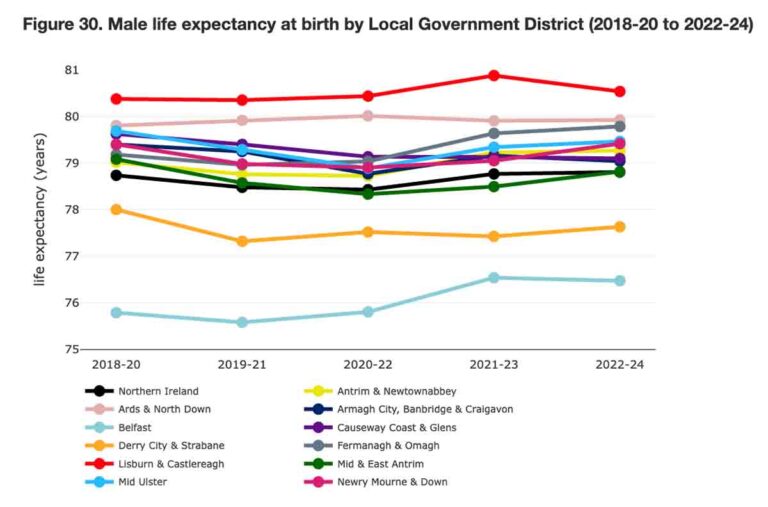
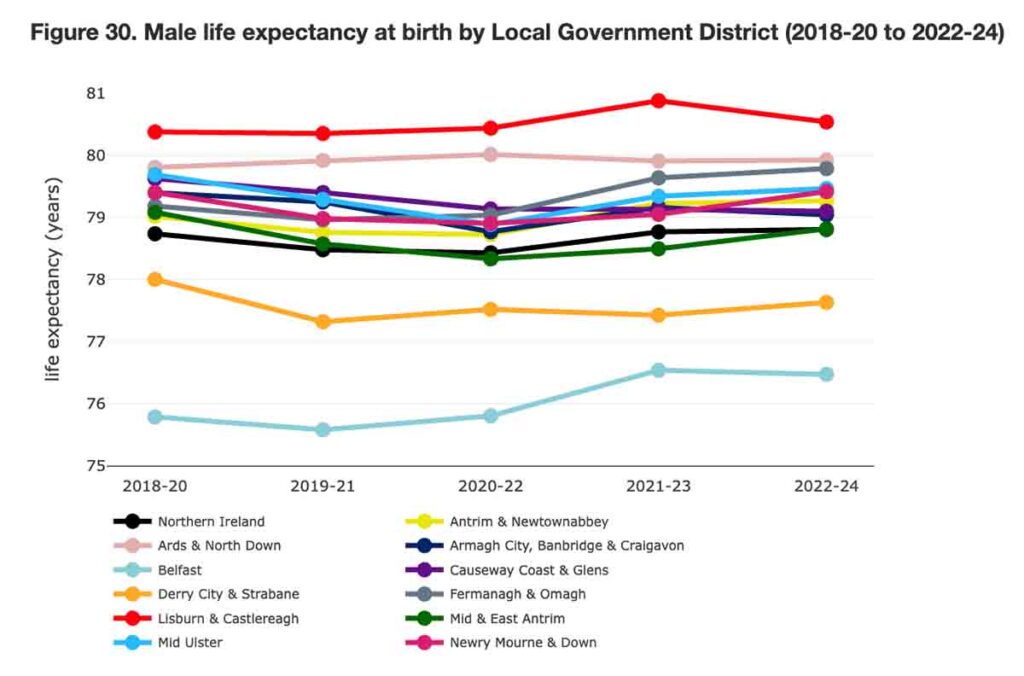
And not surprisingly, the North Down belt (from Lisburn to Castlereagh shows a life expectancy for males of 80.5 years and 83.8 for females. Belfast is showing 4 years less in each category.
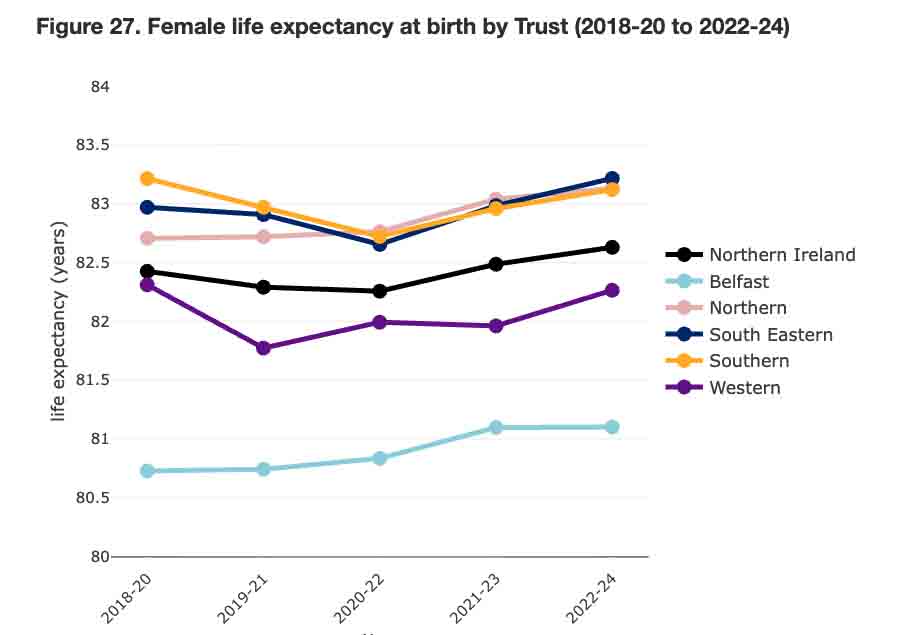
The stats also show that both male and females in the South Eastern HSC Trust area tend to live longer on average than in the other 5 trusts areas.
The information is hard to digest, and the link below gives graphical information to help analysis.
But it begs the question, if the life expectancy is highest in the South Eastern HSC Trust for males and females, does this figure distort the life expectancy of those further south in that Trust area. What is the life expectancy of males and females in the sub-Trust Downpatrick area ? The information is hard to extrapolate from the report but I’ll continue to read through it.
Key Findings – Regional
The most-least deprived gap in female life expectancy widened by 0.5 years, from 5.0 years in 2018-20 to 5.5 years in 2022-24. While there was no significant change in the deprivation gap for male life expectancy over the analysed period, it remained high at 7.2 years in 2022-24.
The rate of self-assessed good/very good general health decreased over the last five years in all areas and the most-least deprived gap widened. The inequality gap for male healthy life expectancy also widened to 14.9 years over the analysed period due to a decrease of 4.5 years in the most deprived areas.
While female healthy life expectancy decreased by 1.9 years in NI, there were no observed changes in the most or least deprived areas, however the inequality gap between the most and least deprived areas remained high, at 14.6 years.
Large inequality gaps continue to highlight markedly higher rates of premature mortality in the most deprived areas, with the gap between the most and least deprived areas widening over the period for five of the eight indicators analysed. Gaps widened for avoidable and preventable mortality where death rates increased for NI and in its most deprived areas.
For under 75 respiratory mortality there was a narrowing of the gap due to an observed improvement in the most deprived areas. Despite this improvement, the inequality gap remains the highest of all premature mortality indicators where the rate in the most deprived areas was around three and a half times the rate in the most deprived areas.
Large inequality gaps continue to exist for mental health indicators. The inequality gap in the suicide rate widened over the analysed period with the rate in the most deprived areas now treble the rate in the least deprived areas.
Alcohol and drug related indicators continue to show some of the largest health inequalities monitored in NI. The deprivation gap for drug misuse deaths widened over the analysed period and showed the largest inequality gap, with mortality in the most deprived areas almost six times that of the least deprived.
In 2024/25 the percentage of primary 1 pupils affected by obesity in the most deprived areas was 73% higher than the rate in the least deprived areas. For year 8 pupils, the most-least deprived gap was slightly wider at 87%.
In 2024/25, the most-least deprived inequality gap for dental extractions for all ages narrowed however the rate in the most deprived areas was still more than double that in the least deprived areas. With the exception of dental registration rates, inequality gaps widened over the analysed period for the remaining dental indicators.
Females in the South Eastern HSC Trust area top the chart for female life expectancy from birth closely mirrored by the Southern Trust.
Key Findings – Sub-Regional
Male and female life expectancies were lowest in the Belfast LGD (76.5 years and 80.5 years respectively). Male life expectancy was highest in Lisburn & Castlereagh LGD (80.5 years), and female life expectancy was highest in Lisburn & Castlereagh and Fermanagh & Omagh LGDs (83.8 years).
The largest inequality gap in male life expectancy was seen in Mid & East Antrim LGD where the gap between the 20% most deprived areas and the LGD average stood at 6.6 years. The largest gap for females was seen within the Belfast Trust area (4.7 years).
Similar to the regional picture, deprivation related inequality was most prominent in indicators relating to alcohol, drugs, self-harm, smoking during pregnancy and teenage births, which were among the largest inequality gaps for the majority of Trusts and LGDs.
Drug misuse mortality was the largest inequality gap in Belfast, Northern and Western HSC Trusts, where the rates in their most deprived areas were almost two and a half times (132%, 124% and 130%) their respective Trust averages. Drug related admissions was the largest inequality gap in the and Southern Trust, while the teenage birth rate showed the largest gap in the South Eastern Trust.
With the exception of Lisburn & Castlereagh LGD, drug related admissions was among the top five inequality gaps within all eleven LGDs. In the Mid & East Antrim LGD, the rate of drug related admissions within the 20% most deprived areas, was two and a half times (inequality gap of 149%) the LGD average.
Large inequality gaps for alcohol related admissions also exist in the majority of Trusts and LGDs. The rates in the respective most deprived areas for the Belfast Trust, Southern Trust, Western Trust, Armagh City, Banbridge & Craigavon LGD, Belfast LGD, Derry City & Strabane LGD, Lisburn & Castlereagh LGD and Mid & East Antrim LGD were around double the Trust/LGD average.
Alcohol specific mortality showed the largest inequality gap (97%) in the Causeway Coast and Glens LGD, where the death rate in the most deprived areas was around double the LGD average.
The under 20 teenage birth rate was the largest inequality gap in the Antrim & Newtownabbey (123%) and Armagh City, Banbridge & Craigavon (133%) LGDs.
Smoking during pregnancy showed the largest inequality gap in Lisburn & Castlereagh LGD (195%) where the rate in the most deprived areas was around treble the LGD average.
Newry Mourne and Down is mid-table in life expectancy by birth in the local government data. But what is the figure for the mid-Trust area around Downpatrick ?
Extra bedtime reading:
The Health Inequalities Annual Report is one of a series of reports produced as part of the NI Health & Social Care Inequalities Monitoring System (HSCIMS) and presents a comprehensive analysis of health inequality gaps between the most and least deprived areas of NI, and within Health & Social Care (HSC) Trust and Local Government District (LGD) areas across a range of indicators.
The Health and Social Care Inequalities Monitoring System (HSCIMS) comprises a basket of indicators which are monitored over time to assess area differences in mortality, morbidity, utilisation of and access to health and social care services in Northern Ireland and has expanded over recent years to include additional work streams relating to health inequality.
Inequalities between the 20% most deprived areas and the 20% least deprived areas are measured. These areas are defined according to the 2017 Northern Ireland Multiple Deprivation Measure (NIMDM).
The information presented in this publication is based on data from General Register Office, Hospital Inpatient System, Northern Ireland Emergency Departments, Child Health System, Northern Ireland Maternity System, Northern Ireland Cancer Registry, Business Services Organisation, Northern Ireland Fire and Rescue Service, Northern Ireland Ambulance Service, Community Information Branch – DoH, and the Health Survey Northern Ireland.
Assessments of change for outcomes relating to service-based indicators, including all hospital admission and dental treatment activity, have been analysed and presented based on whether there was an observed increase or decrease in activity, rather than positive or negative changes to health outcomes.
This is due to difficulties in ascertaining whether any changes in rates are due to changes in demand (i.e. health of the population), or, as a result of changes in service provision.
All figures relating to these indicators should be treated with caution as they may also be impacted by external factors that are not reflective of service demand. As unmet demand is not accounted for in the data, these indicators should therefore be viewed as indicators of service provision rather than demand.
The trend data presented for the majority of indicators in this release includes data for years 2020 through 2022. These data are impacted by the COVID-19 pandemic, sometimes resulting in notable changes to trends for the indicator in question, particularly where service delivery has been affected.
On 9 November 2023, the South Eastern Health and Social Care (HSC) Trust launched ‘encompass’. The system also went live in Belfast Trust on 6 June 2024, in Northern Trust on 7 November 2024, and in Southern and Western Trusts on 8 May 2025.
This has impacted analysis relating to hospital admissions and maternity data. Figures relating to hospital admissions are considered to be ‘official statistics in development’, which are a subset of Official Statistics in line with the Code of Practice for Statistics.
While caution must be exercised when using these figures, they are a meaningful representation of what they measure and are of sufficient quality for publication and use. For maternity analysis presented, updates beyond 2023 are not currently available due to restrictions in data access.
All HSCIMS reports, including an interactive dashboard and data tables are available to view on the Departmental website at:
Downpatrick’s Adam McKee goes on naughty 69 Road Trip to raise funds for PIPS Suicide Prevention
The 69 Road Trip in Ireland certainly picked up speed last week as Adam McKee from Downpatrick joined the other motorists who went for a ride around the corners of Ireland visiting 69 places with names that would make the faint-hearted blush.
Each car was driving for its own charity and Adam McKee was supporting PIPS Suicide Prevention.
So if you are of a sensitive disposition, if your mammy is looking over your shoulder, or you live on the moral high ground, DON’T read on!
Adam McKee from Flixx Graphics in Downpatrick presents a cheque in Rowallane Park to PIPS Suicide Prevention representative Lisa Abell-Farrelly after his 69 Road Trip around Ireland.
The 69 cars drove through towns and villages with names that could be interpreted as very ‘rude’. But if you have a sense of humour and a big heart like Adam, you just have to laugh it all off and drive on to the next spot on the map… and laugh again!
Adam McKee, after driving from Muff in Donegal, Willyrogue in Lough Corrib on the West, Cockhill in Cork and Ballsbridge just a few miles from Slutsend in County Louth on the East, said: “What a weekend!
“We recently took part in the 69 Run around Ireland alongside an incredible group of people.
“We visited some of the most iconic (and cheekiest-named) places across the country for a cause that genuinely matters.
“Every car on the run supported a charity, and we were proud to choose PIPS Suicide Prevention.”
Adam reached the four corners of Ireland on his run and is still buzzing.
Adam McKee supported the PIPS Suicide Prevention chaity with his run around Ireland on the 69 Road Trip.Pictured is Lisa Abell-Farrelly from PIPS.
He said: “Thanks to the generosity of everyone who donated and supported us. We raised a total of £2,838.53, including Gift Aid.
“This contribution will go directly toward PIPS helping people in crisis, providing support, intervention, and hope to those who need it most.
“PIPS performs life-saving work every day, and we are incredibly grateful to play a part in supporting their mission.
“And to everyone who supported us, we’d just like to say a huge thank you. This wasn’t just a road trip… it was an experience that will stay with us for life. We’re still laughing!”
If your cycling routine has started to feel a bit repetitive or you have been putting off upgrading your gear, it might be time to approach things differently. You do not need to change everything at once. Sometimes, starting with a trusted place makes all the difference. Merlincyclesis a strong starting point if you want to make practical improvements without overcomplicating the process. If you are ready to ride more comfortably and confidently, this is a good place to begin.
Cycling is one of those activities where small changes can have a big impact. It is not always about riding further or faster. Often, it comes down to how your bike feels, how comfortable you are, and how easy it is to stay consistent. When something is slightly off, whether it is your setup or your gear, it tends to affect the entire experience. That is why finding the right equipment matters more than people think.
What makes Merlincycles stand out is how approachable it feels, even if you are not deeply into the technical side of cycling. You do not have to be an expert to find something that works for you. Whether you are someone who rides occasionally or someone who cycles regularly, Merlincycles offers a range of options that feel relevant to real riders, not just specialists.
One of the biggest shifts happens when you stop seeing gear as an afterthought. The right components, clothing, or accessories can completely change how a ride feels. It is the difference between pushing through discomfort and actually enjoying the experience. Merlincycles makes it easier to find those upgrades that fit naturally into your routine without making it feel like a major investment or complicated decision.
There is also something to be said about confidence. When you know your setup is reliable, you spend less time worrying and more time focusing on the ride itself. That sense of ease is what keeps people coming back to cycling. Merlincycles supports that by offering products that are designed to perform consistently, which is exactly what you want when you are out on the road or trail.
At the same time, it is important to keep things simple. You do not need to chase every new trend or upgrade every part of your bike. In fact, doing less often works better. Start with the areas that make the biggest difference, like comfort, fit, and durability. Merlincycles makes it easier to focus on those essentials rather than getting distracted by unnecessary extras.
Over time, those small improvements start to build momentum. You might notice that your rides feel smoother or that you are more motivated to go out more often. That is usually a sign that your setup is working with you rather than against you. Merlincycles becomes part of that process by helping you make smarter choices that actually support your routine.
Another thing that often gets overlooked is how much more enjoyable cycling becomes when everything feels right. It is not just about performance. It is about the overall experience. When your gear fits well and performs the way it should, the ride feels more natural. Merlincycles seems to understand that balance, which is why it continues to be a go to for many riders.
You also start to appreciate the value of having a reliable place to return to. Instead of searching endlessly every time you need something, you already know where to look. Merlincycles offers that kind of consistency, which makes future upgrades quicker and less stressful.
If you have been hesitating to make changes because it feels like too much effort, this is a good moment to rethink that approach. You do not need to do everything at once. Start with one upgrade that you know will improve your experience. Merlincycles makes it easy to take that first step without feeling overwhelmed.
At the end of the day, cycling should feel enjoyable, not complicated. The right gear supports that without getting in the way. Merlincycles offers a straightforward way to improve your setup so you can focus on what actually matters, which is the ride itself.
If you are ready to make your cycling routine feel smoother and more rewarding, now is a great time to explore what Merlincycles has to offer. Start small, build from there, and see how the right choices can make every ride feel just a little bit better.
Baseball has long been one of the most statistics-driven sports in the world, and that analytical nature makes it particularly interesting for fans exploring betting markets. With 162 regular-season games for each team, Major League Baseball offers a long calendar of matchups, trends, and storylines that bettors can study throughout the season.
For beginners, MLB betting offers plenty to explore. The long season, pitching rotations, and variety of betting markets create many angles to study throughout the year. Learning a few core concepts can quickly make the process clearer.
By focusing on key bet types, team performance, and reliable research tools, newcomers can approach MLB betting with greater confidence.
Understanding the Main Types of MLB Bets
The first step in baseball betting is understanding the main types of wagers available. Unlike some other sports that rely heavily on point spreads, baseball betting typically revolves around three core options: moneyline bets, run lines, and totals.
A moneyline bet is the most straightforward. Bettors simply choose which team will win the game. Each team is assigned odds that reflect its perceived chances of victory, with favorites offering lower returns and underdogs providing higher potential payouts.
The run line works like a point spread, usually giving the underdog a +1.5 run advantage while the favorite must win by two or more runs.
Totals betting focuses on the combined runs scored, with bettors predicting whether the final number will go over or under a set line set by the sportsbook.
Why Pitching Matchups Matter
One of the unique aspects of baseball betting is the importance of starting pitchers and how they shape game expectations. In many sports, individual players rotate frequently throughout the game, but baseball begins with a pitcher who can strongly influence the entire matchup.
A dominant starting pitcher can significantly shift betting expectations. Even a strong offensive team may struggle against elite pitching, which is why sportsbooks adjust odds when pitching matchups are announced.
Bullpens also play an important role. Relief pitchers often determine the outcome of close games, especially late in the contest. Bettors frequently evaluate how heavily a bullpen has been used in previous games to determine whether fatigue might affect performance.
Understanding pitching depth and bullpen reliability can offer valuable insight when analyzing baseball matchups.
A Long MLB Season: Looking at Futures
The MLB season is one of the longest in professional sports, which creates a different betting environment compared to leagues with shorter schedules. Teams inevitably experience winning streaks, losing runs, and periods where injuries or travel fatigue influence results.
For beginners, it is helpful to focus on trends rather than single-game outcomes. A team that appears inconsistent early in the season may stabilize as players settle into their roles and pitching rotations become clearer.
Because games occur almost daily, bettors also have time to observe patterns develop. Studying how teams perform during home stands, road trips, or against divisional rivals can provide valuable context when evaluating MLB futures wagers. These bets focus on long-term outcomes such as division winners, league champions, or the World Series winner.
Futures markets change throughout the season as teams perform above or below expectations. Fans tracking these expectations often review updated championship projections through markets likeFanDuel World Series odds, as well as broader MLB betting markets. Observing how these odds change over time can provide insight into which teams are gaining momentum or facing new challenges.
The Role of Statistics in Baseball Analysis
Statistics have always been central to baseball culture. From batting averages and on-base percentages to advanced metrics such as OPS and WHIP, the sport produces a wealth of data that helps explain team performance.
For bettors, these statistics reveal patterns that may not be obvious from watching games alone. A team may appear successful overall but struggle against left-handed pitching, or a pitcher might perform far better at home than on the road.
Ballpark factors also influence scoring trends. Certain stadiums are known for producing higher-scoring games due to altitude, weather conditions, or field dimensions. Paying attention to these variables can help bettors better evaluate potential outcomes before placing a wager.
An enormous amount of digital information and statistical analysis tools support modern baseball betting. Fans now have access to detailed matchup previews, statistical breakdowns, and advanced analytics that help explain how teams perform in different situations.
Many bettors use online research platforms to follow player trends, pitching statistics, and lineup changes throughout the season. Digital hubs such as FanDuel Research provide articles and analytical discussions that examine pitching matchups, offensive trends, and key storylines across the league.
Turning Baseball Knowledge Into Better Insights
MLB betting becomes far easier to understand once the core concepts are clear. Learning the difference between moneyline, run line, and totals bets provides a solid starting point for beginners.
From there, deeper analysis of pitching matchups, statistical trends, and team performance can help bettors form more informed opinions about upcoming games. Because the baseball season is long and filled with daily matchups, fans have countless opportunities to observe patterns and refine their understanding of the sport.
While no strategy can guarantee outcomes in a sport as unpredictable as baseball, approaching MLB betting with careful research and thoughtful analysis can make the experience far more engaging.
For many fans, the process of studying the game becomes just as enjoyable as watching the final result unfold.
Over 1100 students in County Down take part in Respect Programme
Over 1100 students from four secondary schools in County Down have taken part in the Respect Programme, funded by the Housing Executive.
Developed by the Children’s Safety Education Foundation, the Respect Programme teaches teenagers about the consequences of anti-social behaviour and crime, including hate crime, on communities and themselves.
A total of £7000 was provided from the Housing Executive’s Community Safety fund for new textbooks, E-books, worksheets and student surveys.
Issues of health and wellbeing and the safety of young people are also tackled.
Michael Fitzgerald, from the Foundation, who works with schools to deliver the programme, said: “We are encouraging young people to challenge stereotypes, think about citizenship issues and also consider opposing viewpoints.
“This helps them deal with problems they encounter in everyday life such as peer pressure, bullying and personal safety, life skills that can be difficult to convey through normal teaching channels.”
Some of the participating pupils with Bemi Walsh from St Coleman’s High School, the Housing Executive’s Laura McConville, Michael Fitzgerald from CSEF, Helen McBrearty from Blackwater Integrated College and James Lennon from St Malachy’s High School.
The Housing Executive has supported the delivery of the Respect Programme in numerous schools across Northern Ireland in recent years, with thousands of students taking part.
Laura McConville, Housing Executive Community Safety Manager, said: “We want to empower young people to make positive choices and play an active role in their community.
“It is the eighth year we’ve funded this community safety programme, which uses real life situations to demonstrate how everyone in our society deserves to be, and should be, respected.
“This year, St Malachy’s High School, Blackwater Integrated College, St Coleman’s High School and Shimna Integrated College are helping their pupils get to grips with anti-social behaviour issues in a constructive way.”
Staff at the four participating schools said their pupils responded positively to the programme.
James Lennon, Head of LLW at St Malachy’s High School, said: “These resource booklets have been a fantastic addition to our LLW department.
“The engaging, colourful design and well-chosen, relevant topics make learning both accessible and enjoyable for our students.”
Helen McBrearty, Head of LLW at Blackwater Integrated College, added: “Respect is an outstanding resource that truly enhances the LLW experience for Key Stage 3 pupils.
“The clear, accessible layout allows learners of all abilities to explore important issues with confidence, and it aligns beautifully with the aims of the Northern Ireland curriculum.
“I particularly value how it encourages independent research while also offering rich material to spark meaningful class discussion.”
Berni Walsh, Senior Safeguarding Officer at St Coleman’s High School, said: “The Respect programme has been a breath of fresh air in its content and presentation.
“It targets issues directly related to the young people and is presented in a way that engages and informs.”
UCD come through strong to win the points at the end against Ballynahinch
AIL Div 1,
Venue: Bellfield, 21st March 2026,
UCD 28 Ballynahinch 21.
UCD stole the points with the last play of the game at Belfield after Ballynahinch failed to capitalise on their domination of possession and territory over the opening sixty minutes of the contest writes James Kirk.
Adam Craig’s squad travelled a little light with injuries and unavailability starting to bite.
However, they had dominated this fixture in recent seasons and opened the scoring through skipper Claytan Milligan while UCD were down a player to the sin bin.
The students fought back with a quick brace of tries aided by sloppy defending from the away side before a second Milligan maul score levelled proceedings on the half-time whistle.
By this stage Conor Rankin had come off with what looked like a nasty hamstring injury, forcing a rejig to the backline with Adam Bennett joining twin brother Daniel in the back three and handing the kicking duties to Paul Kerr.
Ballynahinch then fell behind to a sucker punch when UCD took the lead completely against the run of play, taking an intercept almost the length of the field for a converted try.
Milligan had also departed the scene with an ankle injury at this point but Ballynahinch regrouped and continued to dominate play.
Veteran replacement Aaron Cairns levelled things up with an opportunist try with fifteen minutes to go but Ballynahinch were unable to exercise their earlier control off the match.
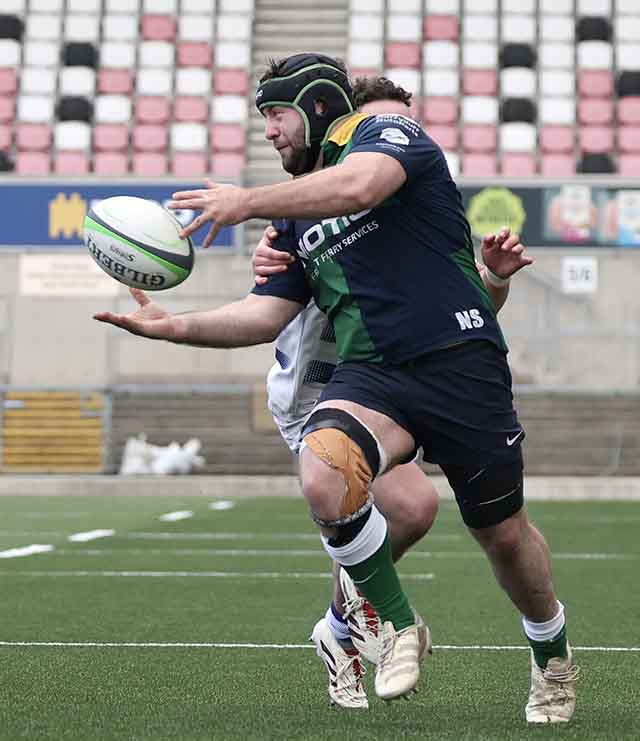
Claytan Milligan in acton receives a pass. He later went off with an ankle injury. Photo: John Dickson/DicksonDigital).
Hinch failed to finish the students off and were duly punished in the dying seconds when the students put their best passage of possession together, eventually creating a line break which breached the Ballynahinch defence and led to the winning score from close range a few phases later.
The final home game of the season is this Saturday March 28th versus Old Belvedere.
All support welcome.
Ballynahinch RFC Round-up For 21st March 2026
Club Notes
The second XV moved just won win from the league title with an eight try demolition of local rivals Banbridge.
The thirds continued their surge up the table with a ten try victory over Belfast Harlequins. Seven wins from their last eight fixtures sees them in third place with two games to play and they will hope to maintain that form ahead of the Crawford Plate final on April 25th.
The fourths and fifths remain in pole position to win their respective league sections ahead of their own Cup Finals at Affidea Stadium on 25th April.
The U18 boys continue to take the long road towards the U18 plate final with a semi final away to Inishowen this weekend their reward for a quarter final victory at Strabane.
Girls rugby continues to thrive with participation up and results beginning to follow. Ballynahinch hosted a brilliant U16/U14 7s event last week with local schools taking part.
The final AIL home fixture is against Old Belvedere on 28th March. To book your place at the pre-match lunch contact James Kirk on 07966143184.
Youth Training continues on Mondays at 7pm for boys and Wednesdays at 7pm for girls. All players U12/U14/U16/U18 welcome and no experience necessary. Contact Johnny Cullen for details on 07595651901.
Mini rugby continues on Saturday mornings from 9.30-11am. Boys and girls from P1 – Yr8 are all welcome, with training run for each age group in their school year.
Education Minister Paul Givan is under attack from local politicians for creating insecurity in Youth Service funding as he changes the method by which the service will be funded
• Mason questions Education Minister’s reasoning over youth service funding
• Galbraith raises concerns over long-term youth service funding uncertainty.
Education Minister Paul Givan is under attack from local South Down politicians who claim that his realignment of finances that were previously ringfenced for Youth Services will in the future now be subject to competition from other services under the Education budget.
Cathy Mason, Sinn Féin Education spokesperson, and SDLP Downpatrick Councillor Conor Galbraith have both attacked the Minister for creating uncertainty and insecurity within the Youth Service which provides a valuable pillar in youth development and building a healthy society in South Down and across Northern Ireland.
NI Education Minister Paul Givan is being questioned by local South Down politicians as to why he has they claim made the youth service less secure and certain.
Down News is awaiting a response from the Education Authority and will post it as soon as it arrives.
The response update: A Department of Education spokesperson said: “The Education Authority will continue to receive funding to deliver both schools and youth services. Moving to a composite block grant simply brings youth funding into line with other established education budget processes.
“This gives the EA the flexibility to make appropriate, evidence‑based decisions, while all spending remains subject to policy, legislation and Departmental oversight.”
***
Paul Givan’s ‘reckless’ changes to how youth services are funded must be stopped says Mason
Sinn Féin MLA Cathy Mason has called on the Education Minister to step back from the ‘reckless’ changes he has made to how funding for youth services is allocated. Previously, the Department of Education set aside a separate pot of funding for youth services, but this will now form part of the Education Authority’s wider budget.
The South Down MLA said: “Youth services like the Patrician in Downpatrick are invaluable to our children and young people, giving them a safe space away to build skills, confidence, and resilience.
Sinn Féin MLA Cathy Mason pictured outside the Patrician Youth Centre in Downpatrick.
“Despite this, Education Minister Paul Givan is pushing ahead with reckless changes that will heap even more pressure on already stretched organisations and workers.
“These will force vital youth services to compete with other Education Authority responsibilities, with no guarantee that the current level of funding will be maintained.
“As well as this, Paul Givan’s department has only provided community and voluntary groups with a guarantee of funding for the first four months of this financial year.
“Before serious harm is done, the minister must step back from this approach and begin treating our youth organisations with the respect they deserve.”
***
Galbraith Expresses His Concerns About The Future Of Youth Service Funding
SDLP Downpatrick Councillor Conor Galbraith who is a youth worker at the Patrician Youth Centre in Downpatrick has raised serious concerns about the Education Minister’s current approach to youth services funding, warning it could lead to further cuts and significant harm to young people and communities.
Downpatrick Councillor Connor Galbraith who works as a Community Youth Worker in Downpatrick is concerned at the Education Miniister’s decision to include the Youth Service in a competitive environment for finances.
Councillor Galbraith’s comments follow confirmation that funding for youth services has only been secured until June, with money no longer ring-fenced and at risk of being diverted elsewhere within the education budget.
The move has prompted concerns across the sector, particularly among voluntary organisations already dealing with years of sustained financial pressure.
SDLP Councillor Conor Galbraith said: “As someone who has worked in youth services for over 20 years, I have seen first-hand the growing impact of repeated cuts on the ground.
“The voluntary youth sector has been asked to do more with less for years, and it is now at breaking point.
“Here in Downpatrick, youth services play a vital role in supporting young people. They provide safe spaces, guidance and opportunities that many rely on every day.
“The approach being taken risks creating further uncertainty and could lead to a reduction in services at a time when they are needed most.
“It is young people in our community who will ultimately feel the consequences of these decisions.
“I will be writing to the Education Minister Paul Givan to outline the impact these cuts are having locally and to call for clarity and proper support to protect these vital services.”
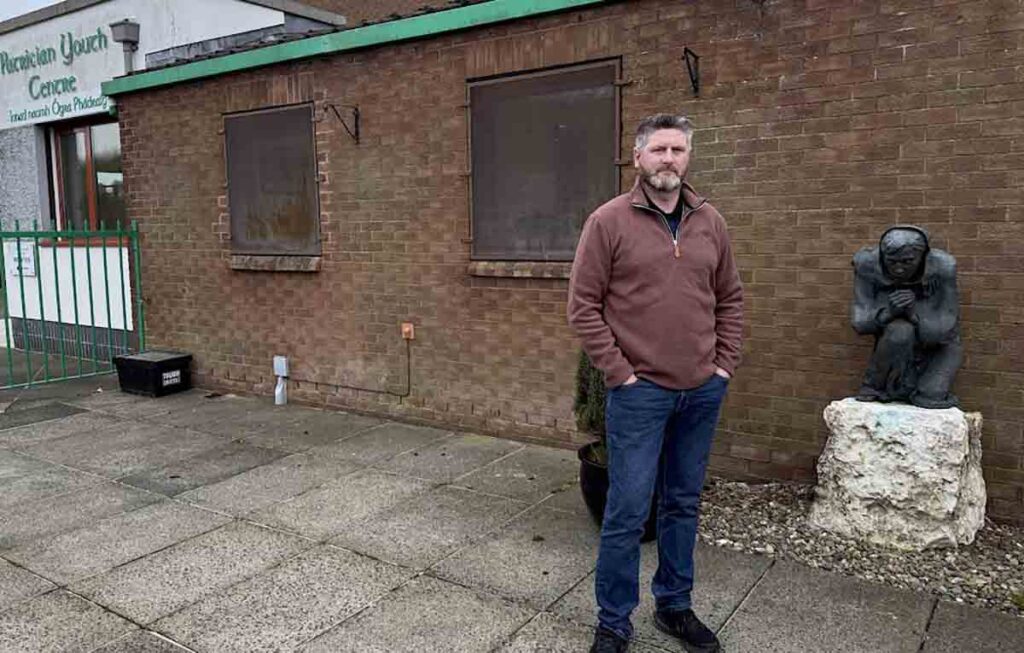
Downpatrick SDLP Councillor Conor Galbraith is a youth worker at the Patrician Youth Centre. He is pictured standing beside the statue of ‘young Patrick’. I wonder what St Patrick the adult would have done in the Minister’s shoes ?