NMD Council backs motion supporting re-opening of Tollymore National Outdoor Centreoutside Newcastle
Councillor Niall Lawlor (Sinn Féin) has welcomed the support received for a motion brought before NMD Council this month regarding the future of Tollymore National Outdoor Centre.
He said: “Since taking up my role as councillor for the Mournes DEA, the future of Tollymore National Outdoor Centre has been a key priority for me and the local Sinn Féin team.
“We have engaged with a range of stakeholders from across the outdoor recreation sector, as well as the local community, to ensure their voices are reflected in the ongoing review being undertaken by Sport NI.”
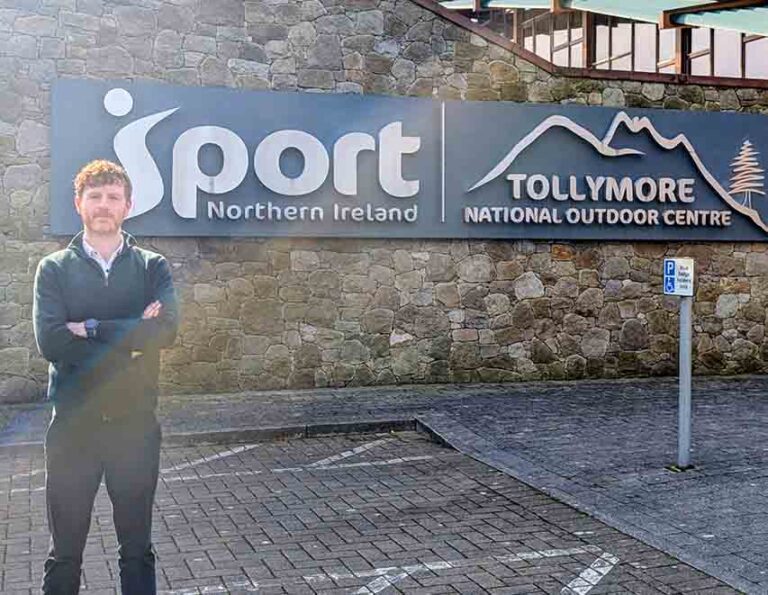
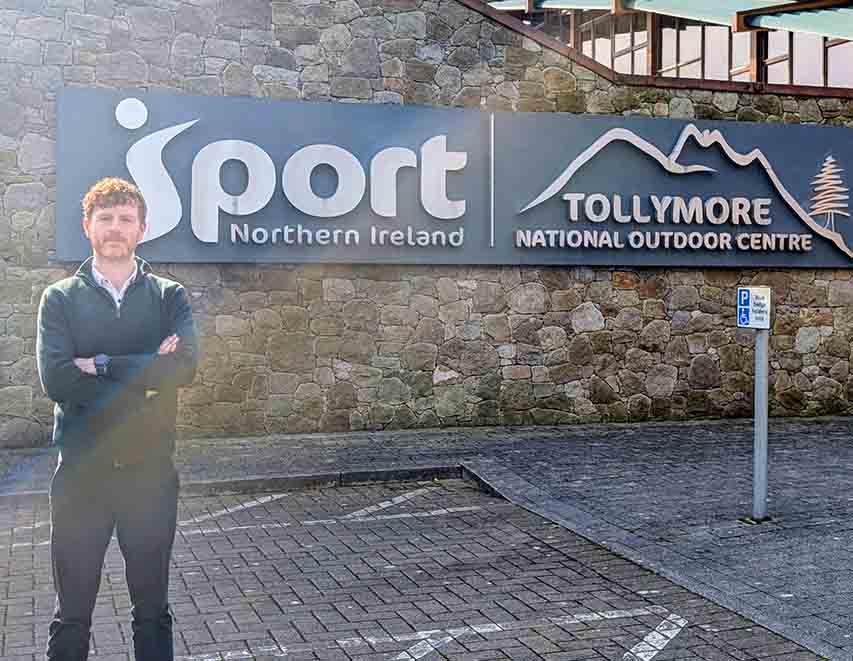
Cllr Niall Lawlor (Sinn Féin) is delighted at receiving support in the council chamber for his motion calling for the re-opening of the Tollymore National Outdoor Centre.
“This is a high-quality facility, and it is regrettable that it has remained closed for such a considerable period.
“At a time when we are seeing significant increases in visitor numbers to the Mourne Mountains, the role the centre plays in safety training and the development of mountain leadership is more important than ever and therefore, should not be assessed solely by profit margins.”
“We want to see the re-opening of Tollymore National Outdoor Centre at the earliest possible opportunity, alongside the development of a long-term, financially sustainable operating model which protects its core education and training services while also improving access for the local community.”
“It is also important that the findings of the on-going review, and any proposed operating models, are shared with Council to ensure alignment with local development and tourism strategies.”
“This centre has the potential to become a real hub for the local community and the wider outdoor recreation sector, and I will continue working to ensure it reaches that potential.”
The motion presented by Cllr Niall Lawlor:
At the Full Council Meeting (13 4 2026).
It reads: “This Council notes the ongoing review and current status of Tollymore National Outdoor Centre in Bryansford and recognises the significant concern within the local community and the wider outdoor recreation sector regarding its future.
“This Council recognises that Tollymore National Outdoor Centre is a world class facility in the heart of the Mournes, providing an essential public service in safety training and the development of mountain leadership.
“This service must be protected in the context of increasing visitor numbers to the Mournes, ensuring the safety of those using our natural environment.
“This Council resolves to write to the Chief Executive of Sport NI to reiterate its support for the reopening of Tollymore National Outdoor Centre at the earliest possible opportunity, alongside the development of a long-term, financially sustainable operating model which protects core education and training services while improving access for the local community.
“The Council will also request that the findings of the ongoing review, and any proposed operating models, are shared with the Council to ensure alignment with local development and tourism strategies.”
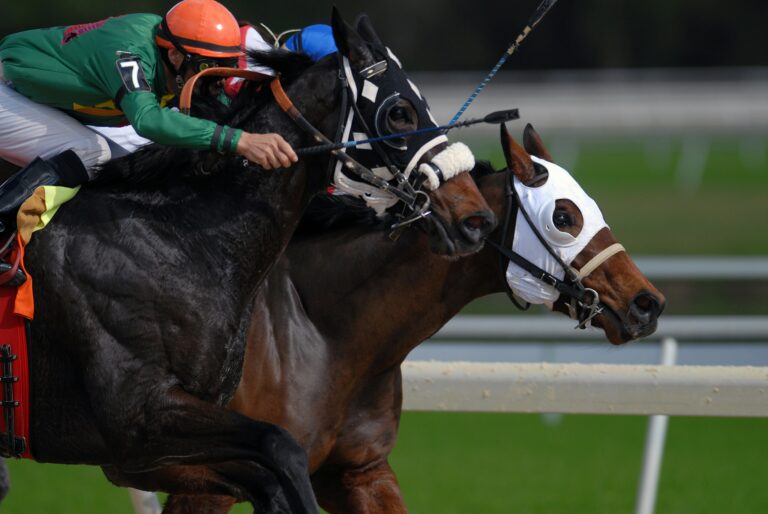
The 2026 Kentucky Derby is already generating anticipation among racing fans and bettors worldwide, with the iconic race set to take place on May 2 at Churchill Downs in Louisville, Kentucky.
Known as the Run for the Roses, the Derby is the first leg of the Triple Crown and one of the most closely followed horse racing events globally.
As the countdown begins, attention is turning to early contenders, shifting odds, and the emerging narratives that define this historic race. For bettors, understanding how the market evolves in the weeks leading up to Derby Day is just as important as knowing the horses themselves.
From early favorites to late surges, the Kentucky Derby consistently delivers a dynamic betting landscape shaped by performance, perception, and momentum.
Understanding How Kentucky Derby Odds Work
Kentucky Derby odds are shaped by a combination of expert analysis and market activity, creating a constantly evolving picture of each horse’s perceived chances. Early in the process, official morning-line odds are released by the track’s odds maker as a projection of how the betting market may open. These are projections based on form, pedigree, and recent performances. It’s important for those wagering on this race to realize that these aren’t fixed prices but rather a guide to how the market might open.
As betting activity increases, live odds begin to shift. Public money plays a significant role, with popular horses often shortening in price as more bettors back them. At the same time, news, recent performances, and bettor sentiment can influence how the market moves.
For bettors tracking the 2026 Kentucky Derby odds, it is important to recognize that these numbers reflect sentiment as much as statistics. Odds aren’t simply predictions; they’re indicators of confidence, momentum, and market perception, all of which can change rapidly as Derby Day approaches.
Early Favorites and What the Odds Reveal
Early favorites in the Kentucky Derby market often emerge from strong performances in prep races and consistent results across the season.
At this stage, horses such as Nearly and Paladin have been widely discussed as early standouts, attracting attention due to their form, pedigree, and high-profile connections. Their presence near the top of early markets reflects growing confidence from both analysts and bettors.
However, being an early favorite doesn’t guarantee success. The Derby is known for its unpredictability, and odds reflect perceived probability rather than certainty. Horses can rise or fall in the rankings depending on their performances leading up to the race, making the market highly fluid.
It is also important to note that the official Kentucky Derby field will only be confirmed closer to race day. This means early odds are based on potential entrants rather than a finalized lineup. For bettors, the key is to interpret what the market is signaling about each contender’s current standing while remaining aware that positions can shift significantly in the final weeks.
Key Runners to Watch This Season
Each Kentucky Derby season introduces a fresh wave of contenders, and 2026 is already highlighting several names gaining traction beyond the early favourites. Horses such as Commandment, Golden Tempo, and Desert Gate have attracted attention through strong prep race performances and steady progression across key events. Their ability to compete at a high level in competitive fields has positioned them as runners worth monitoring.
These contenders often stand out due to a blend of tactical speed, endurance, and experienced connections. Trainers with a proven record in major races, combined with jockeys familiar with Churchill Downs, can influence how these horses are viewed in the market. Consistency across prep races also signals readiness for the demands of the Derby distance.
Tracking how these runners develop, adapt to different conditions, and perform under pressure provides valuable insight into which contenders may strengthen their position as the race approaches.
What Bettors Should Watch Before Derby Day
In the weeks leading up to the Kentucky Derby, several factors can influence both performance expectations and market movements. Prep race results are among the most significant indicators, offering a direct measure of how contenders are progressing against top competition.
Track conditions also play a crucial role. Horses that perform well on different surfaces or in varying weather conditions may have an advantage, particularly given the unpredictable nature of race-day environments. Trainer decisions, including race scheduling and preparation strategies, can further shape a horse’s readiness.
Late odds movements often provide additional insight. Sudden shifts can reflect new information, changing perceptions, or increased bettor support. Monitoring these trends can help highlight which horses are gaining attention as the race draws nearer.
By focusing on these key signals, bettors can better understand how the Derby narrative is evolving in real time.
The Evolving 2026 Kentucky Derby Landscape
As the 2026 Kentucky Derby approaches, the evolving odds, emerging contenders, and shifting narratives continue to build anticipation for one of racing’s most iconic events.
The journey to Churchill Downs is shaped by performance, preparation, and market sentiment, all of which contribute to a dynamic and unpredictable landscape. For bettors, staying informed is essential. From understanding how odds are formed to tracking key runners, injury reports, and late developments, each element offers insight into how the race may unfold.
While the final field will only be confirmed closer to Derby Day, the groundwork laid in the weeks prior provides valuable context. With its rich history, global spotlight, and ever‑changing storylines, the Kentucky Derby remains a race where preparation, awareness, and timing can enhance the overall experience.
Content reflects information available as of 2026/03/19; subject to change.
Cllr Willie Clarke has welcomed the DfI decision to introduce Keep Clear signs at the Edgewater Apartments in Newcastle
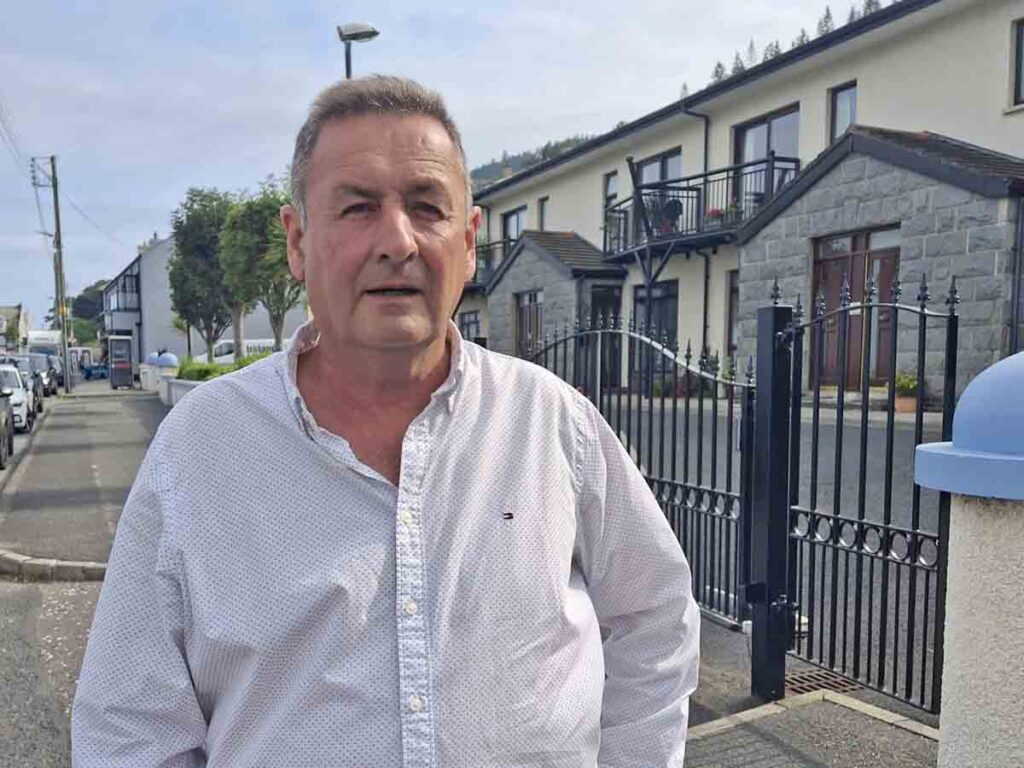
Sinn Féin Cllr Willie Clarke has welcomed confirmation from the Department for Infrastructure (DfI) Roads that “Keep Clear” road markings are to be introduced at the Edgewater Apartments development on South Promenade, Newcastle.
The move follows representations made by Cllr Clarke after several residents raised ongoing concerns regarding vehicles parking across the entrances and exits to the development, particularly at the central access point. Residents reported that parked vehicles were causing serious obstruction, at times preventing them from entering or leaving the site safely.
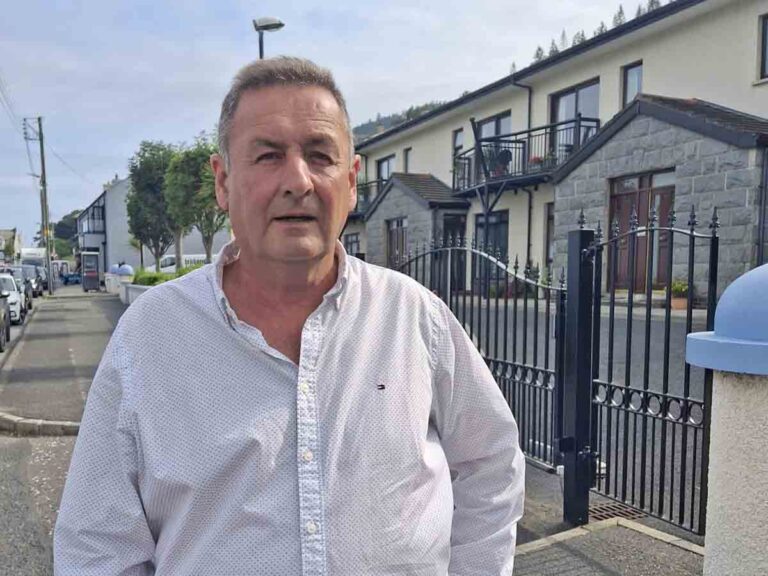
Cllr Willie Clarke has welcomed the DfI decision to instal ‘Keep Clear’ signs at the Edgewater Apartments in Newcastle so that residents have full access and are not blocked by parked cars.
Following Cllr Clarke’s correspondence and a subsequent site visit by DfI Roads officials, the Department has now confirmed that it agrees parking at the entrances is a significant issue and that the addition of “Keep Clear” markings would be beneficial. A works order has now been issued to the contractor for the markings to be installed.
Cllr Clarke said: “I am pleased that DfI Roads has listened to the concerns I raised on behalf of residents at Edgewater Apartments and has agreed to introduce these much needed ‘Keep Clear’ road markings.
“This is a positive step that will help improve access, ease frustration for residents, and most importantly enhance safety at this busy location.”
Cllr Clarke also confirmed that he is continuing to lobby DfI Roads for the installation of dropped kerbs at the same location to further improve accessibility for residents, pedestrians, visitors, wheelchair users, and those with mobility needs.
Cllr Aidan Mathers calls on Council to stopthe unauthorised use of off-road vehicles on Council-owned land
Cllr Aidan Mathers calls on Council to stop the unauthorised use of off-road vehicles such as scramblers and four-wheeled buggies on Council-owned land belonging to Newry Mourne and Down District Council.
Sinn Féin Councillor Aidan Mathers has brought a motion to Council to reduce the number of unauthorised motorised vehicles driving on Council open spaces.
There are many key aspects to this, the main one being public liability… what happens if there is an accident ? Who is responsible ? Who coughs up ? The ratepayers ? So the council decided to go ‘into committee’ to privately discuss the important issue of public concern to many parents, neighbours and members of the public.
These ‘offenders’ are often thrill-seeking younger children and teenagers who enjoy the excitement but they can also cause noise nuisance.
But is this actually achievable to block these ‘offenders’ from racing around on their bikes and buggies? A lot of council property isn’t fenced off such as big parks and beaches, and probably notices and signs in the small print of officialdom may carry little truck in some areas with young bikers and racers. But something clearly needs to be done to get the situation under public safety control.
The timely motion just in advance of the summer holidays was received from Councillor Mathers and read to the chamber (but the discussion was held in private).
“Cllr Mathers read his motion saying: “That this Council notes the ongoing and widespread community concern regarding the dangerous and unauthorised use of scramblers, quad bikes and other off road vehicles on Council owned land, open spaces, parks and public pathways; that our parks and public spaces are vital resources for the people of Newry Mourne and Down, and should be protected, enhanced and kept safe for people; the increased risk these vehicles pose to members of the public, including children, older people, dog walkers and other users of shared public spaces; the sometimes considerable damage caused to green spaces and sports pitches by repeated off road vehicle activity and the negative effect this has on biodiversity and our local environment; that existing legislation which restricts the use of mechanically propelled vehicles on land without the landowner’s permission.
“This Council will proactively engage with police and the community to enforce this policy; audit all parks that are currently being used by these vehicles to ensure that entrance and exit points are properly securedand access to these sites are safe and pedestrian friendly.
Wouldn’t it be great to be a fly on the wall ?
“Calls on the Council to develop and enforce an implementation plan in collaboration with the PSNI and local stakeholders, including:
“Regular joint operations and patrols in hotspot areas.
“Clear reporting pathways for the public.
“Use of signage and all other appropriate deterrent measures.”
Down News will post the Council decision once its available after their marathon meeting which started at 6.30pm and ran until 10pm. But in the absence of a decision, it’s quite possible that the matter will be referred back to council officers to create a report to feed to the councillors at a subsequent meeting (unless of course that has already been done!) which would have saved a lot of time!
Iran crisis causes a world-wide fuel panic – local reaction
• Dark Times Ahead: Down News Has Put Together What Various Government Ministers, Business and Community Representatives are Saying About The Impending Fuel Price Rises– will it blow over or blow up ?
This read may be much longer than what you are accustomed to. But given the gravity of the situation of escalating fuel prices, and shortages, it is necessary to try and analyse and understand what is going on in the world and nationally and regionally here in Northern Ireland.
Local Downpatric sectors, said: “I have watched the price of oil go by over £1 a litre and rising since the start of the Iran war. Oil prices globally have shot up and this impacts on business across the board.
“There is now also a shortage of kerosene needed to fuel planes and the cost of flying has gone through the roof.
“Asia seems to be buying up the available supply. Before the blockage of the Straits of Hormuz, a tanker with a load of kerosene was heading west when it was diverted to Asia as the price rocketed up on the stock market.
“Fuel is determined by a world market. North Sea oil doesn’t affect the price much. There is a new price set each day such is the volatility of the fuel markets.
“There is a growing shortage of diesel and that will certainly affect farmers and the fishing industry in County Down directly.
“We are doing our best to keep prices as low as possible as this crisis unfolds.”
40% of the world’s heating oil comes from Qatar, and the United States refines around 20-22% of the world’s crude oil which provides diesel, kerosene etc.
Strangford Fuels recently acquired Milligan Oil based in Ardglass following the retirement of Clem Milligan.
Urgent action needed by PM on fuel and energy costs say First Minister and deputy First Minister
First Minister Michelle O’Neill and deputy First Minister Emma Little-Pengelly have written to the Prime Minister urging him to take immediate action in response to the escalating impact of rising fuel and energy costs on households and businesses here.
First Minister Michelle O’Neill and deputy First Minister Emma Little-Pengelly said jointly: “We are deeply concerned about the escalating pressures facing families, workers and businesses as fuel and energy costs continue to rise.
“The cost of fuel is putting significant pressure on, with increases not sustainable. These pressures are being felt in family homes here and beyond.
“Alongside rising fuel costs and escalating energy bills, there is also an impact on businesses.
Our hauliers, our farmers, and small and medium-sized enterprises are facing sharply increased operating costs too and these costs are inevitably being passed on further, deepening the cost-of-living crisis.
“Families and businesses cannot continue to absorb these sustained increases without intervention which is why we are calling on the Prime Minister to bring forward a package of measures to support those under pressure.
“This package should include a reduction in fuel duty to ease pressure on both households and businesses, targeted support for hauliers, farmers and SMEs and a comprehensive cost of living support package.
“Given the scale and immediacy of this crisis, we have asked the Prime Minister to act decisively and without delay.”
***
Rising Demand for Heating Oil Support Highlights Urgent Need for ActionSays SVP
Calls to The Society of St Vincent de Paul for help with heating oil costs have more than doubled on the number received in March last year, underscoring the growing financial pressure on households and the urgent need for increased support.
New figures revealed by SVP show that requests for assistance to its Regional Office in Belfast rose by 126.5% in March 2026 compared to the same month last year.
This sharp increase reflects the deepening cost-of-living challenges faced by families and individuals living in poverty and, in particular due to the rise in the cost of home heating oil, as almost two-thirds of homes (62.5%) in Northern Ireland using oil for heating, the highest proportion of UK nations.
Mary Waide, SVP National Vice President, said: “The rise in calls to our Regional Office in Belfast for people who cannot afford to put oil in the tank is absolutely shocking and these figures only capture the people who are brave enough or willing to lift the phone. I’m sure there are many more who need help but just don’t know how to request it or are too afraid to ask.
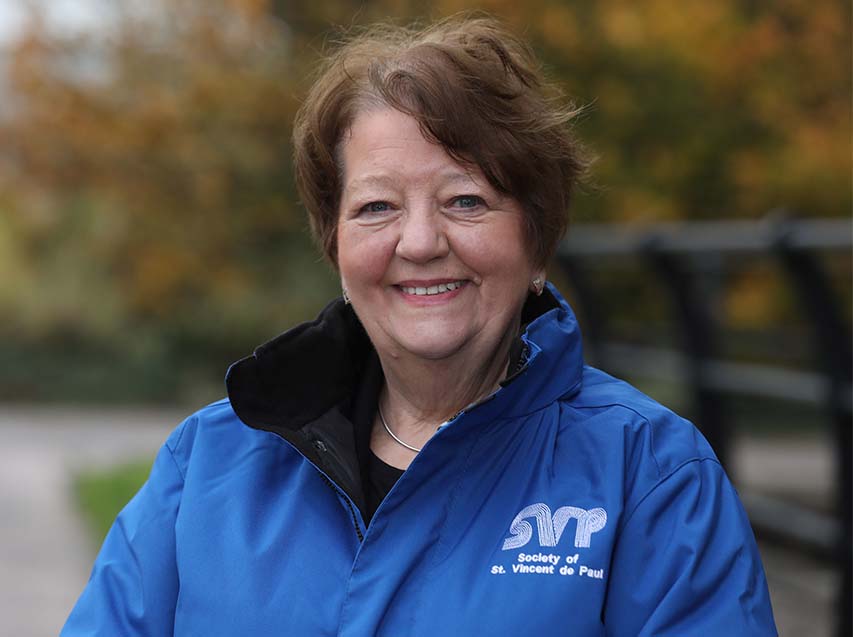
Mary Waide, Regional President, St Vincent de Paul: concerned.
“Even with the brighter evenings, it is still bitterly cold and for people we are visiting, who are sitting in a cold and often damp home, there is little to no feeling of the arrival of spring. While SVP volunteers are out in our local areas doing all we can to provide much needed assistance, the reality is that demand is far outpacing the limited resources we have available. Without additional support, many households will continue to struggle to heat their homes.”
Last year alone, £5.5 million in support was distributed by the Society, made possible entirely through generous public donations.
However, with demand rising so significantly, there is growing concern that current levels of funding will not be enough to meet need in the months ahead.
The charity is now calling for increased donations to expand its reach and ensure more families can access vital support. At the same time, there is a clear call for greater statutory intervention to address the systemic challenges driving fuel poverty.
“We would urge anyone who needs help to contact us and with increased donations we can extend our support further and reach more people in crisis,” said Mary.
“But charitable efforts alone are not enough, government needs to take a holistic and urgent approach to tackling poverty by recognising that households are being hit simultaneously by rising fuel, energy and food costs.
“We need structured, long-term solutions, and greater statutory support, to address the dire and ever-increasing cost burdens being placed upon families and individuals.”
Mary added: “As energy costs remain volatile and financial pressures continue, the message is plain and simple – without urgent action and increased resources, many vulnerable households in communities right across the Region risk being left in the cold.”
UFU writes to Prime Minister warning of impact of rising costs on food production
The Ulster Farmers’ Union (UFU) has written to the Prime Minister and Secretary of State for Northern Ireland, highlighting serious concerns about increasing volatility in agricultural input costs and the potential impact on food production.
Representing approximately 12,000 farm families across Northern Ireland, the UFU has warned that ongoing geopolitical tensions in the Middle East are creating significant uncertainty for the sector, particularly in relation to fertiliser, fuel and energy prices.
UFU President William Irvine said recent global events have once again exposed the vulnerability of food production systems to external shocks.
“Farmers have already experienced the impact of global instability following the war in Ukraine, where sharp increases in fertiliser and energy prices placed enormous pressure on farm businesses,” said Mr Irvine.
The UFU has emphasised that Northern Ireland agriculture is particularly exposed due to its reliance on imported inputs. Fertiliser and fuel represent a significant proportion of on-farm costs across all sectors, including the arable industry, which is especially vulnerable to fluctuations in input prices.
“For our arable farmers, fertiliser and fuel are fundamental to crop production,” Mr Irvine said. “Any sharp increase in costs has an immediate and direct impact on margins, at a time when many in the sector are already under significant financial pressure.”
UFU President William Irvine says the UK government must step up to the plate and deliver solutions for the fuel crisis.
The Union highlighted that many farming sectors, including beef, dairy and cereals, are currently experiencing a financial squeeze, with rising costs continuing to outpace returns. “Across the board, farm businesses are dealing with tight margins and ongoing uncertainty,” Mr Irvine added.
“The prospect of further increases in input costs will only add to that pressure, making it even more challenging to maintain viable and sustainable food production.”
The Union also highlighted the knock-on effects of rising energy costs across the wider supply chain, including processing, transport and distribution. “These pressures do not stop at the farm gate,” Mr Irvine added. “Higher energy costs will inevitably feed through the entire supply chain, contributing to increased food prices and placing further strain on consumers.”
The UFU warned that many farm businesses are already operating on tight margins while managing ongoing policy changes, environmental requirements and market uncertainty.
Further increases in input costs, outside of farmers’ control, could have serious implications for farm viability and the resilience of the local food system.
Concerns have also been raised about the lack of transparency in fertiliser and fuel markets, with farmers often forced to make purchasing decisions without clear or timely pricing information.
“This lack of transparency makes it extremely difficult for farmers to plan and manage their businesses effectively,” Mr Irvine said. “It adds unnecessary risk at a time when confidence is already under pressure.”
In response, the UFU has called on the UK Government to take coordinated and proactive action, including improving market transparency, strengthening supply chain oversight and recognising fertiliser and energy as strategically critical inputs for food production.
The Union has also urged greater clarity on future policy developments, including the Carbon Border Adjustment Mechanism (CBAM), and called for close engagement with the Northern Ireland Executive and DAERA to ensure local farming systems are fully considered.
“Food security is national security,” Mr Irvine said. “A sustainable and profitable farming sector is essential not only for producing high-quality food, but also for supporting rural communities and delivering environmental outcomes.
“Farmers are committed to playing their part, but they cannot continue to absorb escalating costs and increasing levels of risk without the right support and clear direction from government.”
The UFU has requested direct engagement with government to discuss both the immediate challenges facing the sector and the longer-term actions needed to strengthen the resilience of agriculture in Northern Ireland.
***
British government must offer more support for fuel crisis says Hughes
Sinn Féin MP Dáire Hughes has said the British government must do more to help those affected by the rising fuel crisis.
The Newry and Armagh MP was commenting as Sinn Féin MPs supported a letter to the British Prime Minister which outlines a call for temporary immediate reduction in costs of fuel here in the North.
Newry and Armagh Sinn Féin MP Dáire Hughes is concerned at the growing fuel crisis/
Mr Hughes said: “The British Prime Minister must step up and deliver urgent, meaningful support to tackle soaring energy costs driven by Israeli – US attacks on Iran.
“Families, households, and businesses across the north are under severe and growing pressure.
“While the British government can find billions for weapons and warfare, workers and families here are being left behind to shoulder the burden of rising costs alone. That is unacceptable.
“We need a strong, united voice from across all parties to demand immediate intervention.
“Sinn Féin MPs have joined with other MPs from the North to press this case, calling for decisive action to cut fuel prices to ease the strain on our communities.”
***
Ulster Unionist Party responds to Planned fuel protests across Northern Ireland
The Ulster Unionist Party acknowledges the growing public and business frustration over soaring fuel and fertiliser costs across Northern Ireland. While recognising the right to protest, as a Party we would stress that demonstrations must remain lawful, protect access to the road network, and never hinder emergency services.
A Party spokesperson said: “The Ulster Unionist Party fully understands the frustrations being felt by everyone and businesses across Northern Ireland who are being hammered by sky high fuel costs.
“We also recognise the serious pressures facing our farmers, who are dealing with mounting fertiliser costs that will inevitably have knock on effects on food prices for everyone.
Ulster Unionist Party calls for action on fuel crisis.
“Everyone has a legitimate right to protest, but it is a qualified right. Any protest must be lawful, must respect other people’s right to use the road network, to go about their daily lives and to run their livelihoods. Most importantly, protests must not impede the vital work of our emergency services.
“The Ulster Unionist Party will continue to call on the UK Government to implement a realistic, long-term plan for a substantial cut in fuel duty and to do so immediately.
“Working families, businesses and our farming community need support. These are the people being punished simply for going out to work and keeping our economy moving. Freezing or reversing duty increases is no longer enough; the Government needs bold action now.”
***
Fishing Industry Is On Its Knees says Ardglass Fisherman
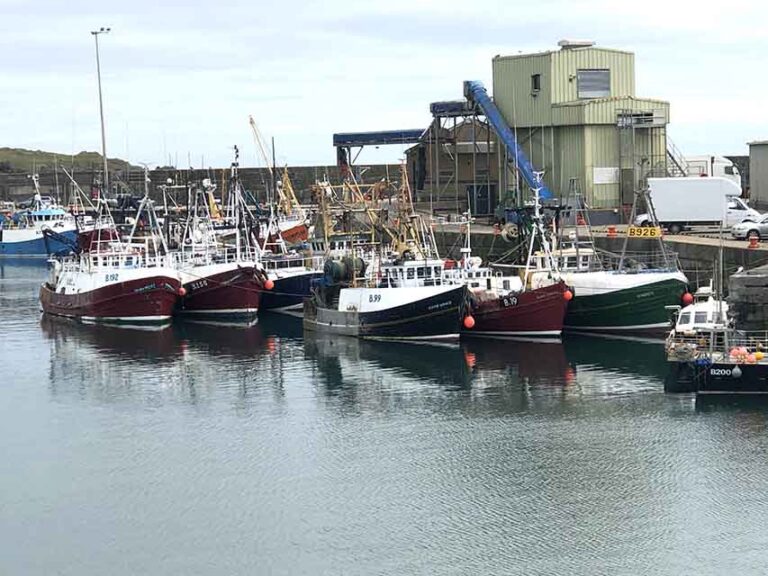
An Ardglass skipper said that the fishing industry across County Down is on its knees because of the huge hike in diesel fuel prices.
He added: This time last year it cost the boat £3500 a week or so to fill our tank now it costs £7500. It’s just insane.
“My boat burns up around £1500 a day on diesel and it has just become unsustainable to fish. I need to land 50 stone of prawns a day to pay for the rise in prices before I make a penny.
Will the boats in the County Down fishing ports of Ardglass, Kilkeel and Portavogie. be tied up soon ?
“It’s a perfect storm for the fishing industry. Fuel prices have shot up; prawn prices have gone down; the contract coast for foreign crews has gone up; general costs in maintaining the boat have shot up. It’s just become unviable.
“When September arrives and the prawn season ends, it will be hard to catch £1500 worth of landing a day between bad weather and catch drop off.
“There are smaller vessels than mine. But every skipper and boat opwner in the fleet is hurting at the moment and the government seems to have forgotten that we exist.
“And there is little we can do to diversify as we are constrained by quotas and licences.
“Our industry is important as we provide food from a national security perspective, and if the fishing and farming industries collapse then we do have a serious problem.
“The government needs to back us up in some way. We are now at the point of total unsustainability. For many of us fishing is in our blood and we’ll fish to the last… and that may sooner than later.”
***
Eastwood challenges UK Government to do more on energy crisis
Alliance MP Sorcha Eastwood has called on her fellow MPs to join together to send a message to the UK Government that it needs to do more to help people here through the energy crisis.
The Lagan Valley MP has asked other Northern Ireland MPs to co-sign a letter which makes several asks of the Government.
They include a reduction in fuel duty as well as scrapping the proposed increase in it, consideration of removal of VAT from home heating oil, and increasing windfall taxes on energy companies.
Sorcha – who has also written to the Prime Minister alongside her Party Leader Naomi Long MLA – said such moves would help ease the pressures many households are under, given the specific circumstances of Northern Ireland.
She added: “The ongoing conflict in the Middle East is having an impact throughout the world, with people here facing rising energy and fuel costs making life unbearable for many people and businesses,” said Ms Eastwood.
“Northern Ireland has been particularly exposed, given our reliance on home heating oil, high rates of fuel poverty and poor public transport links. It’s sadly not surprising we have seen fuel prices rise faster here than most of Europe.
“Therefore urgent action needs to be taken by the UK Government to ease that pressure. The proposed help discussed thus far is far from adequate and is forcing many to choose between heating their home or other essentials.
“We need to see an immediate reduction in fuel duty and ultimately scrapping of its proposed increase. We also need to give consideration of removing VAT from home heating oil, agricultural diesel and general commercial use.
“This can all be partially funded by increasing windfall taxes on energy companies, given the recent increase in share prices in recent weeks. The war windfall they are receiving would be morally and economically repugnant if left unchecked.
“It is vital we speak with a united voice on this matter and that’s why I’ve asked my fellow local MPs to sign this letter, so we can push the UK Government to provide whatever assistance they can, for the benefit of all our constituents.”
***
Farmers For Action Considering Options For Joining UK-wide Fuel Protest
Farmers For Action consideringUK-wide Tax and Fuel Protest
As concerns deepens across the UK, farmers in Northern Ireland just have to look across the border in the ROI to see the mayhem that the fuel crisis has caused.
William Taylor, Farmers For Action co-ordinator said: “Farmers For Action are privileged to be asked by farm organisations across the UK and accompanied by support from organisations across these islands to consider a UK-wide TAX AND FUEL PROTEST.
“Currently we are agreed to wait and watch over the coming days with reference to fuel prices and Governments reactions to the plight that family farmers, SME’s, the haulage industry and the UK’s work force finds themselves in.
“There is huge concern that current policies are failing to address the pressures facing key sectors of the UK economy.
“It should be noted that Farmers For Action was born out of the fuel strike of 2000, where the UK was brought to a standstill for five days until Government listened – a lot was learnt. Today AGAIN this is a big problem – and Government is not acting in the interests of their people!
Popular wood near Crossgar closes for Spring spruce up
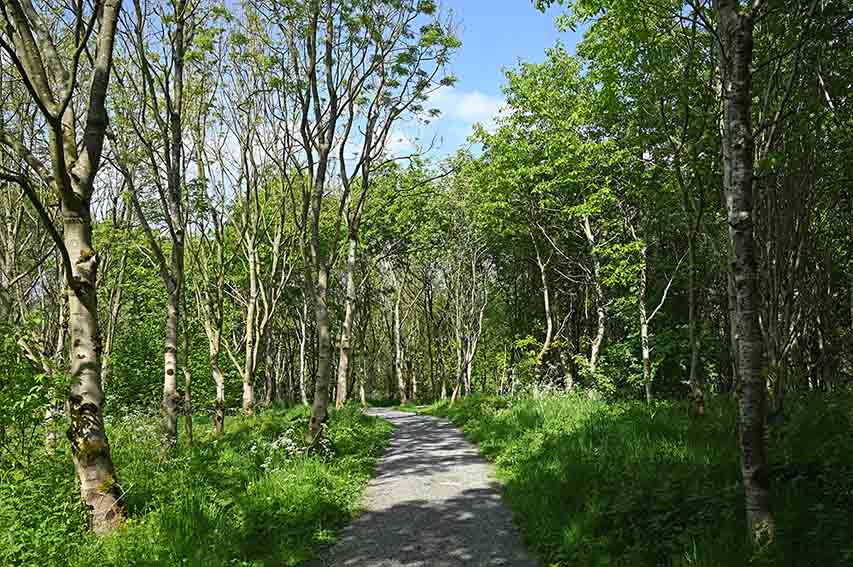
Glasswater Wood near Crossgar, will close this spring for four weeks to receive a spruce up of its car park and walking trails.
The popular County Down spot will close from Monday 27th April and reopen Tuesday 26 May.
During this time there will be no public access to the car park or the woodland as improvements are made to the car park surface and the trails.
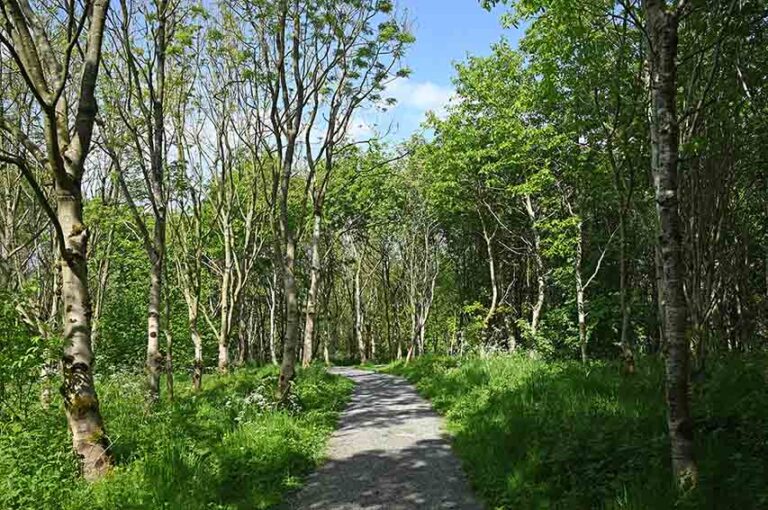
Glasswater Wood near Crossgar will be closed for a spruce up. (Photo: Michael Cooper Photography/WTML).
Woodland Trust Northern Ireland’s Estate and Projects Manager Dave Scott commented: “We are delighted that Glasswater Wood is so popular with local visitors especially dog walkers, but this brings its own issues for us as a charity.
“With over 100,000 visitors each year, this inevitably leads to degradation of the car park and trails which we must fix.
“Unfortunately, some visitors have also created a significant dog fouling problem within the wood, and we hope this temporary closure will give the woodland a chance to recover from this while we improve the car park and trail infrastructure.
“We’d like to remind all our visitors to pick up after their dogs when visiting Glasswater Wood… we pay for a dog bin for this purpose at the entrance.”
Glasswater Wood has over 5 hectares of beautiful native woodland and was upgraded in 2022 by the Woodland Trust Northern Ireland with provision of a new car park and an upgrade of the walking trails.
All about bumblebees and why they matter talk at Glebe House
Tucked away in a wooded glade just off the road that leads into the small village of Kilclief, lies Glebe House which has been very much involved in community harmony and renewal over the decades.
And it continues to redefine itself to address the needs of the local area and indeed farther afield providing community education and a place for social interaction.
The speaker for the evening in the Spiring Talks Series, Geoff Newell, gave a talk at Glebe House last week to a group in very interested participants. He is very much involved in conservation having worked in this area for 9 years and in trying to improve biodiversity with a range of organisations including conservation charities, ecological consultancies, a community organic farm and a Council biodiversity department.
Geoff holds a Masters in Ecological Management and Conservation Biology from QUB, Belfast, and has a postgraduate certificate in Clinical Education along with being an Associate member of CIEEM.
As an active citizen scientist, he has covered a lot of ground. such as participating in the Irish Bumblebee Monitoring Scheme and BTO bird breeding surveys and received a Gold Badge for being a Pollinator Champion for the All Ireland Pollinator Plan.
And to add to this list of activities, Geoff is a volunteer carer and trainer with the NI Bat Group. He has undertaken training in Bat Sonogram analysis with the Bat Conversation Trust, Outdoor First Aid, Pesticide Training, and has an ONN level 3 from SERC. So all in all, he is eminently qualified.
The attendees were in for a very interesting talk on bumblebees, and bees generally, but not focussed on bee management but looking more at the species aspects of this and their different characteristics.
Geoff explained that there were around 100 different species of bees in Ireland and 21 are classified as bumblebees. “They are part of the Hymenoptera order having evolved from wasps. In fact some of those bees may well be extinct now.
He said: “There are many factors affecting the resilience of bees such as climate changes, habitat, availability of food eg no late hay silage, , soil degradation, pesticides and insecticides, and bee diseases. One key factor is the loss of nature corridors. Many gardens now don’t grow plants that are bee-friendly.
“Even a small garden area, or a window box can be an oasis for bees. Bees love herbs, mugwort, alium, etc. but in late summer, they are attracted to honeysuckle, clovers, cornflowers, and campanula etc. flowering hedges such as escalonia are good too for bees and for their nesting.
“So avoid flowers, such as petunias, busy-lizzies, double headed begonias, and double-flowered plants, and use peat free compost. It’s good to create an unused strip to allow tufts of clover etc to grow in it.
And just to think that for the EU the economic value of bees is worth around £14 billion a year. Bees brush against the pollen and help fertilised the female parts of plants.
“The worker bees which are bred first gather pollen and mix it with nectar and attach it to their legs and go back and feed this you the young bees. In some parts of the world, there are very week pollinator stocks and people are paid to pollinate plants such as in China.
“I late spring, the queen bee emerges to form a new colony and lays her eggs eg in a mouse hole, and the first generation of workers take over the foraging for pollen. At the end of the year, the queen stops production of workers and then dies. But the bees tend to hibernate underground over the winter. In 2003, there was a newcomer called the tree bumblebee which arrived in the UK.
Geoff then discussed the different types of bumblebee such as the buff tails, white tails, the early bumblebee, the garden bumblebee, the common carder, and red tails.
He said that honey bees were smaller and could exist in colonies of up to 100,000 bees. And there were also solitary bees too called, miners, leaf cutters, masons and cuckoos.
Geoff added: “If you are really interested in bees, you could join the British Bee Conservation Trust and learn all about good practice in looking after bees.”
Glentoran Insider Breaks Silence On 25 Years Of Turmoil In New Book about Glentoran FC
A former Glentoran director has revealed how the club came close to financial collapse, operated week to week and missed opportunities worth millions in a new insider account covering more than two decades at the heart of the East Belfast side.
Nearly…Glentoran in the 21st Century, written by Ian Clarke, draws on his time as both a director and head of media at the club to document the reality behind one of the most challenging periods in its modern history.
The book details how decisions taken in boardrooms, often under pressure and with limited resources, shaped the trajectory of a club still expected to compete at the top level.
In the book, published by Excalibur Press, he sets out a picture of a club dealing with sustained instability, where long-term planning was frequently overtaken by immediate financial concerns. At times, he describes an organisation forced into short-term thinking simply to remain operational.
Author Ian Clarke with his book Nearly
Nearly outlines how these pressures affected every part of the club, from recruitment and contracts to infrastructure and long-term strategy. However, Clarke points out a prolonged period of underperformance can’t be attributed solely to results on the pitch, pointing instead to deeper structural and financial challenges.
He said: “When a ‘big’ club like Glentoran is unsuccessful over such a prolonged period it is clearly down to more than the performance of managers and players.”
Among the most significant moments explored in Nearly is a missed stadium development opportunity that could have transformed the club’s financial position. Plans for a new ground in East Belfast, which would have secured long-term stability and modern facilities, ultimately failed to materialise, leaving the club to continue operating within existing constraints.
The book also reveals how close the club came to a different future, with proposals involving council-owned land and major redevelopment plans that had the potential to reshape both the club and its wider community presence.
Instead, those plans fell away, contributing to ongoing financial and operational pressures. Clarke also recounts a series of incidents that exposed the fragility of the club’s position, including administrative errors and governance challenges that had immediate consequences on and off the pitch.
Nearly, published by Excalibur Press.
In one instance, he describes how a mistake regarding player eligibility led to the club’s removal from a cup competition at a time when success appeared within reach.
“We walked off the pitch that day against Newry in joint first place with Linfield and in the semi-final of an Irish Cup, a potential double. Then immediately after the game a club official comes into the manager’s office and tells me ‘I think Joe Crowe might be ineligible.’ You can imagine the sick feeling that overcame me and the staff.”
The fallout from that incident is presented as one example of how quickly circumstances could change, with decisions and errors carrying significant sporting and financial consequences.
Elsewhere, Nearly details the wider financial context in which the club was operating, including debt levels, cash flow challenges and reliance on short-term funding solutions.
Clarke describes a period in which maintaining day-to-day operations often required external support, loans and continuous negotiation.
It also captures the internal pressures faced by those running the club, with committee members dealing with mounting financial obligations while attempting to preserve the club’s long-term future. Despite these challenges, Clarke highlights periods of resilience and achievement, including cup success and competitive performances achieved under difficult conditions.
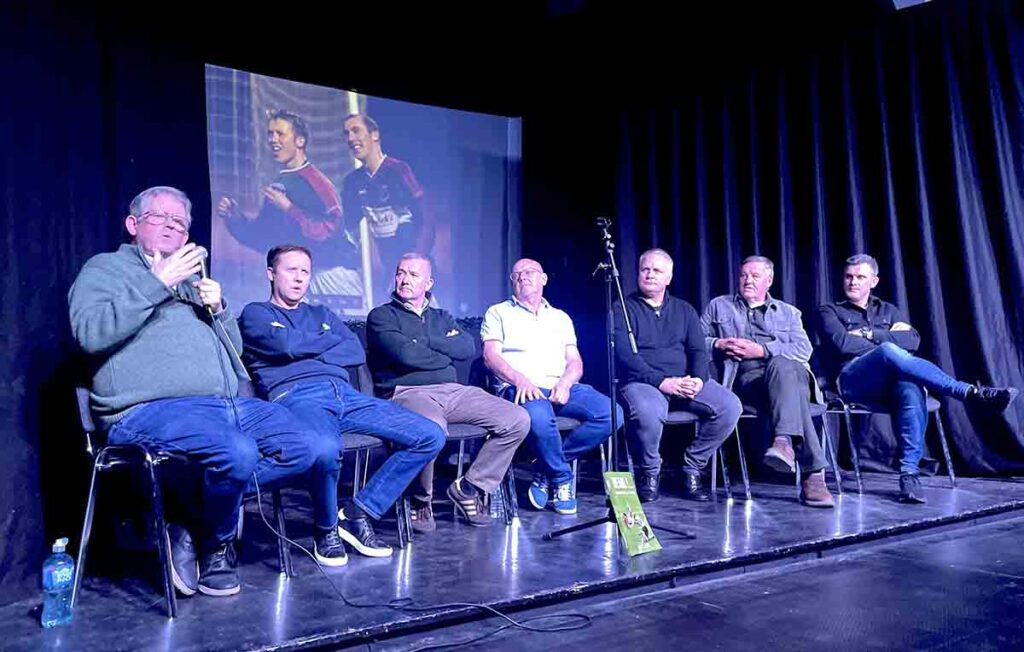
Author of Nearly, Ian Clarke hosts a panel at his book launch with Scott Young, Eddie Patterson, George Neill, Colin Nixon, Grahame Jenkins, Elliott Morris who were all interviewed for the book.
Moments framed as evidence of what the club was capable of, even while operating within significant constraints.
He added: “The simple fact was that the only thing that could turn around Glentoran’s fortunes was money. Quite a lot of money. An amount of money way beyond what anyone currently involved in the club could ever hope to muster. Someone else’s money.”
The 2019 takeover by Welsh-Iranian businessman Ali Pour brought investment, full-time football and European competition. But six years on, with the league title last won in 2009 still seemingly beyond the club’s reach, Clarke’s assessment of the Pour era in the book is measured rather than celebratory, with the book including a candid interview with Ali Pour and the other major figures behind the takeover.
He added: “The simple fact was that the only thing that could turn around Glentoran’s fortunes was money. Quite a lot of money. An amount of money way beyond what anyone currently involved in the club could ever hope to muster. Someone else’s money.”
A consistent theme throughout the book is the role of supporters, whose loyalty is presented as central to the club’s survival during its most difficult periods. Clarke reflects on the level of public interest surrounding the club, noting its continued prominence within the local media landscape regardless of performance.
Clarke said: “Glentoran, good or bad, command a level of interest matched only by Linfield. No other club comes close.” The book also places Glentoran’s story within the wider context of East Belfast, highlighting the connection between the club and its community suggesting the club’s fortunes have long been intertwined with the area it represents, with both experiencing periods of change and challenge.
“Nearly is a frank and honest detailed account of a period often viewed through headlines and speculation rather than direct experience. Drawing on internal discussions, first-hand involvement and access to the decision-making processes, Clarke provides an account of how close the club came to both success and crisis.
“Readers will have the opportunity to hear from chairmen, directors, managers and players, among them Ali Pour, record appearance holder Colin Nixon and managers including Eddie Patterson and Mick McDermott, some of whom have never spoken about the club’s difficulties publicly before.”
Meanwhile, Clarke, who spent his professional career in senior and board-level roles at major newspapers across Northern Ireland, England and Scotland, is clear about who the book is written for.
“Throughout the downs of the past 15 years the broad Glentoran support has shown a loyalty and commitment to its club that the club has not always deserved. This is their story and this book is for them,” he said.
“Nearly: Glentoran in the 21st Century” by Ian Clarke is published by Excalibur Press, priced at £20 and available now from:
Mathison Highlights Strangford Issues at On-Site Meeting with DfI
Alliance MLA Nick Mathison has welcomed constructive engagement between local residents and the Department for Infrastructure (DfI) following a site visit in Strangford Village.
Mr Mathison facilitated a walkabout in the village alongside members of the local Residents’ Association and the DfI section manager, providing an opportunity to highlight a range of ongoing concerns directly on the ground.
Issues raised during the visit included road and footpath defects requiring repair, pressures around car parking, and the need for improvements to streetlighting.
Alliance Strangford constituency MLA Nick Mathison has welcomed engagement between the DFI and local residents on issues around the village.
Speaking after the visit, he said: “It is always a pleasure to get down to Strangford Village and to work closely with residents on the issues that matter most to them.
“I was delighted to facilitate this walkaround with the Residents’ Association and DfI, which provided a valuable opportunity to highlight concerns directly with officials.
“A number of issues were raised, including defects for repair, car parking challenges, and streetlighting.
“The Department has taken these matters away for consideration, and I am hopeful that this engagement will now lead to tangible works being progressed.
“I will continue to follow up with DfI to ensure that the concerns raised are addressed and that residents see real improvements in the area.”
Mr Mathison added that ongoing collaboration between residents, elected representatives and statutory agencies remains key to ensuring that local infrastructure is maintained and enhanced in line with community needs.
Portaferry RNLI receives £1000 donation from Ballygalget GAC
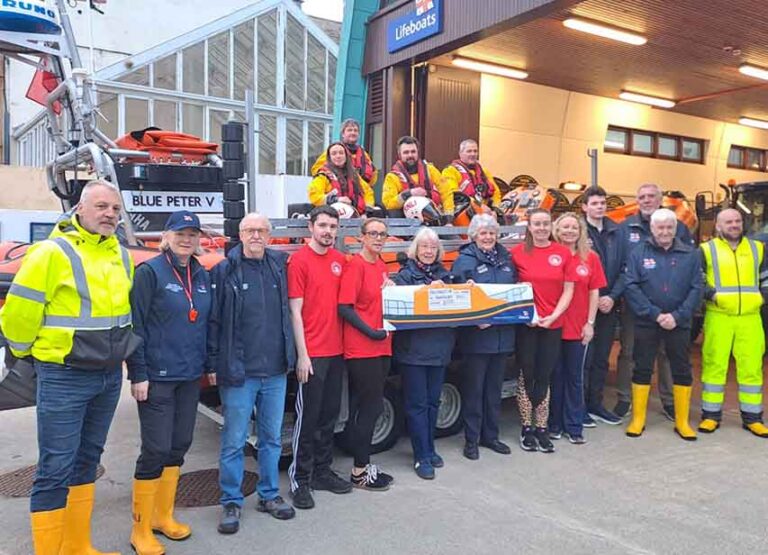
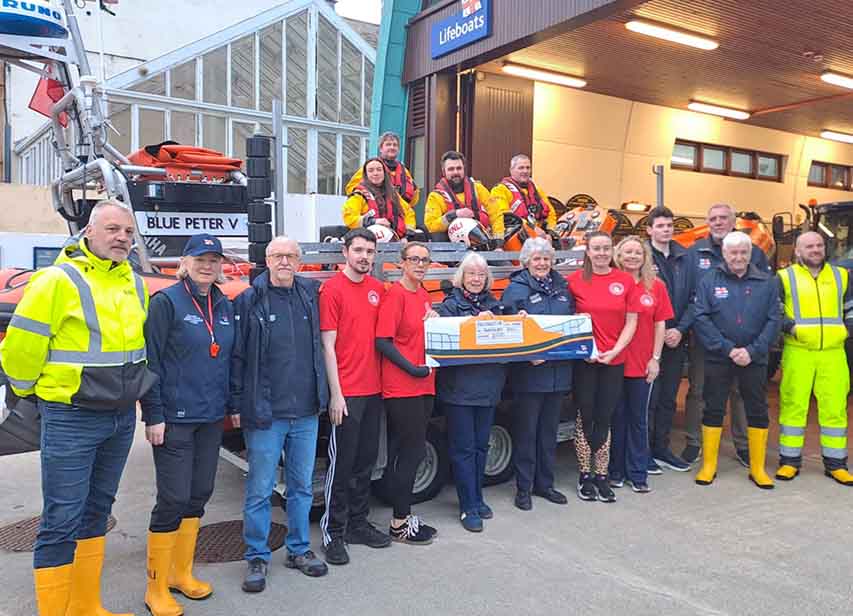
Portaferry RNLI volunteers recently welcomed representatives from Ballygalget Gaelic Athletic Club (GAC) to the station where a donation of £1000 was handed over to the RNLI.
The money was raised during a cold water dip which took place at nearby Cloughey Beach during the club’s Ballygalget’s Better Lifestyle (BBL) initiative.
The initiative encourages club members and the local community to improve their lifestyle by taking up various fitness challenges over a number of weeks. One such challenge was their well organised fundraising charity dip.
Portaferry RNLI volunteers receiving a £1000 donation from representatives of Ballygalget GAC. Pictured in red, Ballygalget GAC representatives (l-r) Ciaran Rotherhan, Debbie Rotherhan, Orlaith Dynes and Shauneen O’Neill.
Patricia Browne, chairperson of Portaferry fundraising guild, was present at the station to receive the donation and said: “We wish to thank the committee and members of Ballygalget GAC for this incredible donation.
“Congratulations to everyone who took up the BBL challenges especially those who went into the water to raise this money.”
Portaferry RNLI Water Safety Officer John McAleese who visited the club and delivered a talk on how to stay safe in and around the water during the club’s BBL initiative, said: “This is the second water safety talk Ballygalget GAC have organised, both have been well supported.
“It was great to see the club encouraging not only their members but also the local community to attend the water safety talk and help raise awareness of the simple steps needed to enjoy the water safely.
“I attended the swim but just watched from the shore. It was a great event for everyone in the community, and I thank the members of Ballygalget GAC for organising it and inviting me along.”