
Changes To Ambulance ED Handovers On Way

NIAS ambulances will leave patients after 2 hours in care of the EDs to free up cover for 999 calls

The Northern Ireland Ambulance Service (NIAS)s drawing a line at 2 hours to activate patient handovers at Emergency Departments across the hospital trusts in Northern Ireland.

The NIAS as a health trust has made the move in order to free up its ambulances to fulfil their role in front-line care of patients on getting them to the Emergency Departments (EDs) on time for subsequent care.

Everyone needs to be familiar with these new operating procedures to that patient care is optimised and when an emergency does arise and 999 is rung, that the boundaries and expectations of our healthcare are understood and respected.

However, in recent years, waiting times for ambulances have escalated due to ambulance drivers having to care for patients untiil ED medical staff were available to provide care for the patient. This involved often elderly patients lying on trolleys or sitting in chairs for hours.

Or, at worst, patients not being collected for hours while they be in critical or undiagnosed states of health and an ambulance was not readily available.

The standard operating procedure (SOP) to be adopted by the NIAS will begin on 24th April 2026.

When a patient is booked on the trust system, the clock will be ticking. This system is separate from nurse triage which happens when the ED prioritises patient care according to severity of illness.

Withing 15 minutes of arrival, a patient will be registed at the admin desk by the ambulance crew and the clock starts ticking at this point. A triange nurse will then assess the patient within 15 minutes.
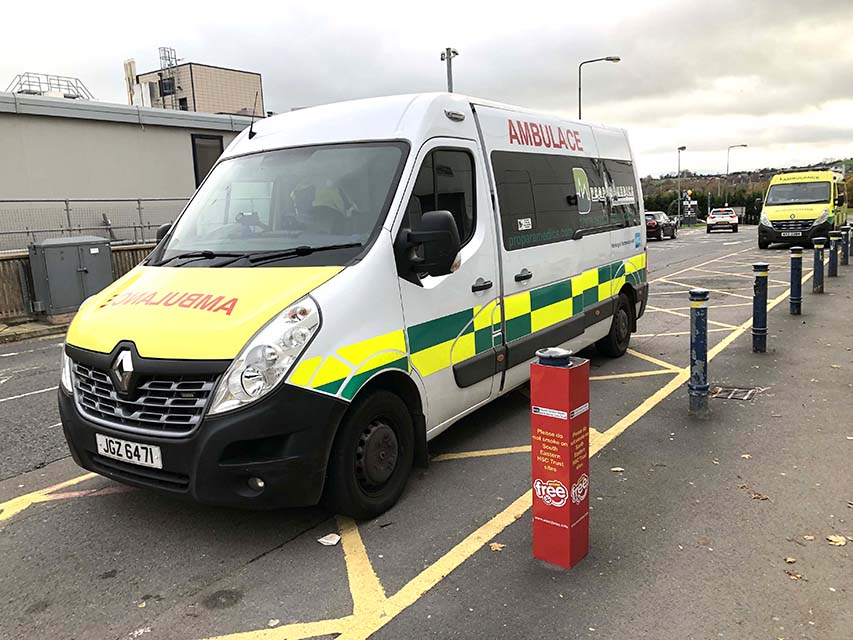
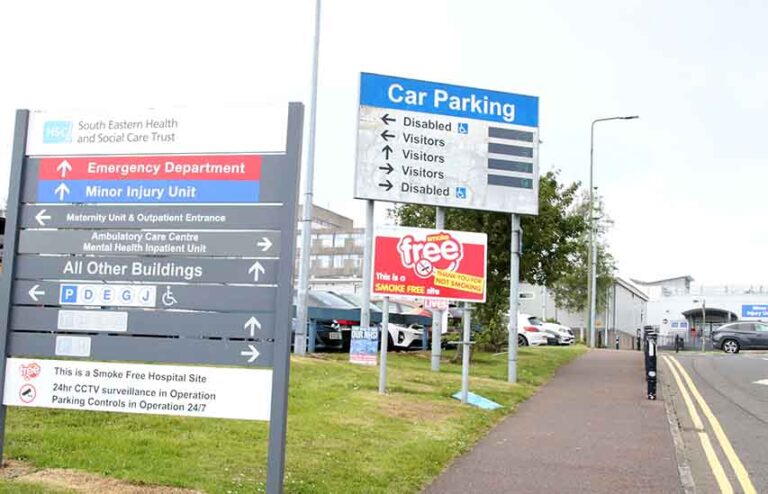
The Northern Ireland Ambulance Service (NIAS) has introduced new protocols which will be effective from Friday 24th April reducing the time they will remain with patients at Emergency Departments this releasing ambulances for 999 calls. (Photo: Jim Masson.DownNews©).

The handover will be completed within a 2-hour framework from arrival. And the members of trust staff must record the handover time on the ePCR system. A HALO system will be in place to monitor escalating patient cover needs, check patient queuing and help improve communication.

The ambulance crew will remain with the patient until the changeover takes place this could be a maximum of two hours.

The handover is the ‘clinical responsibility’ of the hospital trust and ED clinician and releases the ambulance for a 15-minute preparation to then be back on active duty receiving calls and directions from the Emergency Ambulance Control Centre.

Ambulance staff are expected to ensure that patients are accommodated on chairs or trolleys promptly

Once the patient is on the hospital system, the nurse in charge of ED patient flow takes over.

A caveat to this is that if a patient is deemed so ill, the patient will remain in the ambulance initially maintaining with the NIAS staff, immediately contacting the trust staff. This allows for the patient handover plan to be completed and the ambulance is therefore freed up for further 999 calls.

As a comparison, in the NHS England model, Yorkshire trusts have to operate this scheme within a 45 minute window compared to the 2-hour window in Northern Ireland. But as the system settles, there may be room to tighten up the changeover efficiency and reduce that window.

If there are delays over 15 minutes in patient handover, there are further protocols in place to address this. Crews must ensure they have made every effort the patient is safe and on a chair or trolley. The NIAS crews may also discuss any changes in a patent’s condition with trust medical staff. A Deteriorating Patient protocol must be addressed by medical staff following consultation with triage staff.

Through the upwards of a 2-hour period, while waiting for medical treatment, NIAS staff must monitor the patient and report any deteriorating to the trust staff.

At the 90-minute point, the trust staff are expected to provide feedback to the NIAS staff on the patient.

If after 2-hours the NIAS crew may leave the ED but they have to notify the ED coordinator where the patient is and that they are leaving.

At this point, the coordinating trust nurse must confirm this critical change and register it on the rPCR computer system.

In the standard operating procedure (SOP), NIAS crew have a professional responsibility to ensure safe effective, and accountable transfer of patient care when handing patients over to the receiving Emergency Department (ED).

All Emergency Departments will experience the changes in patient care due to the NIAS inroducing new guidance rules saying they must leave the patient after 2 hours in the EDs care.

The NIAS SOP states that “Ambualnce clinicians must balance two key professional responsibilities ie ensuring a safe and accountable transfer of care into th ED, and supporting the effective use of emergency ambulance resources for the wider community.”

The critical shortage of ambulance cover across Northern Ireland has been mainly as a result of anulances and theuir crew shaving to wait for extended perios of time literally taking them out of service.

Long delays of responses by ambulance crews to emergency calls are associated with:

• delays in pain relief and sepsis treatment

• increased risk of deterioration

• breaches in privacy and infection control

• delayed administration of time-critical medications

• challenges with providing nutrition for those to require surgery / requiring SALT assessment.

The NIA SOP futher states that all delays will be considered as possible safety events and will be addressed accordingly.

Also, if a patient is detoriating and a conflict arises between NIAS staff and ED staff, the HALO / line management system will kick in. The ED is expected to respond immediately to issues of airways, ventilation, acute stroke, sepsis, ECG changes, etc.

The NIAS staff can assist with pain relief within scope, but the ED must assist if pain persists or time-critical medications are due.

And in terms of personal care for patients eg supporting hydration, nutrition, toileting and pressure area care, the role of the NIAS staff is to assist but not to lead which is the ED staff responsibility.

The above details are the Standard Operating Protocol planned to come into effect from on 24th April 2026.

This change should make a huge difference releasing ambulances to address 999 calls and reduce response times.

But a critical question is, are the hospital trust themselves prepared for he change in handing over patients to the EDs and are sufficient resources in place?

***

Southern Trust Says new System Will take Time To Embed

A spokesperson for the Southern HSC Trust said: “From Monday 27th April, the six Health and Social Care Trusts in Northern Ireland will begin to implement a ‘release to rescue’ protocol which seeks to ensure that ambulance crews are able to hand over patients to the clinical care of Emergency Department staff within two hours of arrival.

“The aim is to free up Northern Ireland Ambulance Service (NIAS) crews so they are available for the next emergency.

“This is the first phase of a whole system change and introducing Release to Rescue won’t be a quick fix and will take time to embed.

“It will be challenging at times for staff but it is an important and necessary step to ensure the safety of patients both in EDs and in the community.

“Internal engagement and communication with our staff has been on-going in recent weeks and will continue in the run up to implementation and in the months ahead.”

South Eastern HDSC Trust Repsonds Saying It May Be Challenging At Times

A spokesperson for the South Eastern HSC Trust said: “From Monday 27th April, every Health and Social Care Trust in the Region will begin to implement the ‘Release to Rescue’ protocol.

“It aims to ensure that ambulance crews are able to hand over patients to the clinical care of Emergency Department staff within two hours of arrival, so they are available for the next emergency response in the community.

“It is important to stress that many handovers already happen within two hours and this protocol is only targeted at those that take longer.

“The South Eastern Trust has been working hard with all its staff, both in our hospitals and in the community, to help implement this initiative.”


Mathison Says Check The EA SEN Consultation

Nick Mathison MLA urges local engagement on the EA consultation into support for pupils with SEN statements

Strangford Alliance MLA Nick Mathison has encouraged parents, teachers, classroom assistants and all those involved in supporting children with Special Educational Needs to respond to a major consultation on the future of support for pupils with SEN statements.

The Education Authority consultation is now open and closes on Friday 22nd  May.

Nick recently attended and spoke at a large consultation event on 16th April, where he heard directly from teachers, classroom assistants, parents and school leaders about both the potential of the proposed changes and the concerns many have around them.

SEN provision is experiencing significant pressures, particularly around placements and the availability of appropriate support.

Strangford Alliance MLA Nick Mathison is urging parents with children who are SEN registered to check out the SEN consultation being run by the Education Authority which ends on Friday 22nd May. The Enhanced Support Model – Public Consultation through the Education Authority

These pressures have been highlighted in both the Ards and North Down and Newry Mourne and Down council areas, meaning the consultation is likely to be of particular interest to many local families and school communities.

Nick said: “This is a crucial consultation which could have a significant impact on the support available to children and young people with Special Educational Needs.

“I was pleased to attend and speak at the consultation event on 16th April, where it was clear there are strong views from parents, teachers, classroom assistants and school leaders about the changes being proposed.

“It is vital that the Education Authority fully understands the experiences and concerns of everyone involved before any decisions are taken or changes implemented.

“SEN provision in the Strangford area is already experiencing significant pressure, particularly around placements and support for children with additional needs.

“These issues are all connected. Decisions around classroom support, placements, resources and early intervention have a direct impact on children, families and schools.

“Alliance is committed to working with parents, schools and all stakeholders to deliver the best possible outcomes for children and young people with SEN.

“We are clear that any intervention or change must be based first and foremost on the best interests of children and young people, not simply on budgetary pressures.”

LINK TO: The Enhanced Support Model – Public Consultaion through the Education Authority

RGU Buckle Down To Beat Mayobridge

Mayobridge played well in the first half but the RGU came back stronger in the second half to win

Down GAA,

Senior Men’s Gaelic Football Division 1,

Venue, Pairc Tómas Ruséil, Friday 17th April 2026,

Final Score: RGU Downpatrick 0-18 3-7 Mayobridge.

Downpatrick RGU made a great recovery after faltering in the first half as for the largest part, Mayobridge were pressing the RGU hard and opened with an early point in play by Jamie Barr passing to Danny Cunningham who scored again a short time after writes Jim Masson.

Then Patrick Woods added a goal to the scoreboard as he hit low ball from the right. Mayobridge were leading 0-0 to 1-02. The RGU hadn’t focussed their game yet and were still scoreless at this point and tring to cope with the Mayobridge quick attacks.

Jarleth Brannigan made a great cross to Conor McGrady who lost the ball under pressure from defenders.

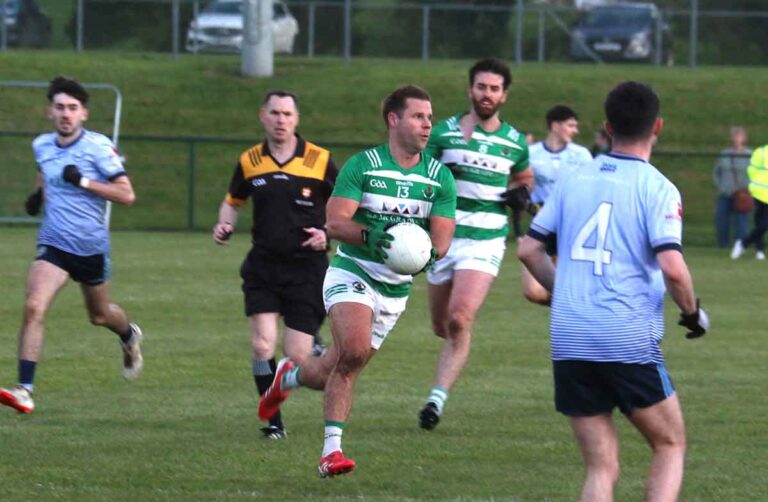
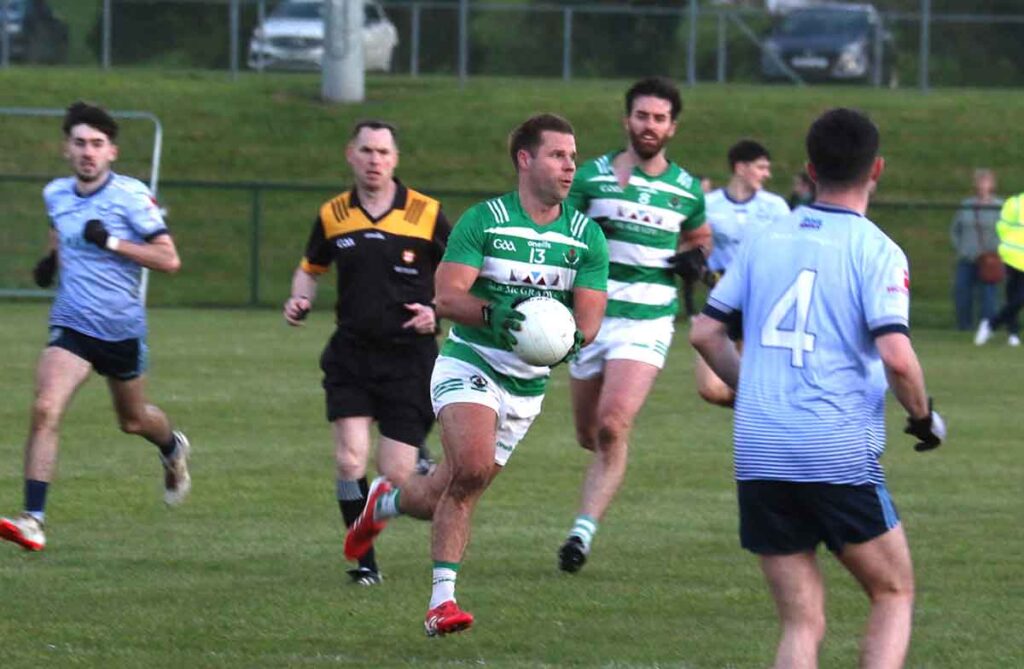
Gerdie Collins in possession played a good game on the RGU front line.

But on 12 minutes tempers overflowed and there was a scuffle between two opposing players and the Mayobridge goalkeeper too got involved. It was early season and both teams were keen to collect the points so the rivalry was sharp.

The RGU won a free and Anthony Doherty claimed a 2-pointer to help redress the balance. Then Matty Hardy pressed forward and another point was taken by the RGU.

View Match Photos on Down News Facebook

Doherty then crossed a free kick to Hardy who caught well but was overrun by defenders. On 21 minutes Mayobridge got possession again and pressed forward. But the RGU moved back quickly towards the Mayobridge goal and Gerdie Collins was fouled and Brannigan pointed from the free.

But Mayobridge broke quickly and forward Corey Clekin took a goal for his side on 28 minutes. But the RGU’s Doherty replied with a 2-pointer.

Just before the whistle for half time, Mayobridge’s Ronan Murphy hit wide from around 25 yards’.

The half-time score was RGU 0-6 to 2-5 in Mayobridge’s favour. They had had a wind advantage which was significant.

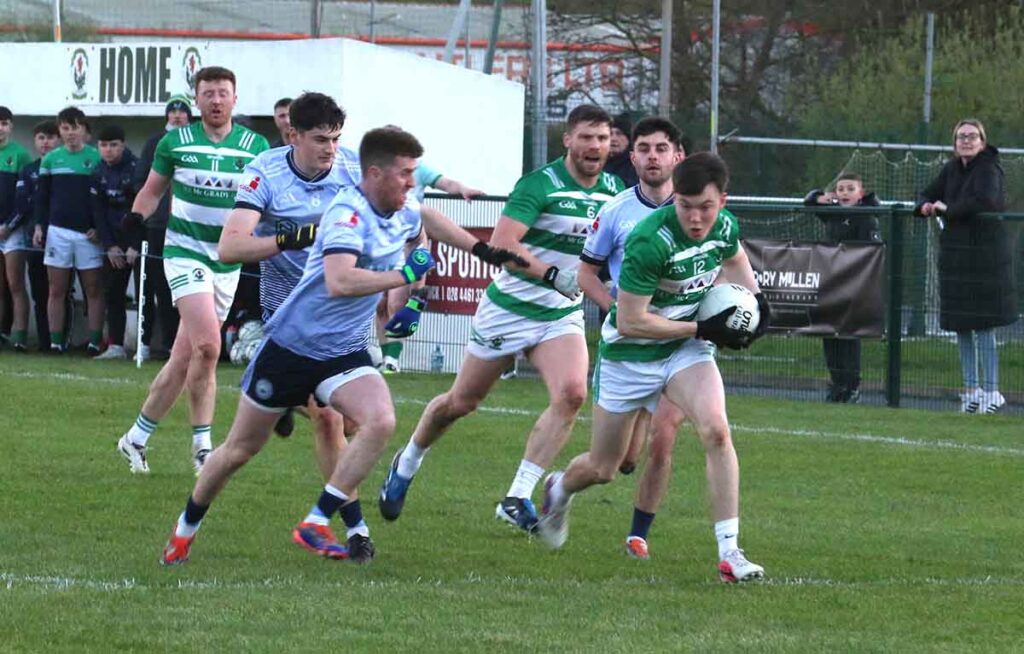
Tom McNeill in action starting a great run at the Mayobridge goal.

As the second half had just commenced, the RGU came out fighting and captain Jarlath Brannigan received the ball and made a run towards the Mayobridge goal chased by a defender. He received a free for his efforts and pointed.

Minutes later, Brannigan was sent off when the referee blew his whistle for a foul as Brannigan was deemed to have used his elbow striking a defender which Brannigan disputed and he was red-carded.

Despite this loss, the RGU kept their discipline and came out again determined to claw the points back and Niall Morrison and Tom McNell almost scored close-in but lost possession and a short time later McNeiil managed to take another point.

But that point was cancelled out by a run from Mayobridge claiming another point and sitting at 0-7 to 2-06. The RGU had a lot of work to do to rectify the situation as they slipped behind.

View Match Photos on Down News Facebook

Then the magic happened, and the tables turned on Mayobridge. Tom Smith found space to run with the ball and fired a fizzler between the Mayobridge posts just at a time when the visitors had slowed down in their attacks on the RGU. Then MCNeill made a good catch on a kick-out and marked the ball. Doherty clipped the ball to Johnnie Bell who secured another point.

The Mayobridge goalkeeper had come out of his area to support the forwards but the Hoops pressed back and on 20 minutes McGrady pointed from a free kick on the 16yard line. Then the game was tied as Brian Grant took a point for Mayobridge and tied the game at 0-12 to 2-16.

Then the RGU’s advantage, the Mayobridge goalkeeper was penalised for taking his time with a clearance kick and a kick from Conor McGrady put the RGU clearly into the lead. Hopes were now high for a win for the RGU but both teams shared a point apiece.

Then McGrady kicked the RGU into the lead once more and Johhnie Bell hit a golden moment as he took a couple of points to nudge the Hoops forward.

Conor McGrady pictured in an attack for the RGU played his part in the win over Mayobridge in kicking in points.

The RGU defence had played well in the second half closing out the Mayobridge attacks. But the visitors made one final point, but they were not completely finished yet.

On a break, Mayobridge scored a goal as Danny Cunningham rocketed the ball past keeper Peter Carberry after a great run.

Just when it seemed as though the Hoops were going to pipped at the post in the closing miniuutes, Gerdie Collins broke forward and took a two-pointer to equalise again.

And this was followed by another long two pointer by Anthony Doherty to give the Hoops a clear 2-point win over Mayobridge in an electric finish which shocked Mayobridge.

That made it 2 wins out of 2 for the Hoops but next week will be a huge test as they face the formidable Kilcoo team and they will have to be rested up early in bed on a Thursday night for that tough match.!!!

The RGU enjoyed a 2-point win over Mayobridge but they could have scored sharper and taken the pressure off themselves a little. Every kick against will Kilcoo will need to count.

View Match Photos on Down News Facebook

The starters:

RGU Downpatrick: 1 Peter Carberry (GoalKeeper) 19 John Shields 3 Ronan Murphy 4 Damien Branniff 5 Sean Bell 6 Anthony Doherty 7 Niall Morrison 8 Damien Turley 9 Matty Hardy 10 Tom Smyth 11 Johnnie Bell 12 Tom McNeill 13 Gerdie Collins 14 Conor McGrady 15 Jarleth Brannigan (C).

Mayobridge: 1 Ci Barr Goal Keeper) 2 Daniel McMahon 3 Seamus McManus 4 Daniel Bannon 5 Liam McManus 6 Thomas Hardy 7 Patrick Woods 8 Conor Colhoun 9 James Barr 10 Daniel Barr 11 Caolan Gallagher 12 Brian Grant 13 Danny Cunningham 14 Daire O’Keefe 15 Corey Clerkin.

bTB Costs Farmers Almost £100 Million A Year

Bovine TB costing farmers over £96 million per year, according to new report

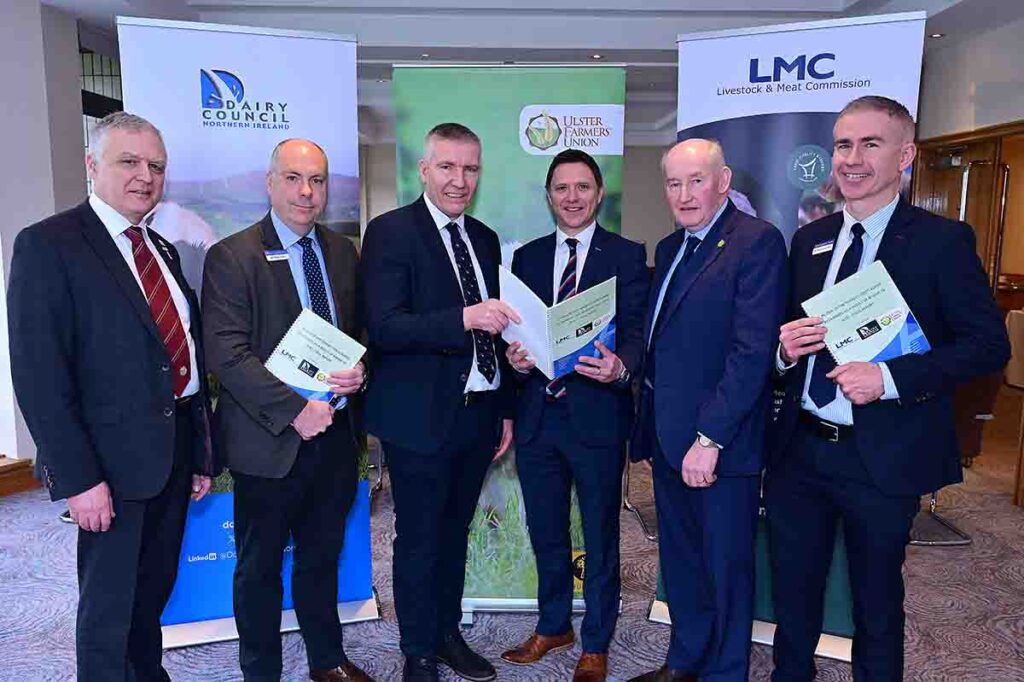
The Ulster Farmers’ Union (UFU), together with the Livestock and Meat Commission (LMC) and the NI Dairy Council, have launched a landmark independent study into the indirect costs of Bovine Tuberculosis (bTB) at the Stormont Hotel.

Stakeholders from across Northern Ireland and ROI agricultural industry, alongside representatives from DAERA as the Andersons Centre presented its findings.

UFU deputy president, Glenn Cuddy, said: “This independent study quantifies, for the very first time, the scale and composition of the indirect costs of bTB borne by NI farmers.

“It draws on stakeholder interviews, a large-scale farmer survey, farm-level and aggregated modelling to provide a robust assessment of how bTB affects farm businesses in practice and we must thank farmers and stakeholders for their participation in this vital evidence gathering process.”

According to the study, indirect bTB costs borne by farmers are estimated at just over £96 million per year, equivalent to almost one-third of total agricultural support in Northern Ireland. 

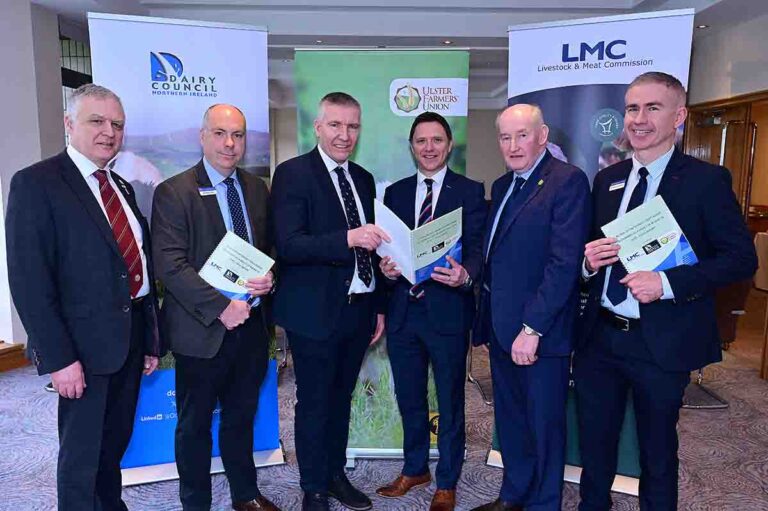
(l-r) William Irvine, UFU President, Richard King, The Anderson’s Centre, Ian Stevenson, NI Dairy Council, Colin Smith, LMC, Glenn Cuddy, UFU deputy president, and Michael Haverty, The Anderson’s Centre.

“This analysis highlights that bovine TB is not only a persistent animal health issue, but a significant economic one, representing a major and persistent drag on farm profitability.

“When combined with DAERA’s direct expenditure on testing, compensation and programme delivery, the total annual economic cost of bTB on NI agriculture is approximately £156 million and the greatest financial impact falls on farmers, with indirect costs far surpassing direct support.”

Colin Smith, LMC Chief Executive, welcomed the opportunity to work collaboratively with the UFU and DCNI to commission this independent, robust report. 

He said: “The report shows almost £50million (51.4%), of the total cost is carried by herds that have had no breakdown. This stark statistic highlights these costs will persist in the long term unless decisive action is taken to eradicate bTB.

“In addition to this, the report also highlights the environmental and social costs of bTB which cannot be underestimated.

“LMC remains committed to working in partnership with stakeholders to drive forward the bTB eradication programme. Together we can deliver meaningful progress.”

Dairy Council for Northern Ireland Chief Executive, Ian Stevenson, welcomed publication of the report. 

Commenting, Ian Stevenson, said: “This independent review comprehensively analyses and quantifies the indirect costs borne by farmers in Northern Ireland as a consequence of Bovine TB.

“For too long our farmers have endured the practical, financial, environmental and mental anguish that comes with trying to tackle Bovine TB in the cattle population in Northern Ireland. 

“The excellent case studies really give a sense of what farming families have to deal with when the scourge of bTB makes an unwelcome visit.

“Through this insightful review, which was jointly commissioned by DCNI, LMC and UFU we have brought meaningful evidence to the annual cost of this disease on industry, and I am hopeful that the findings will give added momentum to the push for eradication of this disease in Northern Ireland.”

Key cost drivers include production losses, additional labour, cashflow constraints, biosecurity expenditure and environmental inefficiencies, with over half of these indirect costs arising even in the absence of a breakdown, reflecting the baseline burden of routine testing and disease risk.

The UFU deputy president added: “The findings confirm that bovine TB is not a short-term or episodic issue, but a major structural constraint on Northern Ireland’s livestock sector.

“Policy needs to be framed around reducing the total economic impact and not just managing stock valuation costs. Priority must also be given to measures that minimise the risk of a bTB breakdown,” added Mr Cuddy.

“There is no single solution to the bovine TB challenge. However, evidence shows that incidence can be significantly reduced through sustained, coordinated action across multiple fronts and dealing with wildlife is one of the examples.

“Farmers must also remain central to this process if meaningful and lasting progress is to be achieved.”

Mourne Stars Shine In Annual Performances

Recitation, poetry, performances, acting musical theatre and more were all on show by the Mourne Stars in Newcastle

On Friday 3rd and Saturday 4th April 2026 the Newcastle Community Cinema (NCC) stage in Newcastle was buzzing with lots of very talented young people!

Mourne Stars held their annual Drama Festival for the pupils of this local Drama School. It was so popular that they had to run the event across two days again, to allow all of the talented pupils the chance to perform.

They had the chance to compete with fellow class members on stage reciting poetry, acting or performing a piece from musical theatre, reciting Prepared Reading and some opting to Perform in a scene for two actors.

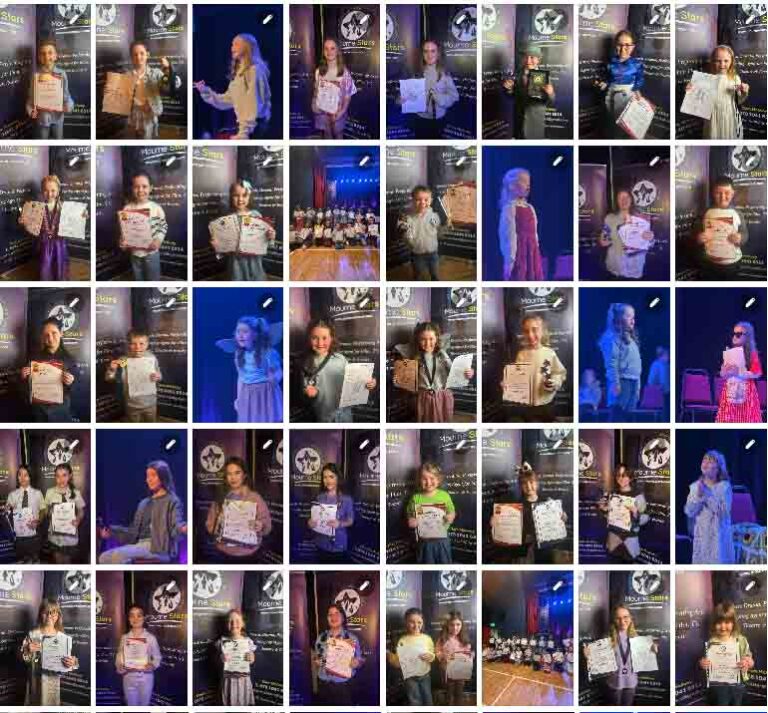
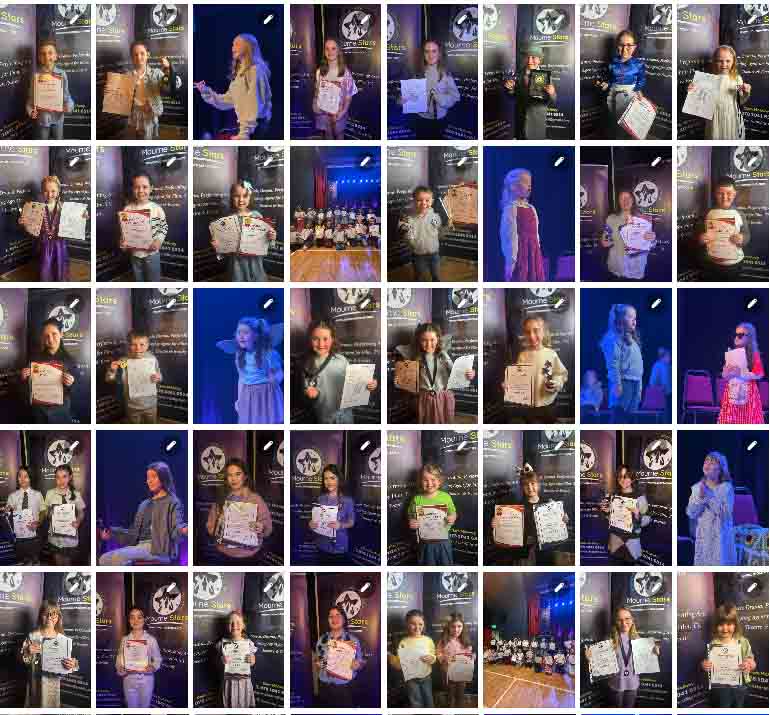
Congratulations to all the participants in the Mourne Stars annual festival held in the NCC centre in Newcastle. They are amazing! (Photos courtesy of Mourne Stars).

The pupils had been preparing for the competition for a number of weeks in their classes in Newcastle, Annalong, Castlewellan, Ballynahinch, Downpatrick, Atticall and Hilltown.

The competition was judged by an impartial adjudicator, Ann Garvey, who made the whole event very worthwhile for the kids.

Each performer received their own individual feedback, and she took to the stage after each competition to address them and their families with some fantastic praise along with tips and advice for future performances for drama examinations and/or other local festivals like this one.

The audience was full of very supportive families and friends of the performers, and they were treated to some delicious treats courtesy of the Little Popcorn Shop.

There was a new award this year, The Rising Star Award. As well as the usual First, Second, Third and Highly Commended placings, there was also a Rising Star awarded to one or two performers from each category.

This was given to a performer who showed potential for future performances and had a little spark of confidence. This was certainly a popular award and all recipients were absolutely delighted!

CHECK OUT THE PHOTOS COURTESY OF MOURNE STARS

Overall, the event was really successful! Clare and all of the teachers and assistants were so proud of all of the young performers.

“It takes a lot of courage to get on to the stage and the pupils of Mourne Stars showed lots of confidence on Friday and Saturday.

There were category prizes but every single one of the participants deserve recognition for their wonderful performances. As the adjudicator Ann Garvey id a couple of times, “if you have confidence, that will stick with you for life.” Well, everyone certainly showed that last weekend, so well done to you all!

For further information Mourne Stars Speech, Drama & Performing Arts classes, visit their website www.mournestars.com

or follow them on Instagram, Facebook or TikTok.

There you can see more photos and celebrations of all of the ‘Stars’ at the most recent Drama Festival!

CHECK OUT THE PHOTOS COURTESY OF MOURNE STARS

The Modern Gamer’s Choice: Finding Balance Between Solo and Shared Play 

0

Gaming has evolved far beyond simple high scores. While a certain satisfaction can still be found in playing your favourite title on your own, online play has opened up group play to the masses. 

The question is about when you opt for each option, balancing the need for personal headspace with the desire for community connection.

Photo by Mateo on Unsplash

Understanding Solo vs Shared Play 

The gaming landscape is more diverse than ever. Recent data suggests that while multiplayer titles dominate the headlines, a significant 57% of players still lean towards single-player experiences. This shows that we have the freedom to choose our gaming style based on our mood and schedule. Solo play offers a narrative-driven, private escape, while shared play serves as a way to socialise without the need to leave the house. 

The Appeal of Solo Play: Your Time, Your Pace 

There is a unique satisfaction in solo play that multiplayer modes struggle to replicate. Gaming provides a space to unwind and enjoy a personal hobby at our own speed. Without the pressure of coordinating with a team or keeping up with others, single-player modes allow for total autonomy. 

Whether mastering a complex strategy game or exploring a detailed simulation, the focus is on personal achievement and the quiet enjoyment of a well-crafted experience. Having a leisure activity that doesn’t require an audience or a teammate is a nice way to reclaim your personal time

The Social Power of Shared Play 

On the flip side, gaming remains one of the most effective ways to maintain friendships in the digital age. Modern platforms act as social hubs where shared goals and camaraderie take centre stage. Sure, the competition is great, but it’s the memories made along the way that linger long after you’ve powered down.  

The industry has seen a rise in community-focused experiences, such as arcade games that allow individuals to play together in shared environments. These spaces allow you to enjoy the mechanics of the game while being part of a larger, vibrant group.  

The Hybrid Future: Blurring the Lines 

Today, the line between alone and together is thinner than ever. Many modern titles offer hybrid experiences where you can progress through a solo campaign while remaining connected to a global leaderboard or a community chat. Technology now allows us to stay part of a persistent world, checking in with friends and participating in community events even when we only have a few minutes to spare. 

As we look forward, the focus remains on choice. The online world offers a space for everyone, those immersed on a solo journey and the others crammed into a bustling lobby alike. Just remember, always play within your limits and ensure you are using the tools available to keep your hobby fun and the experience positive. 

Forex Trading Tools: What Every Trader Needs to Succeed in the Currency Markets

0

The foreign exchange market is the largest and most liquid financial market in the world, with daily trading volumes exceeding $7 trillion. To navigate this vast and volatile landscape, traders rely on a diverse arsenal of tools – from charting platforms and economic calendars to sentiment indicators and automated trading systems. Understanding what these tools do and how to use them effectively can be the difference between consistent profitability and costly mistakes.

Photo by Maxim Hopman on Unsplash

Charting Platforms and Technical Analysis Tools

At the heart of any forex trading workflow is a charting platform. These tools allow traders to visualize price movements, identify patterns, and apply technical indicators. A well-designed gbp/usd chart, for example, can reveal weeks or months of price behavior at a glance, helping traders pinpoint key support and resistance levels, trend reversals, and momentum shifts.

Most charting platforms offer a wide range of built-in indicators: moving averages, Bollinger Bands, RSI (Relative Strength Index), MACD (Moving Average Convergence Divergence), and Fibonacci retracements, among others. The quality of a charting tool is often judged by how customizable it is, how many timeframes it supports, and whether it provides real-time data.

Popular standalone charting platforms include TradingView and MetaTrader 4/5. However, many brokers now embed advanced charting capabilities directly into their trading interfaces – eliminating the need to juggle multiple windows.

Economic Calendars

No technical setup is complete without an awareness of fundamental drivers. Economic calendars list scheduled news releases — central bank decisions, employment reports, inflation data, GDP figures — that can trigger sharp moves in currency pairs. A trader who ignores an upcoming Federal Reserve statement or a UK inflation print risks being caught on the wrong side of a sudden spike.

Good economic calendars not only list events but also show the expected consensus figures and allow traders to filter by impact level (low, medium, high). Some platforms integrate calendars directly into the trading environment, automatically highlighting high-impact events on charts.

Trading Platforms and Order Management

While charting tools help traders decide what to do, trading platforms execute those decisions. The MetaTrader ecosystem (MT4 and MT5) remains the industry standard, offering one-click trading, pending orders, stop-losses, take-profits, and algorithmic trading via Expert Advisors (EAs). cTrader is another popular choice, known for its cleaner interface and more transparent order execution.

These platforms also provide access to depth-of-market (DOM) data, which shows the buy and sell orders queued at various price levels — useful for scalpers and high-frequency traders who need to understand short-term liquidity.

Dukascopy: A Comprehensive Toolset in One Ecosystem

Among the brokers and platforms that take tool access seriously, Dukascopy stands out for the breadth and depth of what they offer to traders of all levels. Dukascopy provides one of the most extensive sets of tools available from a single provider in the retail forex space.

Their JForex platform gives traders access to advanced fx charts with full customization — multiple chart types, dozens of technical indicators, and deep historical data going back years. This is particularly useful for strategy backtesting, where the quality of historical data directly determines the reliability of test results.

Beyond charts, Dukascopy offers a built-in economic calendar, live news feeds, a trading contest community, and a social trading component called SWFX (Swiss Forex Marketplace), which aggregates liquidity from a wide network of participants. Their mobile app mirrors much of the desktop functionality, which is increasingly important as traders move between devices throughout the day.

Dukascopy also provides a free demo environment, allowing traders to explore the full suite of tools without committing capital — a valuable resource for those learning the platform or testing new strategies.

Sentiment and Positioning Data

One category of tools that many retail traders overlook is sentiment analysis. The COT (Commitment of Traders) report, published weekly by the CFTC, reveals how large institutional players — hedge funds, asset managers, commercial hedgers — are positioned in futures markets. Shifts in these positions can signal upcoming trend changes before they fully develop on a price chart.

Some brokers provide proprietary sentiment tools showing the percentage of their own clients currently long or short a given pair. While these figures reflect a single broker’s client base, they can still offer a useful contrarian signal.

Automated Trading and Backtesting Tools

Algorithmic trading has moved well beyond institutional desks. Retail traders can now build, test, and deploy automated strategies using tools available on most major platforms. MetaTrader’s MQL language, for instance, allows traders to code EAs that open and close positions based on predefined rules — without manual intervention.

Backtesting engines let traders simulate how a strategy would have performed on historical data. The more robust the data and the more rigorous the testing methodology, the more meaningful the results. Walk-forward optimization, Monte Carlo simulation, and out-of-sample testing are techniques used to stress-test strategies before going live.

Risk Management Calculators

Perhaps the most underappreciated tool in a trader’s kit is the position size calculator. Given a defined risk per trade (typically 1–2% of account equity), a stop-loss distance, and the current exchange rate, these calculators determine the correct lot size to trade. Using proper position sizing consistently is foundational to long-term capital preservation.

Many brokers and independent websites offer free calculators for this purpose. Some advanced platforms integrate them directly into the order entry window, making precise risk management the default — not an afterthought.

Conclusion

The modern forex trader has access to an extraordinary range of tools. The key is not to collect as many as possible, but to build a coherent, integrated workflow — one where each tool serves a clear purpose. Whether you use a standalone charting platform, a broker-integrated suite like the one offered by Dukascopy, or a combination of both, what matters most is mastering the tools you choose and applying them with discipline and consistency.

Bangor Man Shares His Bowel Cancer Journey

Bangor man battles bowel cancer from small early symptoms to his life-changing diagnosis

A Bangor man diagnosed with Bowel Cancer is bravely sharing his deeply personal journey to raise awareness and encourage others to act quickly if they notice any symptoms.

Bowel Cancer is a general term for cancer that develops in the large Bowel (Colon) or Rectum. It is the third most common cancer in Northern Ireland and the second leading cause of cancer death.

Each year, around 1,100 people are diagnosed and more than 400 people die from the disease.

Jeremy Stewart, was diagnosed with Bowel Cancer in April 2025, after spotting what he describes as a “very, very small trace of blood in his stool”, a sign he initially dismissed.

Jeremy Stewart from Bangor chats about his journey with bowel cancer. (Photo courtesy of SEHSCT).

Jeremy said: “The blood in my stool was so small, I almost ignored it. But when it came back a couple of weeks later, I decided to make an appointment with my GP and that decision made all the difference.”

Jeremy was seen quickly by his GP, who took his concerns seriously and referred him for a Colonoscopy. The test revealed a tumour in his lower Bowel.

Jeremy recalled: “That moment was the hardest part of the entire journey.  It was a real shock. You are suddenly faced with the unknown,  you do not know what lies ahead. Those first few weeks were very frightening.”

Following his diagnosis, Jeremy underwent Radiotherapy and Chemotherapy before making the decision to have surgery.

In November 2025, he had a six-hour operation to remove part of his Bowel and spent three weeks recovering in hospital. He is now nearing the end of a 12-week course of Chemotherapy.

Jeremy said: “It has been a long journey, almost a year, but I am coming to the end of it now.  I can honestly say the care I have received has been absolutely outstanding.”

Jeremy praised all those involved in his treatment in the Ulster Hospital, “Everyone has been so professional, but also incredibly kind and compassionate.”

Now, he is determined to use his experience to highlight the importance of early detection, particularly among men, who he believes can be reluctant to seek medical advice.

“I would have been someone who rarely went to the Doctor,” he admitted. “But if you notice anything unusual, no matter how small, do not ignore it. Go and get it checked.”

South Eastern HSC Trust, Colorectal Nurse Specialist, Sarah Christie highlighted the signs and symptoms to look out for.

“Symptoms of Bowel Cancer can include blood in your stools (faeces), an unexplained change in Bowel habits, such as persistent diarrhoea or constipation, unexplained weight loss or abdominal pain, extreme tiredness for no obvious reason or a pain or lump in your tummy.

“These symptoms are often similar to less serious Bowel conditions. However, it is important to know what is normal for you and to contact your GP if any of these symptoms last for more than three weeks.

“GP’s will assess symptoms and if necessary, refer patients for further investigation.”

Sarah explained that several factors can increase the risk of developing Bowel Cancer, including:

• age (around 80% of cases occur in people over 60),

• diets high in red or processed meat and low in fibre,

• obesity

• and lack of physical activity,

• alcohol consumption and smoking,

• family history or inherited conditions and existing Bowel conditions.

Stressing the importance of taking part in Bowel Screening when invited, Sarah added; “Bowel Screening saves lives and it plays a vital role in detecting cancer early, often before symptoms develop. 

“In Northern Ireland, people aged between 60 and 74 are invited to take part in Bowel Cancer Screening every two years. The test is completed at home in private and can detect hidden blood in the stool.”

Jeremy underwent Bowel Cancer Screening previously and is encouraging everyone who is invited to take part. He said: “I was lucky my cancer was caught early and it had not spread. Screening and early action can save lives, it is as simple as that.”

Reflecting on his journey, Jeremy has one clear message: “If you have the slightest concern, go to your GP. Do not put it off. The earlier you catch it, the better your chances. It could save your life.” 

For more information about Bowel Cancer Screening, contact the free helpline on (0800) 015 2514 or visit:

https://www.publichealth.hscni.net/publications/bowel-screening-test-kit-instructions

Butler Sets Out His Case For Clean Biomethane

Butler calls for securing control of our energy & food production destiny: turning waste into power, security and opportunity

With the recent global fuel crisis still ongoing, the pressure is building for Northern Ireland to generate its own independent source of energy through clean biomethane.

Ahead of the Ulster Unionist Party motion on Clean Biomethane for Northern Ireland’s Energy, Food and Environmental Security in the Assembly on Monday, Ulster Unionist Agriculture, Environment and Rural Affairs spokesperson Robbie Butler has set out his table.

He said: “Northern Ireland quite literally is standing at a decisive crossroad.

“This time it is one that makes a significant, and often unpredictable difference to our daily lives and our pockets.

“If we can grasp the opportunity, it is one that will shape not only how we power our homes and businesses, but how we sustain our agri-food sector, protect our environment, and future-proof our rural economy.

“For too long, we have been exposed to global energy shocks, supply chain instability and geopolitical volatility. We have become accustomed to being price-takers in an increasingly uncertain world.

“Yet, at the very time when energy security is rising to the top of the global agenda, Northern Ireland finds itself in a uniquely advantageous position rich in the very resources needed to take a different path.

Robbie Butler MLA will be leading the UUP contribution to the debate on creating a system for clean biomethane from the organic waste that he says already exists as a resource.

“As Ulster Unionist Party spokesperson for Agriculture, Environment and Rural Affairs, I believe the time has come for us to grasp that opportunity with both hands.

“We produce significant volumes of slurry, poultry litter and food waste every year. Historically, these have been viewed as environmental pressures, liabilities to be managed and controlled. But the evidence now before us tells a very different story.

“Research from Queen’s University Belfast and AFBI, supported by the Centre for Advanced Sustainable Energy, has demonstrated that Northern Ireland has sufficient organic material to produce enough biomethane to match the gas currently flowing through our distribution network. That is not a marginal gain, it is a system-wide opportunity.

“Further analysis from our local gas network operators suggests that biomethane production from existing and planned anaerobic digestion facilities could deliver around 3.5 terawatt hours of energy, equating to almost 90% of current industrial and commercial gas demand.

“In practical terms, that means locally produced renewable gas could power the backbone of our economy.

“This is nothing short of being transformative.

“Anaerobic digestion allows us to take organic waste like manure, slurry, agricultural residues and food waste, and convert it into biogas, which can then be upgraded to biomethane and injected directly into our existing gas network.

“Crucially, that network, representing over £1.2 billion of investment, is already in place and ready to accommodate renewable gas without requiring costly changes to infrastructure or consumer appliances.

“At a time when other regions are scrambling to retrofit systems, Northern Ireland has the ability to move quickly and decisively.

“But the case for biomethane goes far beyond energy production.

“It offers a practical and scalable solution to one of our most pressing environmental challenges: nutrient management.

“By processing slurry through anaerobic digestion, we can stabilise nutrients, reduce emissions, and produce digestate which is a more controlled fertiliser product.

“This has the potential to significantly reduce nutrient run-off and play a meaningful role in addressing the well-documented pressures on our waterways, including the ongoing challenges at Lough Neagh.

“Notably, over half of Northern Ireland’s anaerobic digestion capacity sits within the Lough Neagh catchment area. That presents a clear opportunity to align environmental improvement with energy production to turn a problem into a solution through smart, joined-up policy.

“This is what a circular economy looks like in practice: local waste turned into local energy, supporting local jobs and industries, while returning value back to the land in a more sustainable way.

“A regionally balanced biomethane sector would strengthen farm viability, enhance food security, and provide a stable, indigenous source of energy.

“It would reduce our reliance on imported fossil fuels, shield consumers from global price volatility, and ensure that the economic value of decarbonisation is retained within our rural communities particularly in areas west of the Bann where much of this potential lies.

“However, we must approach this opportunity with both ambition and caution.

“If we are to build a successful biomethane sector, it must be under-pinned by robust governance, transparency, and accountability at every level. Stakeholders, including our farmers who own the vast majority of the nutrient asset need to be convinced that what we are sitting on works to the advantage of all of us and our precious environment.

“Any future support scheme must be fit for purpose, inflation-proofed, and carefully calibrated to avoid unintended consequences.

“It must command public confidence, protect the taxpayer, and provide long-term certainty to investors and farmers alike.

“That means strong regulatory frameworks, clear lines of accountability, and meaningful oversight involving government, industry, and regulators working in partnership.

“Done right, this will not be a repeat of past mistakes, it will be a model of how to deliver sustainable, responsible green growth.

“What is now required is full political backing across the Executive and Assembly.

“This cannot be treated as a niche initiative or confined to a single department. It demands a genuinely cross-departmental approach bringing together the Department for the Economy and the Department of Agriculture, Environment and Rural Affairs to co-design and deliver a comprehensive strategy.

“That strategy must include a stable and bankable support mechanism, streamlined planning and grid connection processes, and targeted investment in nutrient recovery technologies to directly address phosphorus and ammonia challenges.

“Encouragingly, work has begun through the re-establishment of an interdepartmental biomethane group. But we must now accelerate that progress and match it with the urgency that this moment demands.

“This is a once in a generation opportunity.

“An opportunity to move from energy dependence to energy resilience.

“An opportunity to support our farmers while protecting our environment.

“An opportunity to deliver real green growth that is rooted in our rural communities.

“We have the evidence. We have the infrastructure. We have the industry ready to invest.

“What we need now is the political will to act decisively and to ensure that this time, we get it right.

“That is why I will be leading on the Ulster Unionist Party motion for debate in the Assembly on Monday, to assess political ambition and appetite for real and sustainable energy and food security for Northern Ireland.

“Northern Ireland can lead in green gas production. But only if we choose to take control of our own energy future.”

Lyons Announces Help With Home Heating Oil

Lyons announces agreement for home heating oil support

Communities Minister Gordon Lyons has secured Executive agreement for a £36.4million support package for home heating oil users in Northern Ireland. Approximately 500,000 homes in Northern Ireland rely on oil as a primary heating source.

Eligible households will be able to apply for a £100 prepaid card that can be used at heating oil suppliers.

Minister Lyons said: “With roughly two thirds of homes in Northern Ireland relying on oil heating, recent price increases of nearly 100% in just a few weeks have been especially punishing here.

Communities Minister Gordon Lyons is to provide £100 cards to those who meet the criteria for qualification for the domestic home heating oil support.

“This measure will deliver targeted support to more than 300,000 households to help hard-pressed working families and vulnerable people struggling to meet essential heating oil costs.”

Eligible groups identified as most vulnerable to increased heating oil costs include:

  1. Households in receipt of income-related means tested benefits, namely Pension Credit, Universal Credit and Income Related Employment and Support Allowance;  
  2. Households in receipt of Disability benefits; 
  3. Pensioner households not in receipt of Pension Credit with income below £30,000; and
  4. Households on incomes below £30,000 and not in receipt of income related benefits.

The Executive has agreed £36.4million for the Department for Communities to support delivery of the scheme. This includes the £17.2million allocated by the UK Government and an additional £19.2million from the Executive.

The Minister added: “My officials will work at pace to open the scheme and I will announce further details as soon as possible.

“With 24% of households already living in fuel poverty before the recent surge in oil prices, it is clear that the situation has only deteriorated.

“My ambition is to deliver lasting, meaningful support. Alongside this new measure, I will reform my Department’s Discretionary Support Scheme to ensure grant assistance is available to those in need, regardless of the type of home heating they rely on.

“In parallel, I am actively progressing work on a Warm Healthy Homes Fund to help make fuel poverty and cold, damp homes a thing of the past.”