


Looking back and looking forward from the trip to Auschwitz-Birkenau
Holocaust Day has come and gone once more, and I reflected on a trip I took as part of a 6-week OCN course in Good Relations in 2017 with a group from the Downpatrick and Newry area.
We visited Krakow in Poland and my experience of the Polish people was that they were very friendly, warm and hospitable writes Jim Masson.
But over the centuries the Poles have experienced significant political trauma and upheaval torn between the East and West.
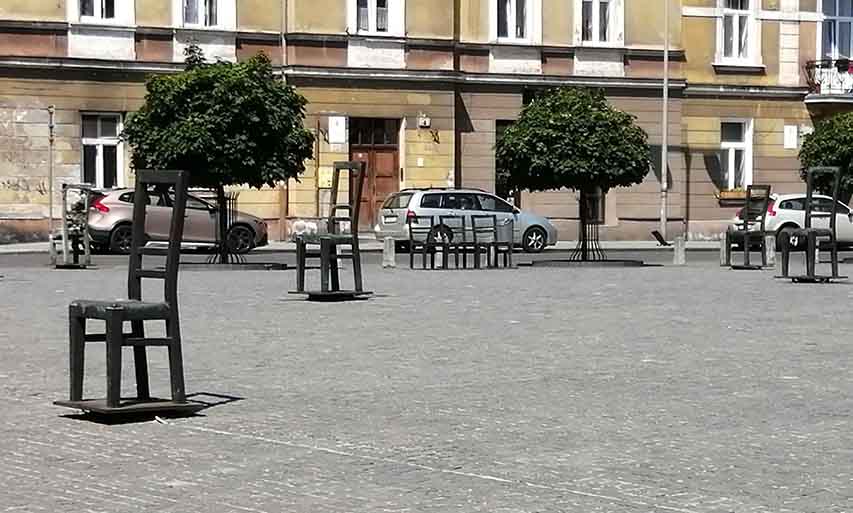
On our first day on arrival we noticed a square at the back of the Qubus Hotel where we were based. There were a number of large school chairs positioned across the square, a harrowing monument to the Jewish schoolchildren who were sent to the gas chamber – they were asked to bring one possession with them – they each chose a school chair.
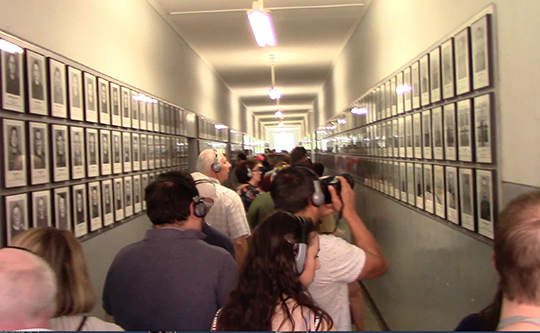
We did the standard tour at Auschwitz going through corridors with photos of murdered Jews, large glass cases of piles of suitcases, hair, spectacles, shoes, clothes, and other personal items. The Nazis had reduced death to an unfeeling, inhumane industrial scale never seen before.
In Auschwitz I saw a couple of small box-like rooms where prisoners were packed into where they could not stand up, a terrible torture. And in the yard adjacent, there was a wall where they shot prisoners. Altogether, it was impossible to escape the overwhelming experience.
Interestingly, there were a huge number of Chinese visitors there as they too had experienced brutal repression and mass murder at the hands of the Japanese in the Sino-Japanese war in the 20th century.
Since WW2, there have been many horrific wars across the world where one nation has tried to eradicate another. This hate in its absolute form must be addressed, suppressed, fought against, totally rejected, wherever it rears its ugly head.
The hate may be part of our human condition, and could if we are not careful allow it to lead to out extinction on this planet.
On the trip we went to Bikenau, a death camp. This was where people were gassed en masse and cremated in three large furnaces.
Two of the large chimneys and ovens were blown up by the Nazis at the end of the war when they feared huge reprisals. One tall chimney and oven still remains which I visited, a chilling reminder what the Nazis did to the Jews, something any Revisionist cannot deny.
I walked through the gas chamber where they dropped the canisters of Xyclon B gas into or sometimes pumped in Carbon Monoxide that led to excruciating and terrible deaths.
I could never in reality imagine that horror. But the silence in the dark concrete room with its heavy doors spoke a thousand words, and more.
I can remember walking through the quarters where the prisoners were bunked in areas, freezing in the winter, segregated by fences of electric barbed wire. Escape was impossible, death was certain.
The guides in Auschwitz spoke different languages. They have a system were you get a set of earphones and the guide speaks into a microphone as you toured the facility in groups.
And I can remember handing the headphones back and experiencing a sense of numbness, a feeling of disbelief, at what I had just seen on a scale unimaginable.

Some of us visited the Jewish quarter in Krakow, and enjoyed a quite, late evening beer overlooking the picturesque rooftops of Krakow as the sun dropped down. No sirens, the herding up of Jews, screams, gunshots, jackboots on the cobbles. Just the quiet murmurings of tourists and locals sipping, enjoying the peace.
Across the street from the Rubenstein Hotel was a Jewish synagogue which had managed to disguise its identity by levelling and covering up the gravestones adjacent trying to avoid the persecution from the Nazis.
What impact did this visit finally have on me ? I understood why my father spent six years in the army from Dunkirk, El Alamein, the invasions of Sicily and Italy, and going through D-Day and getting to the Scheldt border with Germany when he made his personal sacrifice in losing his leg. He was a Royal Engineer, always on the front line.
There is no place in this world for absolute greed, hate or such violence as seen in the Holocaust, no matter what form it takes. We have the power for immense good, and the capability for immense evil.
I know what side of the divide my values are positioned and whilst the ‘free world’ may not be perfect, the alternatives do not bare thinking about.
Therefore, it is important to remember Holocaust Day every day of the year like a shining light in the darkness and embrace warmth and kindness to each other as pillars of our common humanity.
***
Holocaust Day Remembered at Belfast City Hall
• Bridging Generations On Holocaust Memorial Day 2026
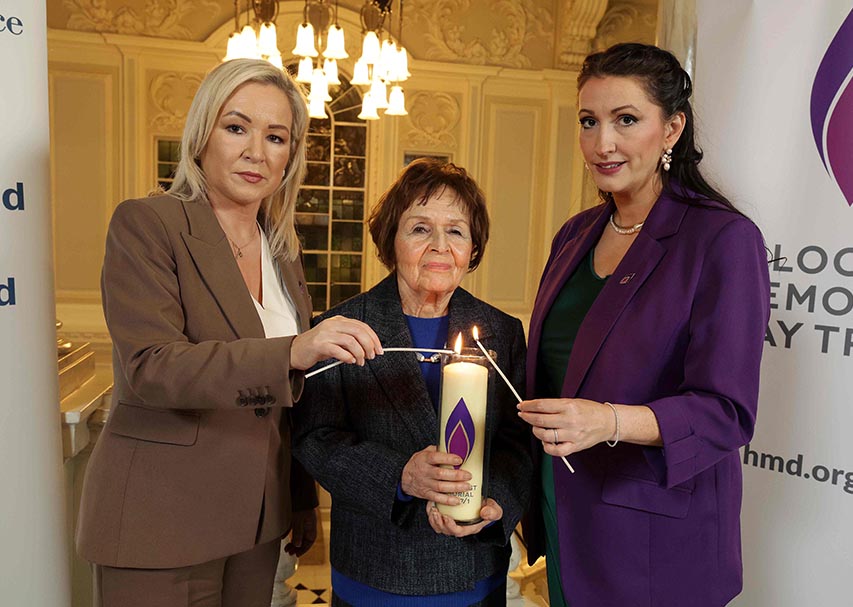
First Minister Michelle O’Neill and deputy First Minister Emma Little-Pengelly joined Holocaust survivor Janine Webber and hundreds of others at Belfast City Hall on Tuesday night (20 January) to mark Holocaust Memorial Day.
A spokerson for The Executive Office said that Holocaust Memorial Day is held annually on 27 January and marks the anniversary of the liberation of the Nazi concentration and extermination camp Auschwitz-Birkenau.
This year’s theme ‘Bridging Generations‘, is a call-to-action.
It encourages everyone to honour the lives lost and remember the unimaginable suffering caused by Nazi persecution. The theme emphasises the vital role of younger generations in safeguarding these memories.
Around 300 people gathered at the event, to participate in acts of remembrance for the victims of the Holocaust and those impacted by the horrors of more recent genocides.
During the Regional Commemoration hosted by The Executive Office along with the Holocaust Memorial Day Trust and Belfast City Council, Holocaust survivor Janine Webber spoke of the hardship and great loss she endured due to Nazi persecution.
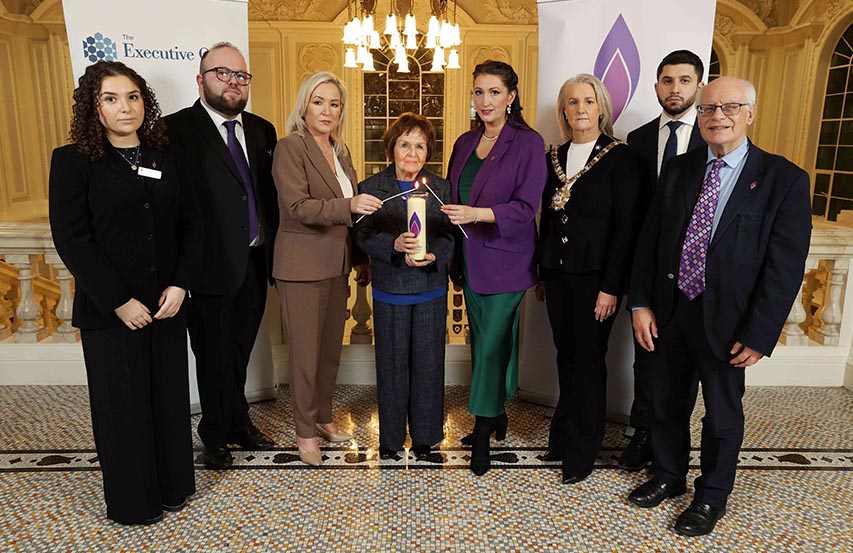
Janine told her story of hiding under a wardrobe with her family as a child, losing both of her parents within months of each other by the age of nine and working on a farm and living in a convent under a false identity during the Second World War.
Janine Webber BEM said: “As a Holocaust survivor, I carry memories that must not be lost, and sharing my testimony is so important.
“This year’s Holocaust Memorial Day theme, Bridging Generations, reminds us that remembrance is a responsibility shared by us all.
“While young people carry these memories forward, every generation has a duty to listen, to learn and to act – so that these stories endure and help build a more humane world for generations to come.”
Speaking at the event, First Minister Michelle O’Neill said: “Holocaust is what happens when hatred is allowed to grow, when whole communities are targeted and when the world looks away.
“For many years, survivors of the Nazi Holocaust have shared their stories. Now, as fewer survivors remain, the responsibility to preserve their truth rests with us.
“We must not allow their lessons to be ignored. Educating and empowering our young people is essential.
“As we remember the Holocaust, we cannot turn away from what has happened since then and right up to the present day.
“We must pass the duty to speak up and speak out to the next generation so they can build a world where compassion and humanity prevail.”
Deputy First Minister Emma Little-Pengelly said: “This special Holocaust Memorial Day event is an opportunity to honour the memory of the six million Jewish men, women and children whose lives were taken during the Holocaust, and all who have been killed in subsequent atrocities.
“But for remembrance to be meaningful, it must be more than an act of looking backward – it must also be an act of moral clarity about the world we are living in today so that we can create a better future where antisemitism has no place.”
Olivia Marks-Woldman, Chief Executive of the Holocaust Memorial Day Trust, said: “Holocaust Memorial Day is a time for people to come together across Northern Ireland to commemorate the six million Jewish men, women and children murdered during the Holocaust, and the millions more murdered under Nazi persecution.
“We also learn and commemorate where persecution led in Cambodia, Rwanda, Bosnia and Darfur. We are so grateful to The Executive Office for hosting this important ceremony and for their continued commitment to remembrance.
“By coming together to remember the past, we reaffirm our shared responsibility to protect the future – one grounded in empathy, understanding and respect.”
Lord Mayor of Belfast Tracy Kelly said: “Remembering and learning from the Holocaust must continue.