



Picture a foreign exchange student at a County Down school entrance, timetable in hand, unsure where registration happens. Another pupil offers to walk with her. At the next junction, she turns towards the wrong staircase; he points down the corridor, then slows so she can follow the room numbers herself.
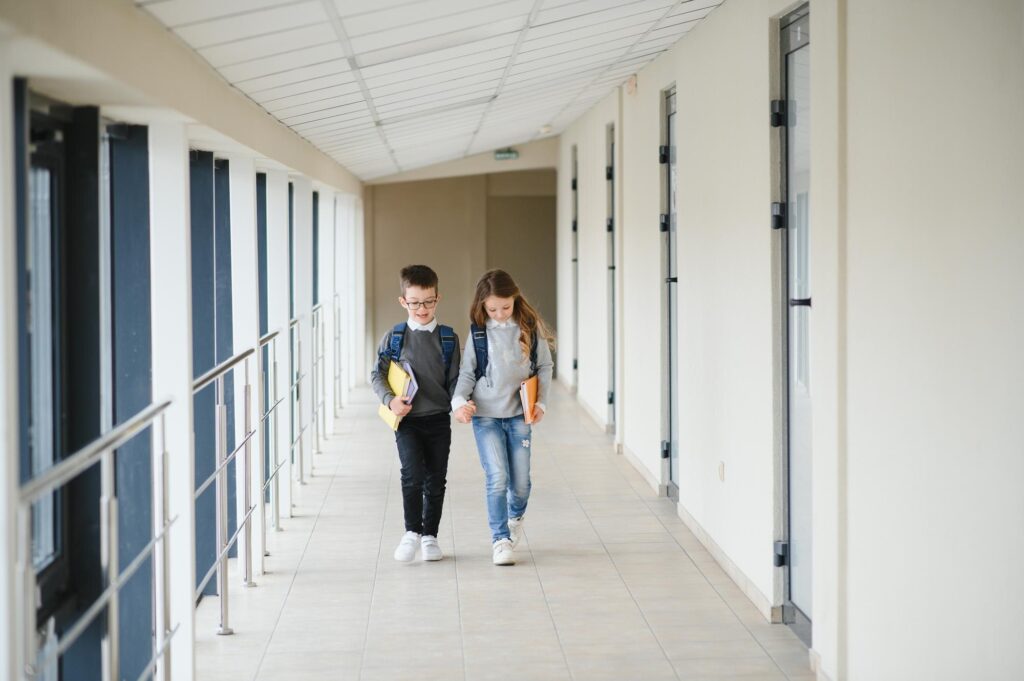
Call them Camille, visiting from France, and Finn, a local pupil: an imagined pair whose first conversation concerns finding a classroom. By the time they reach it, Camille knows where registration happens. Finn has noticed how much of his school day depends on things nobody explains.
Learning Together in the Classroom
In geography, their task is to compare journeys to school. Finn sketches his route; Camille draws hers alongside it. They mark transport options, then discuss how distance, weather and settlement patterns affect each journey.
The teacher asks for an annotated map showing two similarities and two differences. Finn starts drawing while Camille records explanations; halfway through, they swap. When an unfamiliar word stops the discussion, they point to the map and try again.
A completed example and clear assessment criteria help both pupils understand the task. The teacher explains expectations about doing their own work and identifies whom Camille can ask for help.
By the bell, their map contains two accounts of an ordinary morning. Finn has practised explaining something familiar; Camille has contributed knowledge the class did not already have. Their teacher could reuse the maps for a lesson comparing transport choices, with pupils writing captions that explain how evidence supports each comparison.
When an ordinary geography task causes confusion, families may look to school resources or a homework help service such as do my assignment for coursework support. Identifying whether the difficulty concerns vocabulary, instructions, or geographical concepts makes it easier to ask a useful question.
Before a Family Says Yes
At home, enthusiasm needs a practical conversation. Imagine a prospective host family discovering that the evening bus will not get everyone back from a club. Someone must drive, and the family car is already needed elsewhere. That small conflict gives their questions a purpose:
- What is being agreed? They check the stay’s length, school placement, costs, travel and household expectations. A proposed evening return time goes on the table before anyone promises it will work.
- Who protects and supports the student? They ask about safeguarding checks, medical consent, insurance, emergencies and complaints, including who helps if the student needs another home. They obtain both everyday and out-of-hours contacts.
- Who handles school arrangements? Attendance, transport, learning support and school communication each need an owner. The missed-bus problem cannot remain somebody else’s assumption.
- Is the household ready? Everyone discusses time, privacy and sharing home life. If hosting cannot work, the organizer may have supervised activities or practical tasks they can help with instead.
- What applies to this placement? NI Direct describes private fostering as an unrelated adult caring for a child under 16 (under 18 if disabled) for more than 28 days; the carer or parents must notify their local Health and Social Care Trust. This concerns qualifying arrangements, not exchange visits generally: ask the Trust whether it applies before agreeing to host. They also confirm support, any payment and whether a return visit is expected.
Making Home Feel Manageable
The first domestic snag might be laundry. In the imagined household, Camille puts a jumper beside the washing machine, assuming someone will explain the controls. Her host assumes it is ready for the next load. Neither asks.
They catch the misunderstanding before the wash starts. Together, they check the care label, choose the appropriate setting and agree where clothes awaiting help should go. A two-minute demonstration settles what an unexplained rule would not.
Names, meals, bathroom routines, internet access, keys and ways to contact the family need similarly ordinary explanations, spread over several conversations. Practise the school journey together and write down the home address, emergency contacts and a backup plan for failed transport.
Ask privately about food, allergies, religious observance, accessibility and contact with home. Cooking together can make conversation easier without requiring a cultural performance. Allow quiet time and homesickness; arrange private check-ins and involve the coordinator if concerns persist. Hosts need room to adjust, too.
A Welcome Beyond the First Day
Camille’s imagined first week continues through small encounters:
- Monday: share the welcome. Finn meets her at the entrance, another pupil explains lunch, and a third offers to accompany her to a club. One friendship need not carry the whole visit.
- Tuesday: make routines visible. A map, timetable explanation and named staff contact save repeated guessing. Finn explains a local expression after noticing that repeating it more loudly has achieved nothing.
- Wednesday: make invitations usable. Before the club visit, someone checks her interests, costs, equipment, accessibility and the journey home. An invitation becomes useful when she can actually accept it.
- Friday: check privately. A teacher asks where she spends breaks, which lessons remain confusing and whom she would approach for help. Those questions return later in the stay.
- Throughout: act on exclusion. Nationality-based teasing requires a school response. The visitor should not have to laugh along or manage it alone.
Keep the map and explanations for future newcomers, correcting gaps pupils identify. Finn’s lesson is precise: knowing where lunch happens is different from knowing where to sit.
Exchange Beyond the School Gates
There is a real County Down example beyond this imagined week: Down News reported on French exchange visitors at the St Patrick Centre in Downpatrick. The encounter places exchange students in a local visitor attraction, beyond the familiar circuit between classroom and host home.
For another group planning an outing, that local setting offers a starting point. Ask visiting and local pupils to choose something they want to understand, then compare their questions afterwards. Local pupils could fact-check the answers with the attraction’s staff and work with visitors on a short guide for future school groups, practising research and writing for an unfamiliar audience.
Keep the arrangements concrete: a local contact, permission, supervision and transport. Sharing photographs or personal stories remains optional. Nobody needs to speak for an entire country to contribute to an afternoon together.
Connections After the Farewell
Before departure, Camille and Finn could return to their map. Their imagined conversation might begin: “I thought you were being quiet because you didn’t want to talk.” “I was still working out what everyone meant.”
That exchange gives reflection a shape: what happened, what each first assumed, and what they would ask differently now. Invite the host household to add what would have eased arrival.
If both teenagers want to stay in touch, agree on a suitable channel and a first catch-up, with appropriate consent and safeguarding arrangements. A teacher-managed class follow-up is another option if both schools want it. No friendship needs a compulsory timetable.
The map can go home folded inside a notebook, its creases crossing two routes to school.
A More Welcoming Community
Back at the entrance, another newcomer studies a timetable. Finn pauses beside the staircase, leaving enough room for them to look at the signs together.