


Independent UK market report exposes Northern Ireland’s disproportionate reliance on waste export markets
• arc 21 includes Newry Mourne and Down District Council.
• NI councils are sending waste overseas for processing into fuel.
• NI councils dithering on key decision to support an arc21 residual waste project.
• The Warrenpoint harbour waste recycling issue is a symptom of the problem of government indecision.
NI accounts for over 16% of the UK’s total residual waste exports despite only having less than 3% of the UK population. This is due to a local infrastructure deficit which risks significant economic, environmental and reputational damage according to Indaver.
Data from a recent market report by the UK’s leading independent waste sector advisors, Refynix (formerly Tolvik Consulting) has confirmed that Northern Ireland has a hugely disproportionate reliance on waste export markets to manage its residual, black bin council collected waste compared to other UK regions.
This is largely non-recyclable waste that is being exported to fuel Energy-from-Waste plants across Europe due to insufficient treatment capacity in the UK, including here in Northern Ireland.
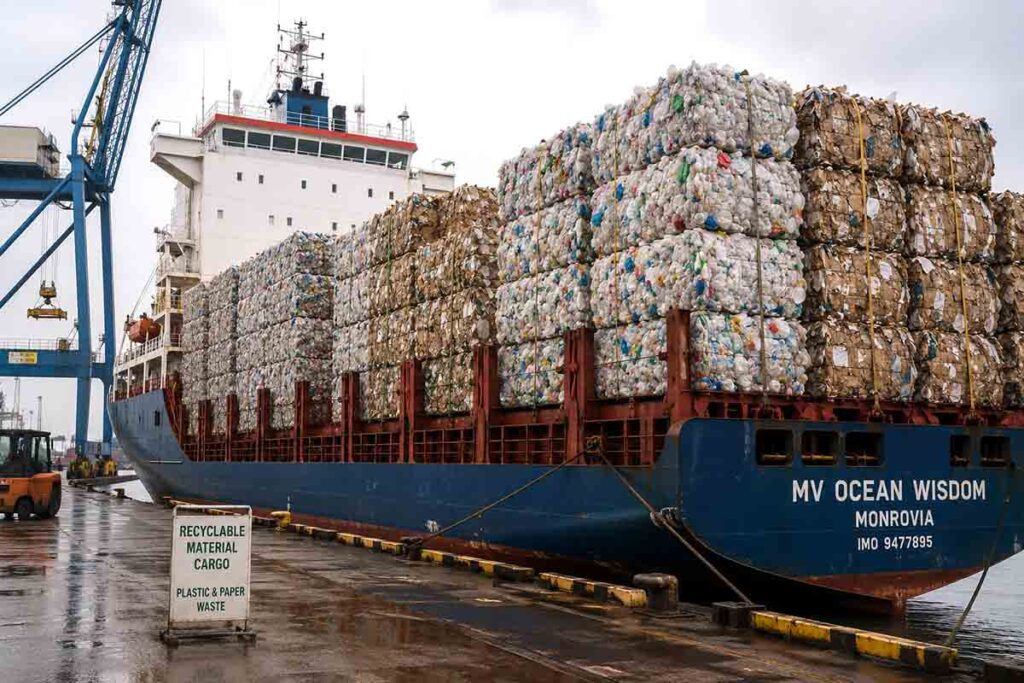
This means the waste’s inherent value is being extracted abroad through renewable electricity and heat recovery which supports other decarbonisation uses and NI councils are missing a trick says the report.
Based on 2025 figures Northern Ireland accounted for 16.1% – some 302,000 tonnes (up from 289,000t) out of a UK total of 1.87Mt of residual waste exports.
This worrying reliance on waste exports has grown dramatically in recent years (by nearly 2.5 times since 2020) and is directly due to the lack of local integrated waste infrastructure to manage this waste in a sustainable manner. By comparison Scotland only exported 25,000 tonnes (down from 100,000t) while Wales exported 47,000 tonnes (up slightly from 45,000t) in the same year.
The report highlights that despite the UK as a whole reducing its residual waste export by 13% year on year, consistent with more EfW capacity coming online, Northern Ireland figures went the opposite way, increasing by nearly 5% y.o.y.
The report also confirms that as of the end of 2025 there were 64 fully operational EFWs and a further 11 in construction/commissioning elsewhere in the UK.
According to Indaver, the European waste management experts behind plans to deliver a £250m public waste infrastructure project to meet the needs of six NI councils that make up the arc21 area, this data proves how much of an outlier Northern Ireland has become in its approach to waste management infrastructure.
The company has been warning for some time that Northern Ireland is facing a looming waste crisis unless it delivers the necessary infrastructure to manage its own waste.
Speaking about their concerns Colin O’Hanlon, Indaver said; “There is chronic under-capacity in the Northern Ireland waste management sector for our black bin waste, and this latest independent data proves we are lagging significantly behind the rest of the UK and Europe in adopting the modern infrastructure necessary to address this growing challenge.
“We have been saying for some time that continued inaction means we are nearing a tipping point where we are increasingly vulnerable and risk adding a waste crisis to our existing wastewater infrastructure crisis. This could further damage Northern Ireland’s economic aspirations and environmental stewardship.
“For many years through various strategies and plans, energy recovery from waste has been viewed as a more environmentally friendly solution than landfill, which it is. Waste exports were only ever seen as an interim solution until Northern Ireland developed sufficient modern and robust infrastructure, but that long-term solution still needs to be progressed.
“Waste exporting is a notoriously complex process involving many movements of waste on roads and ships and which requires port infrastructure and storage.
“It is our view that the issues being experienced over recent years in Warrenpoint, where over 85% of this waste is currently exported from, are a direct symptom of the risks associated with this process and our wider reliance on waste export.
“This is not only an unsustainable approach which comes with economic, environmental and reputational risks, but the markets for this waste are increasingly unreliable and volatile.
“They can be subject to the vagaries of European weather and resulting market demand and in some cases RDF imports are now being taxed by the receiving countries. All this explains why the rest of the UK has and continues to invest in modern waste infrastructure thus reducing reliance on waste exports. Meanwhile Northern Ireland is not.”
In line with Northern Ireland Government policy Indaver, believes that like most councils in the rest of the UK, implementing a local solution would deliver self-reliance, enable NI to increase recycling levels and ensure we recover energy from NI waste locally instead of abroad, benefiting both the environment and the economy.
Colin O’Hanlon added: “Unlike the current wastewater infrastructure crisis, there is a ready-made solution waiting to be implemented.
“That solution is the £250 million arc21 residual waste project, which presents an opportunity for Northern Ireland to catch-up with the rest of the UK and Europe and to showcase how private-sector investment can drive public benefit, deliver long-term value and leave a valuable asset in public ownership.
“The project simply requires a Department for Infrastructure (DfI) Ministerial approval in the near future to deliver a robust and evidence-based planning decision.
“This will allow it to progress to the next stage of procurement where a business case evaluation will trigger a democratic decision by the arc21 councils to decide if it progresses.”
The Refynix report can be found at:
by registering for a free account (also attached) and you can find this waste export data on Page 20.
To read more about the project and Northern Ireland’s waste infrastructure needs you can view and download the Indaver report:
“Tipping Point – NI’s Looming Waste Crisis: The Case for Critical Waste Infrastructure for Northern Ireland“ ” at: