A Health Questiontime is being held in the St Patrick Centre On Thursday 24th November 2022
The Health Questiontime, organised by the Down Community Health Committee takes place on:
Thursday 24th November at 7.30pm
in the Saint Patrick Centre, Market Street, Downpatrick.
The panel of senior local politicians comprises Patrick Brown MLA of the Alliance Party, Councillor Alan Lewis of the DUP, Colin McGrath MLA of the SDLP and Cathy Mason MLA of Sinn Fein.
A spokesperson for the Down Community Health Committee said that “the event is an important opportunity for local people to come along to listen to the key players in the area, to question them and to make their own voices heard.
“The very future of the NHS as we know it, much beloved of a grateful population that has funded it, is now at stake.
What does healthcare mean to you? Come along to the Health Questiontime organised by the Down Community Health Committee and make your voice heard.
“Services are severely restricted generally, but in rural areas in particular, as the Belfast Parish Pump politics distorts the distribution of healthcare provision across all six counties.
“The fact that health is a devolved matter and that there is collective responsibility around the Executive table, when the Executive is functioning, so politicians have a crucial role to play and, when necessary, must be held to account.
“Every politician loves the NHS, or so we hear. But how does that love manifest itself? What about our local services at the Downe Hospital?
“What steps have the politicians been taking and have their parties taken, at the highest level, to demonstrate a commitment to that hospital?
“And what about mental health services? What about waiting lists? Are free prescriptions a luxury we can no longer afford? Are there opportunities for the delivery of a more economic, effective and efficient health service for us all?
“What about health service pays? What about consultants’ contracts? Has a two tier healthcare system already evolved? Should it have? What about care for the elderly?
“What is the future of urgent and emergency care provision for our community? What about general practitioner services?”.
The event is free and open to the public. Everyone is welcome. Tickets are not required but please phone 4461 4340 to book a seat or email :
Sinn Féin MLA Emma Rogan has condemned those responsible for anti-social behaviour at the old Downe Hospital site and for arson.
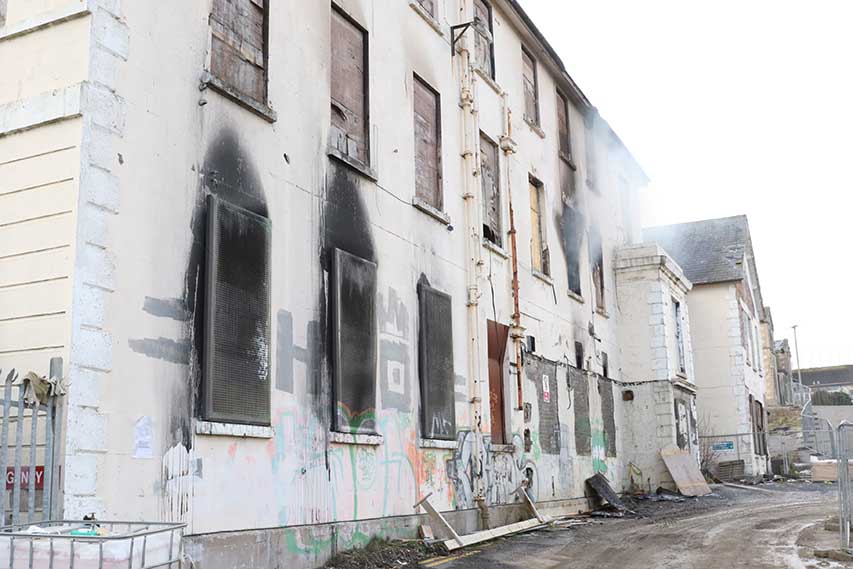
The scene after the fire at the old Downe Hospital on Tuesday evening. Smoke is still billowing from a first storey window.
The South Down MLA said: “I would make an urgent appeal for this anti-social behaviour to stop immediately.
“Those responsible set a skip alight which resulted in the Fire and Rescue Service being called to the scene.
“This is disgraceful behaviour when emergency services are already under pressure during a public health emergency.
“Those responsible have nothing to offer local people apart from disruption and inconvenience and I would call on them to cease.”
Currently, social housing building is still in progress and many of the homes are at an advanced stage of completion or completed.
South Down MLA Emma Rogan.
Community anger at fire at Old Downe Hospital fire says Hazzard.
Sinn Féin South Down MP Chris Hazzard has said the local community are angered to see another fire at the Old Downe Hospital site on Tuesday evening 9th February.
The South Down MP said: “The community were angered to see the Old Downe Hospital ablaze once again tonight.
Concerned at arson at the old Down Hospital site: South Down MP Chris Hazzard.
“I commend the Fire and Rescue Services for their efforts to tackle the blaze.
“The emergency services are under pressure at this time and do not need this type of incident.
“I would encourage anyone with information on how this blaze started to come forward to the PSNI.”
St Louis Grammar School in Kilkeel is included in the Capital Works Projects announced todayby Education Minister Peter Weir at the NI Assembly.
Education Minister Peter Weir has today announced nine schools to advance in design under the Major Capital Works Programme.
Three primary schools and six post-primary schools will benefit from an estimated capital investment of £156 million.
St Louis Grammar School is to progress in the capital build scheme says Education Minister Peter Weir.
The news has been welcomed by South Down MP Chris Hazzard who welcomed the confirmation from Education Minister Peter Weir that St Louis Kilkeel would be included in the next round of new school builds.
Mr Hazzard said: “This is fantastic news for the school and the wider Mournes community what have been waiting on a new school build for quite some time.
“I am delighted for everybody at the school, for the pupils and future generations of children who will benefit greatly from first class education facilities – and of course the wider school management and Board of Governors who have worked tirelessly in recent years to ensure St Louis was included in this next round of capital funding for local schools.
“I look forward to continue to work alongside the St Louis School community in the years ahead to ensure the smooth delivery of this exciting project, and again congratulate all at St Louis for their efforts.”
New School Building for St. Louis Grammar School Kilkeel
After many years of campaigning the Board of Governors, staff and wider community welcomed the news that St. Louis Grammar School Kilkeel has been brought forward in design under the major capital works scheme from the Department of Education. This is a significant financial investment into education for the South Down and Mourne community securing a wonderful new school building to enhance the magnificent teaching and learning continuously delivered by St. Louis.
A delighted St. Louis Principal, Mr Kevin Martin, paid tribute to the efforts of many to get St. Louis to this point. He said: “Successive Boards of Governors, School Management teams, and local representatives have campaigned long and hard with the support of many stakeholders within the community, and such great news is welcomed as we approach our centenary year”.
Founded by the St. Louis Order in 1922, St. Louis has delivered an excellent quality of education to the people of Mourne, South Down and further afield for 98 years. It has witnessed many changes during this time, including changing from an all-girl boarding grammar school to a modern co-educational grammar school.
Mr. Martin thanked the vision of the Department of Education and the Education Authority in reaching their decision on the future of education in Kilkeel and added: “We believe that the decision to invest in a new building at St. Louis acknowledges the excellent level of education we have delivered to our students over the last 98 years.
“This investment will allow us to continue to deliver a high quality of education to the young people of Mourne and the wider region of South Down for the foreseeable future”.
Speaking in the Assembly, Education Minister Peter Weir said: “I am today announcing nine school projects to advance in design under the Major Capital Works Programme, which will result in an investment in the region of £156 million in the schools’ estate.
“Improving the schools’ estate is one of my priorities and in the current unprecedented and difficult times, I hope this latest announcement regarding major capital investment will send a strong signal to the local construction industry and local communities that the Department of Education is planning for the future and is committed to supporting the local economy and the wider community through the delivery of our capital programme.”
Minister Peter Weir added: “My Department’s capital programme aims to ensure that all our young people are educated in school facilities which are safe, secure and fit-for-purpose, enabling them to receive the quality education experience required to help them to fulfil their potential.
“This announcement today represents another strand of the overall capital programme and follows my announcement in May of funding of a further sixteen projects under the School Enhancement Programme.”
Everybody carries a tune in their head, but some more than others.
As I enjoy a bit of folk music and even try and play a couple of instruments for fun, I have more tunes bouncing around my grey matter than most. I’ve had an eclectic array of folk influences from my dad to Tom Paxton and Robbie Burns to Liam Clancy.
An early influence… the early Tom Paxton.
Folk music. Not classical musical or even pop. But Verdi’s Nabucco (The Rising of the Slaves) has a special significance for me. So here’s a list of my top ten tunes that have some significance in my life at certain moments… but there are many, many more tunes I like to listen to.
1. ‘Danny Boy.‘ This enduring, classic song of love and death touches the hearts of many. When I was a wee lad, my dad used to sit me on his knee with my younger brother and sing this song. It was his favourite. He was a great fan of Bing Crosby so probably learned it from him off a 78. My dad was a fairly good singer was always asked to sing a song or two at get-togethers. ‘Danny Boy’ climbs up one and a half octaves and is charged with intrinsic emotion. It was certainly a big hit when Barry McGuigan’s father sang it as his championship bouts. Little did my dad know then I’d eventually marry a colleen from County Down.
2. Verdi’s Nabucco (Rising of the Slaves.) This section of Verdi’s opera is well known. It is about the slaves leaving Egypt in Exodus in the bible and travelling to the Promised Land. This is an inspirational piece of music. It was adapted as a revolutionary anthem during the Risorgimento, the rising of the states that finally unified Italy under Garibaldi in the 19th century. Since then it has been adapted by revolutionary groups around the world, and even the Wolfe Tones have a version of it.
Inspirational… The Slaves Chorus from Verdi’s Nabucco.
I first heard it one Saturday when I went over to my grandparents to do their shopping (as one did in those days.) My grandad, a very autodidactic individual, quite politically radical to the left, put on a 78 on the gramophone and said: ‘Listen to this!”. I did. It stuck with me ever since. He said nothing. He just smiled. He knew I had got the meaning of it! I can still hear the gramophone’s needle scratching in my mind’s ear.
Relax and listen to the track! It is about hope, faith, and a sense of destination. A very inspirational piece.
3. Dear Little Shamrock. Dad was a bit of a crooner. He worked as a stone mason in his early years. One day at a get together with family he sang ‘Dear Little Shamrock’ (probably another Crosby influence). I remember him saying to me that he was dressing stones in the granite yard with another mason who was 82 years old one summer’s day. And the old man enjoyed a song. My dad sang it to him and he loved it and before long they were harmonising their way through it in a great duet in the granite yard amidst the dust, sweat and heat. (see below).
4. My Love is Like a Red Red Rose. I’ve always been a great fan of Robert Burns. I love his poetry and music. But the link below tells another story, one of an early crush I had. When I went to the Aberdeen Folk Club in the mid-sixties, Isla St Clair used to sing there. She was a pupil at the Academy Grammar. I always remember she used to wear dark coloured round necked knitted geansais (jumpers). Her speciality was Scottish Gaelic ballads which she’d sing unaccompanied… the voice of an angel! She appeared in the Downpatrick Folk Club in the 90’s… and I missed her! Shattered!
5. It was ‘The Last Thing On My Mind‘. Tom Paxton, a leading American folk singer, lived in London for a couple of years and toured the UK. He had cut his teeth in Greenwich Village in New York in the 60’s, the hub for folk singers and artists in America. He rubbed shoulders with Bob Dylan, Athro Guthrie, Pete Seeger, Joan Baez and many others. He was the guest one evening in 1966 at the Aberdeen Folk Club. Just over 200 people packed into the function room in the Royal Hotel and I was sitting six feet right in front of him on the front row! I was captivated. When he played his anthem tune, ‘Last Thing on My Mind’, it just blew me away.
I bought his book of songs, and later got ‘Rambling Boy’, his LP, and tried to teach myself to finger pick – and I’ve been trying since then off and on. In 2017, Paxton came to play in the Ulster Hall, and his press agent sent me some material to help promote the show. I ended up phoning him in the east coast of America and interviewing him. Amazingly, he fired a name at me… “Arthur Argo!” Arthur was the chairman on the folk club in Aberdeen and a journalist! It stunned me as I had not heard his name for 40 years! Anyway, I went to see Paxton in the Ulster Hall and enjoyed his music as always.
But, in an obituary article for Arthur Argo (1935-81), I learned his father too was a stonemason. I wonder if our dad’s had been singing ‘Dear Little Shamrock’ together ? I’ll probably never ever know.
I think I’m making some small progress though after on the guitar. I can play three chords now! … after all these years ! The folk club was great – I heard many class acts such as Archie Fisher, Isla St Clair (who sang in the Downpatrick Folk Club in the 90’s), and the Spinners and many more.
If you believe in ‘synchonicity’ then this would be an example of it when unexpected things in life connect in a mysterious way.
6. ‘This Land Is Your Land‘ written by Woodie Guthrie, a hard-bitten folksinger from the years of the American depression and the days of the dustbowl, a legend. He inspired many folk singers such as Dylan and Paxton. His clawhammer, fingerpicking style through the 30’s to the 50’s became the benchmark for many folksingers and afterwards. He wrote his songs as he saw them… quite graphic. And his punchy fingerpicking was his medium of delivery! (Peter Seeger also sang it in Aberdeen in 1967 in the Music Hall see 8 below.) It is a song of hope that there is something beyond the misery that the dustbowl farmers were experiencing when they moved to California.
7. ‘When Yellow’s on the Broom. The McCalman’s recorded this song about the Scottish travellers who were given a rough time by the locals (scaldies).
The McCalmans sing ‘When Yellows on the bBroom’.
I remember when I was at primary school I made friends with a James Higgins, a traveller. To me then I could not understand what racism was. Then one day, the summer holidays arrived. We were on holidays and I called down to his basement flat in the tenement building up the street from me… it was empty. His family had moved on. Probably gone berry picking. I always remembered that tinge of sadness at losing a friend. They had gone on the road. When I heard this song by the McCalman’s years later, it brought back my short school friendship with James Higgins, traveller. So here’s to you James wherever you are!
8. ‘Where have all the flowers gone’. The Tivoli Gardens in Copenhagen in 1965. I was getting all starry eyed holding hands with a German Mädchen (young woman) from Hameln (the town of the Pied Piper) – yes, I was being led astray! – when suddenly as we passed outside the music hall I heard her ‘voice’. It was the very real Marlene Dietrich singing live in a show. And she was singing ‘Ver have all ze vlowers gone’. It was only years later that I really appreciated this chance encounter and hearing that gem of a song sung she immortalised in her song. No-one sings it like her.
And later in the 60’s Peter Seeger the legendary folk singer played in the packed Music Hall in Aberdeen and there were shouts all evening for him to play ‘flowers’. He kept it to the end and played it on his 5-string banjo. It was an electric moment I’ll never forget. And he played too earlier another haunting tune that evening, ‘The Peatbog Marchers’ which will also stay with me. It’s about the concentration camp prisoners plodding out to the bogs to cut peat in Poland in the winter.
After my visit last June to Auschwitz concentration camp in Poland, this song too took on a new and special, sad meaning, about the nature and tragedy of all wars. It has a haunting strange melody. The prisoners used the song to create a sense of moral direction to give them a dignity that had been stripped from them.
9. Ar Éirinn ní nesfainn cé hí (‘For Ireland ‘I’ll Not Tell Her Name‘ ) – again a slow love song – but such a beautiful melody. This is a tune I heard on You Tube last year. It is a beautiful melody. Refreshingly simple. I managed to pick the notes off on my tenor banjo and for some reason the tune came fairly easily.
Liam Clancy, sings this love song, slow and melodic.
It was some time later that I remembered why. Years previous, I had tried to play the mandolin and Paddy Gordon of Brier had given me an instrumental CD with the mandolin taking the lead of many well known Irish tunes that I tried to follow. The tune had remained in my head waiting for its moment to make a re-appearance!
10. ‘The Dutchman‘. I was always a great fan of the Clancy Bros and Tommy Makem. The rendition of the Dutchman written by Michael Peter Smith, an American, by Liam Clancy is superb. The song is rich in emotion and imagery, and has a haunting tune that evokes Amsterdam. But below is a version by Steve Goodman, more upbeat.
Goodman sings The Dutchman on a quicker tempo but it’s one of the classics.
It’s about enduring love – whether the Dutchman was shell-shocked after the war, had a stroke, or has dementia, we’ll never know. But the sentiments are precious, and poetic. And his wife Margaret’s love for her husband is deep and unchanging. In an age when dementia is on the increase, its lyrics have a special, tender meaning.
***
This has been a trip down musical memory lane. As a musician I am fourth rate, I dabble. But I enjoy dabbling. I’ve no pretentions of making an apperance on The X Factor! I like the very odd pop tune, I like blues and I’m not a fan of C&W as it sounds very repetitive to me. I like Irish and Scottish traditional music and folk mostly.
And I could listen all day to local musician John Rodgers from Ardglass singing the Blarney Roses with his bodhran.
Interestingly, my first memory of fingerpicking on the guitar was ‘Big Rock Candy Mountain‘ sung by Burl Ives… a great favourite that was played almost every Saturday on Children’s Favourites on the ‘wireless’. “On a summer’s day, in the month of May…”. I can still hear it bouncing along. It was a nonsense song, but the warmth of his voice stuck with me. And the rhythmic picking and hammering on. Then I’d be off to the Saturday matinee for Donald Duck, The Three Stoogies, and Francis the Speaking Donkey at the Regal cinema.
I enjoy contemporary folk music too such as Antony Toner’s ‘Sailortown’. I’m not entirely stuck in the past.
A song about urban change. Brilliant!
And yes, I’m a fan of pipe bands, and just one final mention… I grew up indoctrinated with Jimmy Shand and his accordion band, (but for heaven’s sake don’t tell anyone!!).
If you want to go down memory lane and chat about your favourite tunes, give me a call on :
Down News is running a free FLASH FICTION competition.
As a distraction in the current Covid-19 crisis to the many people who enjoy reading and literature and generally enjoy the arts, Jim Masson, editor of Down News has decided to provide a small prize for a FREE competition in FLASH FICTION.
Jim Masson said: “We are living through a very difficult time with Covid-19, and the experience of the lockdown is something we are not used to. We are only a short time into this dreadful limitation on our lives and for many it will be stressful, for others a welcome break from the grind of life.
“So, I’ve devised a cunning plan. A distraction. The topic for this flash fiction is:
“LOCKDOWN.”
“Your task is to capture in less than 250 words in fiction the essence of lockdown in the flash fiction. Let your imagination loose on it! Time to rock n’roll!”
What on earth is Flash Fiction, some of you may ask?
Well, it’s in the title – ‘flash’, short and snappy, and ‘fiction’, a story.
Some of you may never have heard of this interesting and popular genre of creative writing. It is quite demanding of your writing sensibilities and could even drive you up the wall as you fuss over a word or a full stop.
Basically, you include, within your tight, strict word limit, the key elements of a good story – a maximum of two characters, a plot, a theme, and you write minimalistically. It is in essence pure fiction, a distilled version of a short story or even a novel. It is very, very short and grabs you. It’s a burst of brevity.
Flash fiction is not a short story. It is something entirely different. It is a writing form that is brutally succinct. It’s a very stripped-down form of writing. It’s lean and can be mean.
Inspiration can come to you in a ‘flash’. You can take a comic, dramatic or tragic approach… it’s really about capturing the emotion of the moment.
You may be cooking the supper in a dream, watching TV, changing a nappy, painting a bedroom, or even working at home. Somewhere in that mix of people locked in together, you may be facing an uncertain future economically, sensing the ultimate fear of death, or having a cough that you wish you did not have, or you are missing family members you love. You may simply be hungry, or lonely. Even with life on the internet… we might be living on Mars such is this strange experience of being isolated in LOCKDOWN.
We can’t touch and hug safely anymore and as social beings this can be painful. And the threat of domestic abuse is ever present in fragile relationships that are put under increasing pressure because of these extraordinary circumstances we currently live in.
So, it’s time to let your imagination loose and get creative! Get in touch with your thoughts and emotions in the here-and-now!
What more on the characteristics of flash fiction? Here are a few guides on how to approach writing flash fiction.
write a title that reveals what your flash fiction is about.
every word must play a part on the story – or eject it.
create vibrant characters – no more than three but two is good. You don’t even have to mention their names. Be brief.
ensure the ‘point-of-view’ is clear e.g. the experience of the person telling the story.
touch on the narrator’s emotions.
surprise and shock your reader.
add a ‘twist in the tale’ – an ending that really turns things on its head and surprises.
use clear and positive imagery.
stay in the moment of the experience. Put your mind in a place in time and stay there.
“Flash fiction is not poetry, and it’s not a short story. It is performing a ballet on a sixpence.“
The Competition Rules.
The title must be no more than four words.
Maximum of 250 words for the text of the flash fiction story.
Submit the ‘story’ using Microsoft Word or a similar software (in font size 14 if possible.)
When submitting, please enter “Flash Fiction with your name” in the subject bar in the email.
Down News reserves the right to use the work submitted or editorial promotion in its Arts Section.
The top three best selected flash fictions will be produced on Down News, online newspaper and any others at the discretion of the editor.
The decision of the Down News editor will be final.
The writer must be resident in County Down.
As the stories may be read by persons under 17, content must be suitable for below this age range ie no graphic violence, sexual content, or inappropriate language.
Content must be respectful to age, race, gender, sex orientation, and ethnic origin.
Work must not have been published previously.
Maximum number of entries per person is three.
Closing date and time for final submissions on the above email (in item 4) is Friday 8th May at 5pm.
Prizes.
First: £50 book gift voucher from Waterstone’s Bookshop.
Second: £25 book gift voucher from above.
Third: £25 book gift voucher from above.
Prize winners will be announced on Down News on Friday 15th May.
Vouchers can be used to purchase books online from the store, or alternatively directly over the counter when the outlet re-opens after the Covid-19 lockdown.
So folks, it’s time to let your grey matter loose and try and get yourself into print and win a prize.
Who will be the overall winner in the ‘Lockdown Flash Fiction’ competition and wear the laurels?
Could it be you?
Entries are now open !!!
***
If you have any queries about the competition, please contact Jim Masson at: [email protected] or phone 028 44 615690.
***
Check out an example of flash fiction!
“FinalCut.”
“It was the bank of red irises in my garden that made me do it. They made me think. I never knew I had it in me.
“I was getting desperate. The rats were running wild.
“They nested in my woodshed, had a family, invaded my home. Traps finished them off. Perfectly. I had no choice. I was relieved.
“My space was mine again.”
She sipped water from the cup and sniffed.
“And then he arrived. That summer. A stranger. Love was great at first.
“Then nosing in my cupboards, drawers, my papers and bank account. Leaving his dirty underwear for me to pick up.
“Mines was yours he thought taking me for granted. I’d had enough. This had to end.
“The irises bloomed again and spoke to me that summer day.
“I asked him to dig a pit for a garden pond. Finally, he started. On the sixth day he got the digger working. Then he rested.
“One final cut as he dozed on his deckchair. It was over. Perfect.
“He’s resting now, beneath the lilies where the koi carp swim.
“My space was mine again. Forever… and detective, I didn’t want to kill him. He gave me no choice… it was the irises… the bloody irises.”
Great Game Fairs of Ireland team, who are based in Downpatrick, have joined up to offer a chance to a business in the Down District Council area to:
* have a FREE stand at the Irish Game Fair and Fine Food Festival at Shanes Castle, Antrim, on the 28-29th June xa02014.
www.irishgamefair.com
* xa0AND after the event advertise your product FREE of CHARGE with a quarter page advertxa0 in the Irish Countrysports and Country Life magazine which with its hard copy and online versions reaches 75-80,000 readers.
www.countrysportsandcountrylife.com
There might also be the opportunity to extend the prizexa0 by exhibiting at the Irish Game & Country Fair at Birr Castle, Co. Offaly on the 23rd & 24th August 2014.
Albert and Irene Titterington, of the Great Game Fairs of Ireland team, moved their home and business to Downpatrick just over seven years ago and have been rather overwhelmed by the friendliness of the people from the area.xa0 They have been delighted to work with Jim and Down News on a few projects and thought they might like to do something to help at least one small business in the area.
Down News is also offering the winning business a FREE two months advert and a feature on its homepage.
Any local company other than fast food or ice cream vendors, can win either a FREE stand in the Crafts, Tourism or Fine Food Pavilions or an outdoor plot at the fair to promote their products to a quality audience of over 25,000 people.
To ENTER : Simply drop Jim from Down News an email at:
[email protected]
and in less than 150 words say what you think your product would add to the show and how you think the show could help you.
Entries close on the 31st May 2014.
[caption id="attachment_49614" align="aligncenter" width="545"] Crowds of thousands line the arena at the Shanes Castle Country and Game Fair.[/caption]
***
For further information, contact Jim Masson at:Down News LtdOffice 2 Knowledge HouseDown Business Centre46 Belfast RoadDownpatrickBT30 9UP
……………..
Mobile: xa007855545873Landline: xa0+0353 xa0(028) 44 615690www.downnews.co.uk
]]>
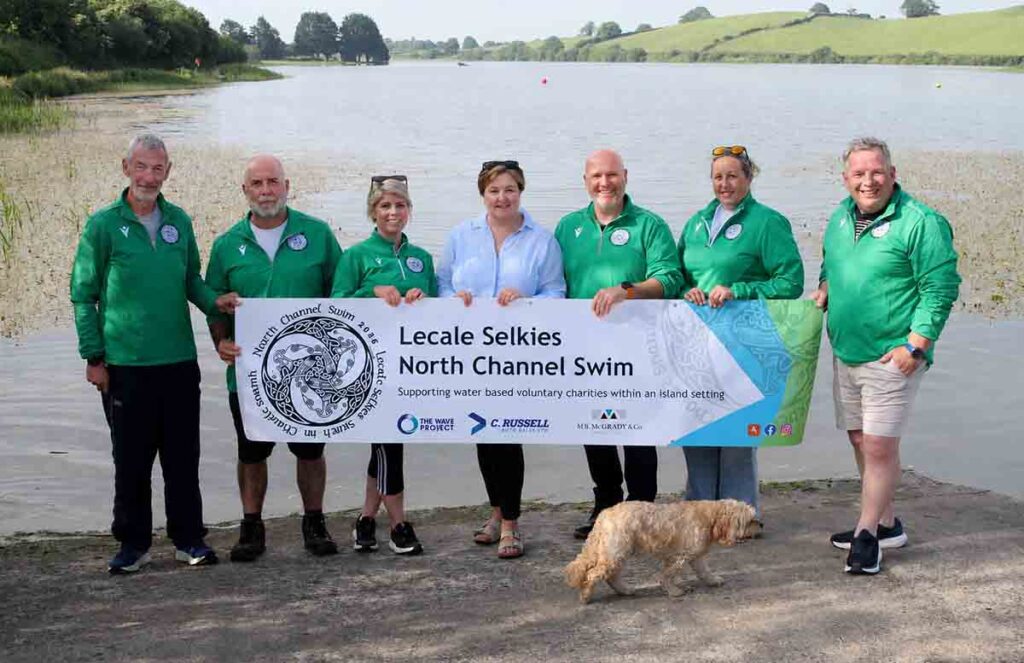
The Lecale Selkies open water swimmers take on North Channel in aid of Wave NI Surf School, a mental health charity
With a good weather forecast and favourable tides, the Lecale Selkies from Downpatrick are ready to take the splash after training for the past year to swim the North Channel in aid of Wave NI Surf ~School
Wave NI is the largest victims and survivors group within Northern Ireland and they offer support to those impacted by the Troubles whether they be injured, bereaved or traumatised by events. That difficult legacy of the Troubles continues.
To date the Selkies have raised over £11,000 for Wave NI Surf School which provides a cold water therapy and surf for children with mental health issues.
What is a selkie ? They were mythological creatures from Gaelic and Norse folklore that could shapeshift from being a seal to a human and could be kind, and even cruel.
The six ‘good’ ‘selkies are expected to dip their big toes in today if weather conditions are all cleared. They will be travelling from Bangor supported by a large RIB (Rubber Inflatable Boat) with a nurse for back-up. And they are determined to raise funds for their chosen charity, Wave NI Surf School
The swimmers have braved the waters of Ballyhornan and Newcastle for the past year in all seasons and weathers getting themselves fit for what will undoubtably be a pressure swim despite the calm sea conditions.
The swim will be a test of their stamina. The North Channel has strong currents and it may take them on a detour. Over the year, the temperature is approximately a steady 6 degrees centigrade. And the distance they will swim in relay will be from 35-45 Kilometres, depending on tides.
The test will be all the more difficult as they won’t be wearing wetsuits, flippers, gloves or boots. They will be swimming just in their skins.
Emma Bohill, the CEO at Down Business Centre, is one of the ‘selkies’, which in Gaelic means a fabled sea creature. But Emma was all smiles and looking forward to the challenge.
“There are six of us altogether doing the challenge and we will swim in a relay, each swimming for an hour apiece until we reach Portpatrick in Scotland. The last person swimming has to touch the rocks there to signify we have completed the swim.
“We are all amateur swimmers. We just want to do something that was unthinkable and go on a journey. It will be great craic.
‘”We are all pretty fit now and we are looking forward to it. The forecast is looking very good.
“It was decided not to cover ourselves in vaseline like many cold water swimmers do as it would make a big mess of the RIB.”
Another Selkie swimmer Colm Surginor said: “We will probably set off from the Gobbins at Donaghadee. The large RIB will act as our safety boat. It has taken a lot of training to do this but it is for a great cause.
“The swim is expected to take around 16 hours and it looks like all systems go at present. When we reach the rocks at Portpatrick, we will all swim on together for the craic. But someone has to officially touch the rocks there.
“This is definitely one of the toughest swims around and we just hope the weather remains calm.
“The journey back to Bangor will only take about an hour. Our families and friends will be there to meet as all and our arrival should be a big occasion. It will be great to get back on dry land again. I hope no-one gets seasick. “
The Lecale Selfies are also very grateful to Margaret Ferguson of the The Lakeside Inn for hosting a fund-raising quiz in March 2026 which raised around £1500. The swimming group decided around last June 2025 that they would support Wave NI.
And the Lecale Selkies are very grateful to sponsors Ciaran Russell Autos and MB McGrady & Co for their sponsorship.
The Lecale Selkie swimmers’ team is comprised of three men and two women: Emma Bohill and Ursula Tumelty, with Tony McLaughlin, Colm Surginor, Jerry McGrady and Stephen Heasley, and Denise Tumelty will be on the RIB as support team.
The Lecale Selkies are raring to go and are waiting on the final ‘all clear’.
St. Brigid’s Primary School Downpatrick Celebrates Major Inclusivity Milestone
St. Brigid’s is celebrating another transformative year reports Kelly Rice, Vice Principal and Learning Support Coordinator.
The school has successfully maintained their IQM Centre of Excellence Award. And through the academic year they have diversified their school culture from integration to deep, community-wide inclusion.
The school’s Senior Leadership Team launched a comprehensive review of its Equality, Diversity, and Inclusion Policy.
Aiming to ensure every pupil, staff member, and parent feels a true sense of belonging, the school conducted extensive consultations with parents, staff, the Student Council, and dedicated focus groups of Newcomer pupils.
The resulting board-ratified policy serves as a thoughtful, community-backed roadmap for the school’s future.
The school’s commitment to inclusivity is vividly on display the moment visitors walk through the doors.
A striking new entrance lobby design features multilingual signage welcoming visitors, inclusive imagery including photos of smiling pupils from a wide range of cultural backgrounds, showcasing a safe and happy learning environment and the schools core Values framed by the school’s motto: “Learning and Growing Together.”
Beyond the lobby, colourful corridors highlight student voice via the Student Council and Eco Committee, alongside academic displays celebrating a successful grammar and punctuation, and problem-solving projects that has been driven by senior leaders.
St. Brigid’s has worked hard to ensure that diversity is not just accepted, but celebrated.
Newcomer pupils actively shape the school’s policies and present a vibrant “Christmas Around the World” assembly in December sharing cultural traditions with their peers.
St Brigid’s is also celebrating another successful year for student inclusivity and digital innovation following a highly successful rollout of its assistive technology initiative.
Driven by a clear vision from the Senior Leadership Team, the school has spent the past year upskilling staff and pupils to create a nurturing, tech-driven environment tailored to individual learning needs.
Central to the school’s success was a strategic partnership with the local SERC College, which placed a student technician on-site. This extra ICT resource proved invaluable, providing classroom assistants and pupils with hands-on support.
Students have also been thriving under the AI Integration programme Amira to support reading. The initiative has positively improved pupil confidence. During a recent assessment, students seamlessly navigated the advanced software package.
Assessors noted the effective use of adaptive AI tools that tailored reading materials to a child’s exact ability level while still offering a healthy academic challenge.
St Brigid’s is successfully adapting to a growing multi-cultural community in Downpatrick, using targeted data and cutting-edge technology to ensure no child is left behind.
Reflecting the diverse traditions moving into the local area, the school made it a priority this past year to enhance staff cultural competency and sensitivity.
Using data from June 2025, the leadership team identified pupils requiring extra assistance with a specific focus on Newcomer pupils and those receiving Free School Meals, carefully matching staff strengths to student needs for weekly support sessions.
The impact on Newcomer pupils arriving within the last 12 months has been profound. Younger students proudly demonstrated their rapid language improvements to a visiting assessor, supported by close communication between staff and parents to encourage English language dialogue.
The school’s data-driven strategy is also yielding excellent results in literacy and numeracy where students identified for additional support are withdrawn weekly from mainstream classes for targeted, small-group sessions with a specialist resource teacher.
By seamlessly blending digital innovation with deep community roots, St. Brigid’s has proven that true inclusivity is not just a policy, but a living practice.
As the school continues to grow, its unwavering commitment ensures that every child, regardless of background or learning need is empowered to learn, grow, and thrive together.
( A report from Kelly Vice Principal, St Brigid’s PS, Learning Support Coordinator. )
Tyrella beach has officially been launched as Northern Ireland’s latest inclusive beach, marking another significant step forward in making Newry, Mourne and Down’s coastline accessible to people of all ages and abilities.
The new inclusive beach was formally launched on Thursday 18th June by Newry Mourne and Down District Council Chairperson, Councillor Glyn Hanna, alongside representatives from the Mae Murray Foundation, project partners, community organisations and invited guests.
Delivered through a partnership between the Council and the Mae Murray Foundation, the initiative provides a range of specialist accessible beach equipment and facilities designed to support individuals, families and community groups in enjoying Tyrella beach safely, comfortably and independently.
Tyrella joins Cranfield as the district’s second inclusive beach, providing enhanced accessibility opportunities and helping ensure that more people can experience the physical, mental and social benefits of spending time by the coast.
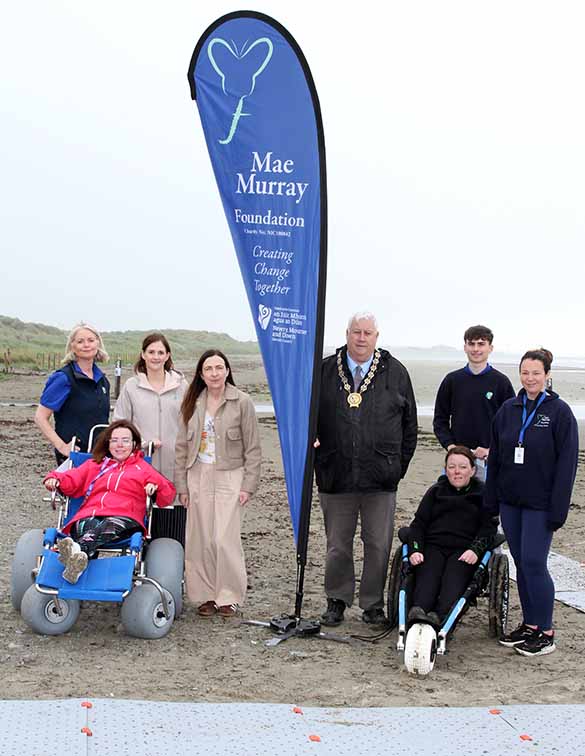
Newry Mourne and Down District Council Chairperson, Councillor Glyn Hanna at the official launch of Tyrella beach as a new inclusive beach, making it accessible to people of all ages and abilities. Included in beach buggies are Naomi Henry (left) and Lisa McNulty and with them are NMDDC representatives (from left) Cara Ryan (Tyrella Beach Countryside Warden), Amanda Smyth (Assistant Director of Economy, Regeneration and Tourism), Michelle Boyle (Head of Tourism), Ryan Tolan (Seasonal Beach Assistant) and Mae Murray Foundation Chief Executive Officer Kyleigh Lough
Guests attending the launch enjoyed an adaptive paddleboarding display, had the opportunity to try a range of specialist beach equipment and viewed the new inclusive beach facilities, including a Changing Places Toilet.
The Council Chairperson Cllr Glyn Hanna said he was delighted to celebrate the official launch of Tyrella as a Mae Murray Inclusive Beach and to see this important investment in accessibility within the district.
He added: “Everyone should have the opportunity to enjoy the benefits of our beautiful coastline, regardless of age, ability or mobility.
“This initiative demonstrates what can be achieved through partnership working and reflects our commitment to ensuring that all residents and visitors feel welcome, valued and included when visiting our district’s spectacular beaches and outdoor spaces.
“The new facilities and specialist equipment available at Tyrella will help more people experience the physical, mental and social benefits of spending time by the sea.
“We are proud to work alongside the Mae Murray Foundation to make our beaches more accessible and inclusive for everyone.”
Mae Murray Foundation Chief Executive Officer, Kyleigh Lough said: “We are delighted to partner with Newry, Mourne and Down District Council to create another inclusive beach in the district.
“People of all ages and abilities will now be able to enjoy a day at Tyrella beach — something many of us often take for granted.
“We now have a fantastic range of accessible equipment available to support individuals, families and community groups to enjoy everything the beach has to offer, whether that’s a walk along the shoreline, spending time with loved ones, or experiencing the sea safely and comfortably.
“This initiative is about creating opportunities, promoting inclusion and ensuring that everyone can enjoy the natural beauty of our coastline with dignity and independence.”
The inclusive beach initiative forms part of an ongoing commitment by Newry, Mourne and Down District Council and the Mae Murray Foundation to improve accessibility and encourage greater participation in outdoor recreation.
Through collaborative working and investment in inclusive facilities, the partnership is helping to ensure that everyone can enjoy the district’s award-winning beaches and natural environments.
For further information on Tyrella Beach and the Mae Murray Foundation, visit:
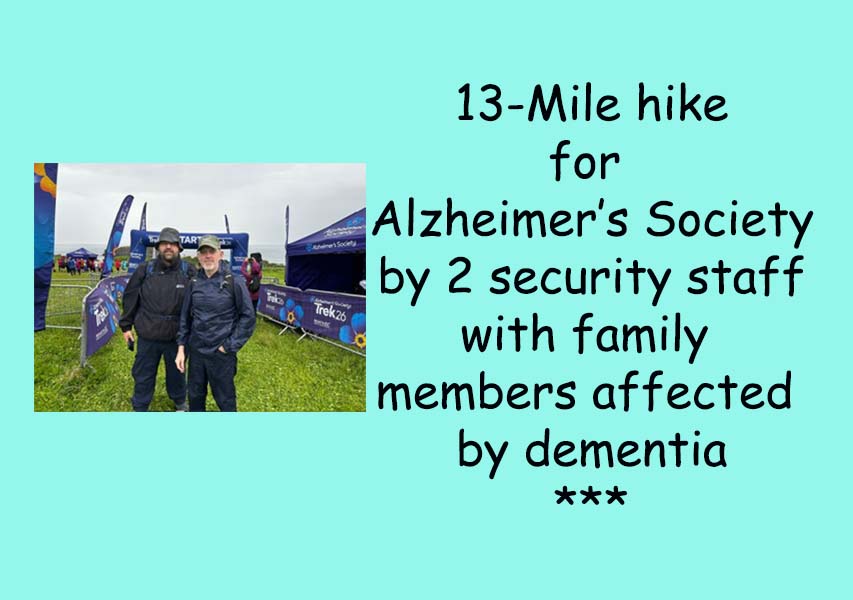
South Eastern HSC Trust security duo do 13-mile hike for Alzheimer’s Society
South Eastern Trust Security Supervisors, Mark Ferguson and Alastair Robinson, have successfully completed the Alzheimer’s Society 13-mile hike at the Giant’s Causeway, raising an incredible £1,200 for the charity.
Taking in the stunning Northern Ireland coastline, the pair took on the challenging trek in support of a cause that is very close to their hearts.
Through both their roles in hospital security and their personal experiences with loved ones affected by Alzheimer’s disease, they understand first-hand the impact that Dementia can have on individuals and families.
Alastair Robinson & Mark Ferguson who went on a 213-mile hike for the Alzheimer’s Society.
Mark and Alastair said: “We were delighted to take part in the hike and raise funds for Alzheimer’s Society. Dementia affects so many people and families, including our own, so this was a cause we were passionate about supporting.
“The walk was challenging at times, but knowing we were helping to make a difference kept us motivated throughout. We would like to thank everyone who donated and supported us along the way.”
South Eastern Trust, Service Lead, Car Parking and Security, Fiona Savage, praised the pair for their achievement, and said: “I am incredibly proud of Alastair and Mark for taking on this challenge for such an important cause.
“Their dedication both in their roles and in supporting this charity highlights the compassion and commitment they bring to the Security Team every day.
“This is a fantastic achievement and a wonderful amount of money raised for Alzheimer’s Society.”
Jeffrey Donaldson Found Guilty of Sex Abuse of Two girls: NSPCC comments on the court decision
A spokesperson for NSPCC Northern Ireland said: “As a public figure, Jeffrey Donaldson held a position of trust in the community, but he grossly betrayed this by repeatedly sexually abusing two girls, while his wife Eleanor was aware but failed to act.
“The victims in this case, now adults, have shown immense courage in coming forward and giving evidence after decades of living with the impact of Jeffrey Donaldson’s abuse.
“Child sexual abuse can have a serious and lasting impact on victims, and it is vital they receive the support they need to move forward with their lives.
“It is so important that anyone who has experienced sexual abuse as a child knows that if they speak out, they will be listened to and supported, regardless of who the perpetrator was or how long ago it took place.
“Everyone can play a part in keeping children safe. This can mean asking difficult questions and being prepared to act on concerns. If something doesn’t seem right, it’s important that it is reported to those who can help protect a child.
“Adults who are worried about a child can contact the NSPCC Helpline on 0808 800 5000 or via:
Police Appeal For Witnesses Following Petrol Bomb Attack In Downpatrick
Police are appealing for witnesses and information after a petrol bomb was thrown at a house in Downpatrick in the early hours of this morning, Monday, 22nd June.
Sergeant Beacom said: “We received a report at around 12.25am this morning that two men, dressed in dark clothing, with hoods up and their faces covered, had thrown a lit item at a property in the Pound Lane area before making off towards John Street.
“Officers attended the scene, along with the Northern Ireland Fire and Rescue Service, where the fire had already been extinguished by one of the occupants.
“Some damage was caused to the house, including scorch marks to the front of the property and the front door.
“Three people were in the property at the time, however, no injuries were reported.
“Anyone with information, including CCTV, ring-doorbell or other footage, is asked to contact police on 101, quoting reference number 24 of 22/06/26.”
Alternatively, you can also submit a report online using the non-emergency reporting form at:
SDLP South Down MLA Colin McGrath has condemned a petrol bomb attack on a home in Downpatrick in the early hours of Monday morning.
Colin McGrath MLA said: “This was an extremely reckless and dangerous act. Regardless of the circumstances, there is simply no place for this kind of attack in our community. The fact that nobody was injured is welcome, but the outcome could have been very different.
“Incidents like this cause understandable concern within the wider community. People want to feel safe where they live and they do not want to see this type of criminality taking hold in their town.
“It is important that there is a clear message that such behaviour is unacceptable and will not be tolerated.
“I’d like to thank the emergency services for their swift response and I would encourage anyone who was in the Pound Lane or John Street areas around the time of this incident, or who may have information that could assist the police, to come forward.”
Petrol bomb attack in Downpatrick condemned SaysMason
Sinn Féin South Down MLA MLA Cathy Mason has condemned a petrol bomb attack on a house in the Pound Lane area of Downpatrick in the early hours of Sunday morning.
Speaking after the incident, the South Down MLA said: “This attack was reckless and must be condemned.
“Three people were inside the property when this petrol bomb was thrown. Thankfully nobody was injured, but the consequences could have been far more serious.
“People have a right to feel safe in their homes without fear of being targeted in this way.
“This attack has caused shock and concern within the local community and those responsible have shown a complete disregard for the safety of others.
“I would urge anyone who witnessed the incident or who may have CCTV footage to bring it forward to the PSNI.
“Those responsible must be held accountable for their actions.”
It creeps up through ordinary things: one reading that takes longer than expected, another group-project meeting, and an essay plan that looks fine in your head but feels much weaker once you start writing. Then you remember there is a presentation next week, a part-time shift you cannot move, and a form that has to be submitted before Friday.
Photo by Yan Krukau: https://www.pexels.com/photo/woman-reading-a-book-8197554/
Each task feels manageable on its own, which is exactly why the problem is easy to miss. It is only when everything starts landing in the same few days that the week begins to unravel.
That is where an academic diary earns its place. Not as a neat little book for people who already have everything under control, but as a way of seeing trouble before it becomes a week of late nights and rushed work.
A diary will not organise your life for you, but it can show you what is coming before everything starts to feel urgent.
It is the overlap that catches people out.
People usually know what is coming. What catches them out is how manageable each task looks until it starts overlapping with everything else.
An essay due in three weeks sounds fine. Reading for Thursday sounds fine. A tutorial, a shift, a society meeting and a train journey home all sound fine too.
Then they land in the same few days.
A diary helps because it gives you distance. Instead of only dealing with whatever is shouting the loudest today, you can look ahead and notice where the pressure is going to build. That is the difference between writing “essay due Friday” and realising two weeks earlier that the essay needs reading, notes, a structure, a first draft and time to edit.
The deadline is only the final date. The useful part is seeing what has to happen before then.
Academic years do not fit neatly into calendar years
A January-to-December diary is fine for appointments, birthdays and general life admin. But anyone who works around education knows the year does not really start in January.
It starts when the new term starts.
That is when the timetable changes, the reading lists arrive, the deadlines appear and the year begins to take shape. By October, you may already be thinking about coursework. By March, revision might need to start. If there is a dissertation involved, the work can stretch across several seasons without caring where the calendar year begins or ends.
That is why an academic-year diary often feels more natural. It keeps the whole study cycle in one place, rather than splitting autumn and spring across two separate diaries.
It is a small practical thing, but it makes planning easier. You can see the year as you will actually live it, not as the calendar happens to divide it.
Start by making the invisible workload visible
At the beginning of term, the first job is simple: put every fixed date into the diary.
Not beautifully. Not colour-coded. Just clearly.
Add lectures, seminars, assignment deadlines, presentations, exams, reading weeks, placement days, tutorial slots, group meetings, holidays and admin dates. Then add the personal commitments that affect your time, because they count too. Paid work, travel, family plans, appointments and regular responsibilities all take space from the week.
This is where many people discover that the problem was never laziness. It was poor visibility.
A monthly view is useful because it shows clusters. A weekly planner view is useful because it shows the detail. Used together, they stop you from planning as though every week has the same amount of space.
Some weeks are light. Some are already full before you add anything new.
Knowing that early changes how you behave.
The week before the deadline is usually the danger point
Deadlines get the attention, but the week before is often where things go wrong.
By that point, you usually want the work to feel like it has a shape. The reading does not need to be perfect, but it should be underway. The argument should be clearer than “I’ll figure it out when I write.” Slides should be more than a few headings. References should not be waiting until the final evening.
A diary helps you spot that point before you reach it.
If an essay is due on Friday, do not only mark Friday. Mark the Monday before as the point where the draft should exist. Mark a day for checking references. Mark another for proofreading. If the task involves research, add time for finding sources, making notes and changing direction when the first idea does not work.
That is not over-planning. It is just recognising that academic work has stages.
An essay is not just one job. It’s reading, thinking, planning, drafting, checking and editing, and each part needs space somewhere in the week.
Reading deserves its own place in the plan
Reading is one of the easiest things to underestimate because it often has no hard edge. There may be no submission button for it, no grade attached to that one chapter, no immediate consequence if it slips by a day.
But reading is usually what determines whether the later work feels possible.
A vague note that says “do reading” is not much help. It is too easy to ignore and too hard to start. A better diary entry is smaller and more specific: read one article, make notes on chapter two, pull three useful quotations, compare two sources, and tidy references.
That kind of planning reduces friction. You are not asking your tired future self to make a decision. You are giving them a clear next step.
This is especially useful in higher education, where independent study can become slippery. Nobody is standing over you every hour telling you what to do next. A diary becomes a way of leaving instructions for yourself.
A good weekly plan includes energy, not just time
It is tempting to treat every blank space in a diary as usable time. Technically, Tuesday evening might be empty. In reality, if you have had lectures all day and a shift afterwards, that is probably not the best moment to tackle the hardest part of an essay.
A useful diary does not just ask, “When am I free?”
It asks, “What kind of work can I realistically do then?”
Heavy tasks need proper focus: drafting, analysing, planning an argument, working through difficult reading. Lighter tasks can fit into lower-energy spaces: updating notes, organising files, checking dates, formatting references, sending emails.
That distinction can prevent a lot of false planning. A week that looks organised on paper but ignores tiredness, travel and interruptions is not really organised. It is fragile.
Blank space helps too. If every hour is filled, the plan breaks as soon as one thing takes longer than expected. Academic work often does take longer than expected. Reading is denser than you thought. A group member replies late. A lecture changes how you think about the essay. A draft reveals a problem you had not seen.
A diary should give you room to respond.
The best system is the one you keep using
There are plenty of diary formats: page-a-day, week-to-view, spiral-bound, hardback, compact, desk-sized, student-focused, teacher-focused. The right choice depends less on what looks impressive and more on what you will actually use once the term gets busy.
A student planner carrying a diary between lectures may want something compact. A teacher planning lessons at a desk may need more writing space. Someone juggling study with work might benefit from a weekly layout that shows commitments side by side. Someone managing longer projects may need notes pages, deadline trackers and monthly overviews.
Small details can matter. A diary that lies flat is easier to keep open beside a laptop. A pocket can hold loose notes or timetable printouts. A bookmark saves time. Paper quality matters if you use highlighters or heavier pens.
These things sound minor until they decide whether the diary becomes part of your routine or disappears under a pile of handouts.
There is no perfect format. There is only the format that fits the person using it.
Do not confuse the cover with the habit
A nice-looking diary can make planning more appealing, and there is nothing wrong with that. If you like picking it up, you are more likely to use it.
But the design is not the system.
The system is the weekly check-in. The habit of moving unfinished tasks instead of pretending they vanished. The moment you notice that two deadlines are too close together. The decision to start reading before it becomes urgent.
That is what keeps academic life from becoming reactive.
An academic diary only works if you return to it. Ten minutes at the end of the week is often enough: check what is coming, move what did not get done, add new dates, choose the next few priorities, and look for anything that could become a problem.
It does not need to be perfect. In fact, it should not be. A diary that allows for crossed-out plans, moving tasks and messy weeks is far more useful than one that only works when life behaves.
Planning is not about doing more
There is a risk with any planner: it can become another way to overload yourself.
That is not the point.
The point of an academic diary is not to fill every page or account for every minute. It is to make better decisions before the pressure hits. Sometimes that means starting earlier. Sometimes it means saying no. Sometimes it means realising that a week is already full and moving something before it becomes a problem.
For students, teachers and education staff, the right tools help make that easier. Even something as ordinary as reliable office stationery can support the routines that keep work visible: diaries, notebooks, folders, pens, highlighters and the small practical items that make planning less of a chore.
Good organisation is rarely glamorous. Most of the time, it is just a series of small systems that stop important things slipping out of view.
What the diary is really for
An academic diary will not make the term less busy. It will not write the essay, finish the marking or clear your schedule for you.
But it can give you a bit more warning.
It helps you see when the work is starting to bunch up, when a deadline needs attention earlier than you thought, and when the week ahead has less room in it than you hoped.
That is the real value. Not perfect pages or colour-coded plans.
Just a clearer view of what is coming, while there is still time to do something about it.
Moment came for PM Starmer to finally announce his resignation in September following the leadership election
This morning just after 9.30am, the podium was set up outside 10 Downing Street, and a statement on the Prime Minister’s future was imminent.
After a weekend at Chequers probably writing his exit strategy and speech, Kier Starmer emerged through the door of No. 10 and address the hundreds of media members facing him. Fox hunting may be banned in England, but hunting the PM sees to be fair game for the media who had their moment after relentlessly harrying the PM in recent months.
Starmer has been juggling a number of political balls such as the war in Ukraine, Putin threatening the UK and Baltic states, the change in the global order, coping with a volatile American president, a faltering economy, the war in Iran, soaring fuel prices, a kaleidoscopic party-political scenario in teh UK, and a NATO unsettle Trump’s hesitancy.
But Labour’s poor showing in the recent Council elections in England was probably the main turning point as MPs feared that they would be for the chopping block next.
Andy Burnham then from his mayoral platform in Manchester’s sending out signals that if he were elected to Parliament he would present a better option of dealing with the Reform threat than Starmer. Burnham had a strong win in the Mackersfield by-election, and the media sharpened their knives and they got their moment this morning.
The above was PM Keir Starmer’s message when he came into office; today he announced he will step down in September after an orderly election for a new party leader, and the summer break.
And there have been internal UK issues such as the North-South divide, problems with illegal immigration, the rise of Reform, but he did say that defence spending had been increased, which was high on his list of achievements which he said the economy was now stronger.
However, I remember him using the words “across the United Kingdom” in a speech once and several times afterwards. But the reality for people in Northern Ireland is they many still feel that NI is a place apart and does not have the same status as other regions in the UK despite the GFA.
Before politics in NI was polarise in the 60s, the was a strongish Labour presence in the North and they held Ministerial position in the 60s cabinets. However, The British Labour Party has turned its back on its ‘brothers’ in NI.
There is a Northern Ireland Labour Party, but they are forbidden by the UK Labour executive to stand candidates or hold branch bank accounts and form local branches to fight council, Assembly and Parliamentary elections. Is this democratic ???
It will be a significant test for Andy Burnham if the current Labour members here in NI press him as the new PM for full parity of esteem.
There does seem to be a fundamental issue with the block grant and hence the constant under-funding of the health and other public services. As a ‘Northerner’, Burnham should understand the implications of this – the fragmentation of the UK as the momentum for a United Ireland never-the-less grows.
Starmer did say towards the end of his speech, which started off in a statesman-like tone and led to what looked like a tearful expression of regret but he was very dignified in how he set out the timetable for his orderly departure, saying he will step down in September after the summer recess and the leadership contest has been held.
The 64,000 dollar question is: has Andy Burnham got what it takes to juggle the same balls as Starmer was juggling ?
If he hasn’t, Reform may turn over his Party, and the Tories will be laughing from the sidelines as usual incapable of seeing their own demise and contribution to what could be the slide of the UK into a lesser world nation status… a has-been country.
Farage is threatening to deport illegal aliens in significant quantities, and a government principled by such right wing values could quickly slide into chaos being something reminiscent of 1930s Germany.
We are living in troubled and unsettling times. Across the country there is an Angst. And there is a danger that everyone puts their faith in Andy Burham who himself gets swamped with issues from different directions and eventually becomes a Starmer Mark II.
New Prime Minister must be selected swiftly as country needs stability
Ulster Unionist MP for South Antrim, Robin Swann, has called for a swift and clear process to select a new Prime Minister following Sir Keir Starmer’s resignation.
UUP MP Robin Swann.
Robin Swann MP said: “There has been huge instability in Parliament in recent weeks as it became clear that Starmer wouldn’t be Prime Minister for much longer.
“What the country needs now is stability, so the process which now follows to select a new Prime Minister needs to be swift and clear, and whoever takes over the role needs to be given the time, space and opportunity to lay out their plans and front-bench team.
“The impact that this change will have on Northern Ireland is yet to become clear, but the appointments the new Prime Minister, most likely Andy Burnham, makes in the Northern Ireland Office, the Ministry of Defence and the Treasury will make his vision and approach for Northern Ireland will be.
“We will look at this change as an opportunity, and the Ulster Unionist Party will be engaging with the new Prime Minister and their team to put to them our vision and priorities for Northern Ireland and the Union.”
Countryside calls for urgent reset in wake of Keir Starmer resignation statement
Earlier this morning (22nd June), Prime Minister Sir Keir Starmer announced his resignation, following growing calls from within the Parliamentary Labour Party for him to set a timeline for his departure.
For the past two years Starmer has stood at the helm of government following his landslide victory in July 2024, that saw his party make numerous gains in rural areas, resulting in more than 120 rural Labour MPs.
Since that point, however, there has been widespread opposition among rural communities towards many government policies and proposals that have been seen as a “war on the countryside”.
Such attacks included the Family Farm Tax, which saw tractor protests take place across the country, huge hikes to business rates for rural pubs, plans to restrict game shooting, and the controversial proposal to ban trail hunting, which just last week saw a mass crowd protest outside the Department for Environment, Food and Rural Affairs (Defra) offices in Westminster.
Rural campaigners have now warned that whoever succeeds Sir Keir as Prime Minister, which looks increasingly likely to be Andy Burnham, must urgently reset relations between government and countryside, and end the “culture war on the countryside”.
Tim Bonner, Chief Executive of the Countryside Alliance, said: “This was undoubtedly a hard decision for the Prime Minister to make and we wish him and his family well for the future.
“After 14 years of his party being politically irrelevant in the countryside, Keir Starmer pledged to renew ‘the bond of respect’ between the countryside and politicians.
“Many rural voters gave him the benefit of the doubt and the result was a record number of Labour MPs representing rural constituencies, some for the first time in history.
“But sadly, shortly after taking office, Sir Keir’s government launched an astonishing attack on the countryside with the implementation of the family farm tax.
“The policy has caused untold pain and anxiety for farmers. It was, plainly, bad politics. We’ve seen taxes on rural businesses and toxic culture war policies including a ban on trail hunting and a clamp down on game shooting, all of which will further harm an already fragile rural economy.
“The government will soon look very different and there will be plenty of time for ministers to consider a change of course. ‘Change’ does not start with culture war on the countryside and a return to the mistakes of the past.
“We stand ready to work with the next government to achieve the very best for our countryside.”
Creativity and Community: Recreational Art Students Exhibit WorkAt SRC
Southern Regional College (SRC) celebrated the creativity and achievements of its recreational art students on Wednesday 17 June 2026.
Artists from Newry and nearby recreational art classes of Banbridge and Warrenpoint, came together to showcase their work at the College’s annual end-of-year exhibition at the College’s Newry campus.
The exhibition marked the culmination of another successful year for SRC’s popular recreational art programme, with students presenting an impressive collection of artwork across a range of styles, themes and mediums.
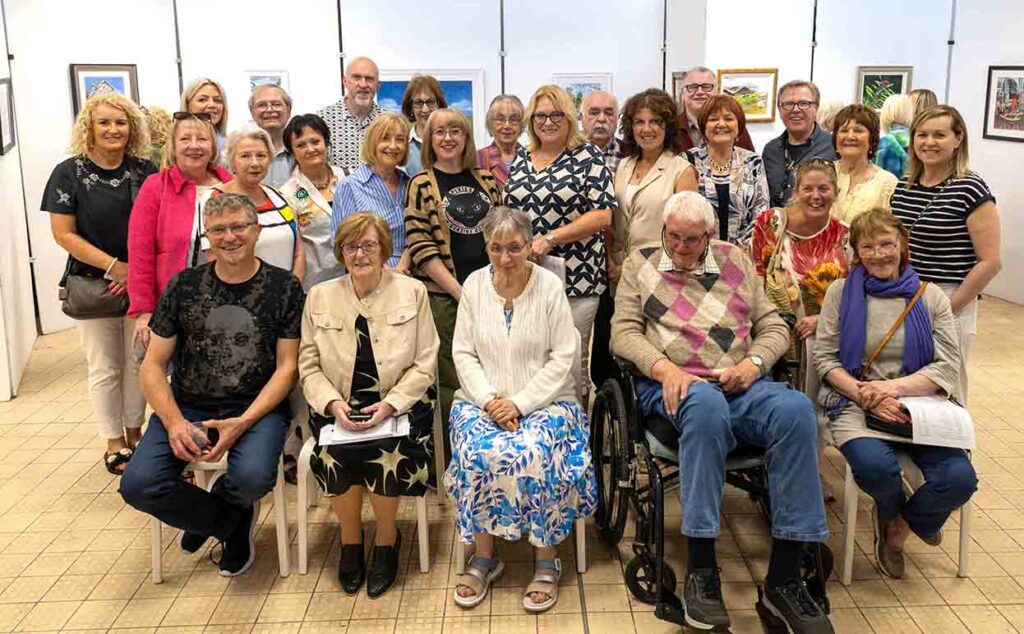
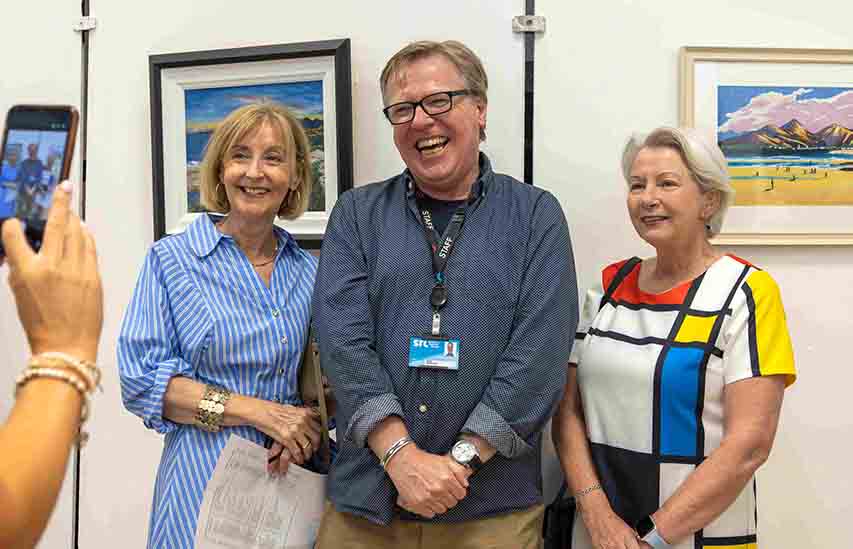
Participants from SRC’s recreational art classes at the end of year exhibition at the Newry campus. Attending the exhibition were students from Newry, Banbridge and Warrenpoint recreational art classes.
From vibrant landscapes and detailed portraits, the showcase highlighted the talent, dedication and personal journeys of the artists involved.
The recreational art classes, delivered at SRC’s Newry campus and in community venues across the local area, continue to attract both new and returning students.
Among those exhibiting was Warrenpoint resident Sally McCardle, a passionate lifelong learner who has been attending courses at SRC for almost 20 years.
Art lecturer Nigel Whiteside with attendees at the Recreational Art end of year exhibition.
Sally said: “I have been studying with the College for around 20 years and have completed a variety of different courses during that time. I would recommend this class to anyone who is considering it.
“Nigel’s encouragement, enthusiasm and openness create such a positive learning environment, and that is one of the main reasons I have continued to return year after year.”
Fellow student Rose Gray from Newry has also enjoyed exploring her creative side through SRC courses over several years.
“Having previously focused on crafts and knitting, Rose has recently discovered a passion for painting and now enjoys experimenting with different artistic techniques and styles.
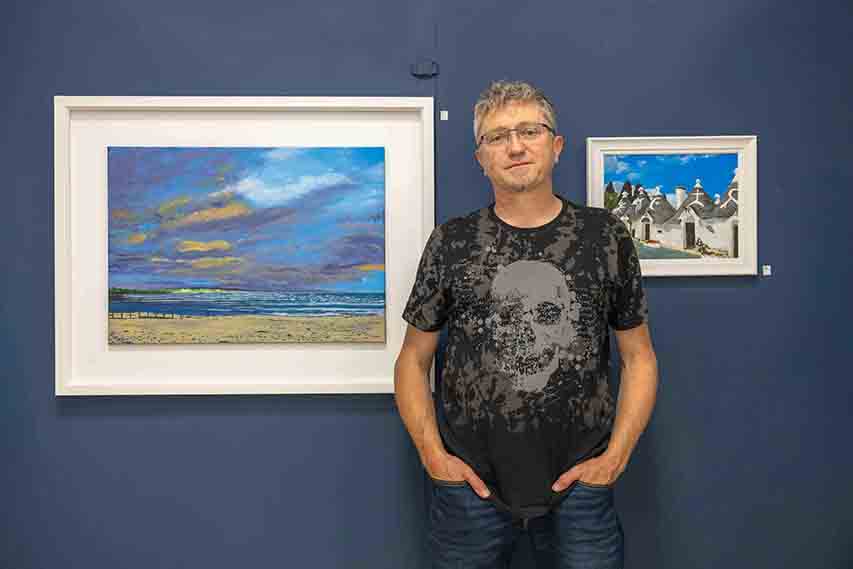
Conor McGuinness from Burren, Warrenpoint alongside his artwork at the recreational art exhibition.
Mr Stephen Rogan, Head of Faculty for Computing, Design & Academic Studies at Southern Regional College commented:
“It is wonderful to see so many familiar faces returning each year continuing to develop their artistic talents.
“The exhibition is a celebration not only of the artwork produced, but also of the friendships, confidence and sense of achievement that these classes help to foster.
“We congratulate all students on their outstanding work and look forward to welcoming many of them back again in September.”
Applications for SRC’s recreational art courses for the 2026/27 academic year are now open.
Moving into a new home is an exciting milestone, but it also comes with plenty of responsibilities that tenants need to manage before settling in. From checking the condition of the property to understanding your tenancy agreement, preparing in advance can help you avoid unnecessary problems later. Whether you are renting your first property or moving to a new area, getting support from experienced professionals such as Mansfield estate agents can make the process smoother by helping you find a suitable home and understand the rental process clearly.
A detailed moving checklist allows you to stay organised and ensures that important tasks are completed before you receive the keys. Taking time to inspect the property, arrange essential services, and prepare your documents will help you start your tenancy with confidence.
Check Your Tenancy Agreement Carefully
Before moving into your new home, read through your tenancy agreement in detail. This document contains important information about your responsibilities as a tenant and the landlord’s obligations.
Make sure you understand:
The length of your tenancy
Monthly rent amount and payment dates
Deposit details and protection scheme information
Rules regarding pets, decorating, or making changes to the property
Maintenance responsibilities
Notice periods if you decide to leave
If anything is unclear, ask your letting agent or landlord before signing the agreement. Understanding the terms from the beginning can prevent misunderstandings during your tenancy.
A property inspection should be one of the first things you complete before bringing in your belongings. Check every room carefully and look for any existing issues.
Pay attention to:
Walls, ceilings, and floors for damage
Signs of damp or mould
Condition of windows and doors
Plumbing fixtures and water pressure
Heating system and radiators
Kitchen appliances
Bathroom fittings
Take clear photographs or videos of the property before moving in. This creates a record of the condition when you started your tenancy and can be useful when you eventually move out.
Review the Inventory Report
Many rental properties come with an inventory report that lists the condition of furniture, appliances, and fixtures. Read through this document carefully and compare it with the actual condition of the home.
If you notice anything missing, damaged, or incorrectly recorded, report it immediately. Make sure both you and the landlord or agent have agreed on the inventory details before you move in.
A thorough inventory check can help avoid disputes about your deposit at the end of your tenancy.
Set Up Your Utilities
Before moving day, arrange all essential services so your new home is ready when you arrive.
You may need to organise:
Gas and electricity accounts
Water supply
Broadband and phone services
Council tax registration
TV licence if required
Take meter readings on the day you move in and keep a record. Providing accurate readings helps ensure you are only charged for the energy you use during your tenancy.
Check Safety Features
Tenant safety should always be a priority when moving into a new property. Make sure essential safety equipment is present and working properly.
Check:
Smoke alarms
Carbon monoxide detectors
Fire exits where applicable
Locks on doors and windows
If you notice any safety concerns, inform your landlord or letting agent immediately. Landlords have legal responsibilities to ensure rental properties meet required safety standards.
Plan Your Moving Day
Moving day can become stressful without proper preparation. Create a simple plan to make the process easier.
Before the move:
Confirm your moving date and key collection time
Arrange transport or removal services
Pack important documents separately
Prepare cleaning supplies
Keep essentials such as chargers, toiletries, and basic kitchen items easily accessible
Having a first-day essentials box can save you from searching through multiple boxes after arriving.
Update Your Address
Once you move into your new home, remember to update your address with important organisations.
Notify:
Your bank
Employer
Insurance providers
Healthcare providers
Government services
Subscription services
Updating your address promptly ensures that important letters and information reach you without delays.
Understand Maintenance Procedures
Before moving in, find out how repairs and maintenance requests should be reported. Your tenancy agreement or letting agent should explain the correct process.
Keep contact details for:
Your landlord
Property management company
Emergency maintenance services
Knowing who to contact and how to report problems will help you deal with issues quickly if they occur.
Meet Your Neighbours and Explore the Area
Moving into a new home is not just about the property itself; it is also about becoming familiar with your surroundings.
Take some time to explore:
Local shops
Transport links
Schools and services
Parks and recreational areas
Nearby facilities
Introducing yourself to neighbours can also help you feel more comfortable and connected in your new community.
Final Thoughts
Preparing before moving into a rental property can make the entire experience easier and more enjoyable. A proper checklist helps you stay organised, protect your rights as a tenant, and create a positive relationship with your landlord or letting agent.
By checking the property condition, understanding your agreement, setting up essential services, and keeping important records, you can begin your new tenancy with peace of mind. A little preparation before moving day can make a big difference and help you enjoy your new home from the moment you arrive.