



Forestry Service keeps a close eye on tree disease in Northern Ireland trying to maintain a healthy tree population
Larch trees across Northern Ireland have been faced with a deadly fungus for the past several years.
A spokesperson from the Forestry Division said: “Phytophthora ramorum is a fungal-like pathogen which can cause damage to some forest tree species, primarily larch, and is commonly referred to as ‘larch tree disease’.
“It was first confirmed in larch in Northern Ireland in 2010, previously present in Great Britain and wider Europe.
Since 2010, tree felling of significantly affected larch areas was undertaken by Forest Service on its estate and by third party woodland owners, due to the classification of ramorum as a regulated quarantine pathogen.

“Harvesting of these affected areas contributed to mitigating the speed of spread of the disease over that time frame.
“The affected areas harvested continue to be managed as woodlands, including their regeneration with alternative disease tolerant species.
“Due to the extent of the presence of Phytophthora ramorum, becoming widespread in the environment across NI, it became legislatively classified as a non-quarantine pathogen since 2022.
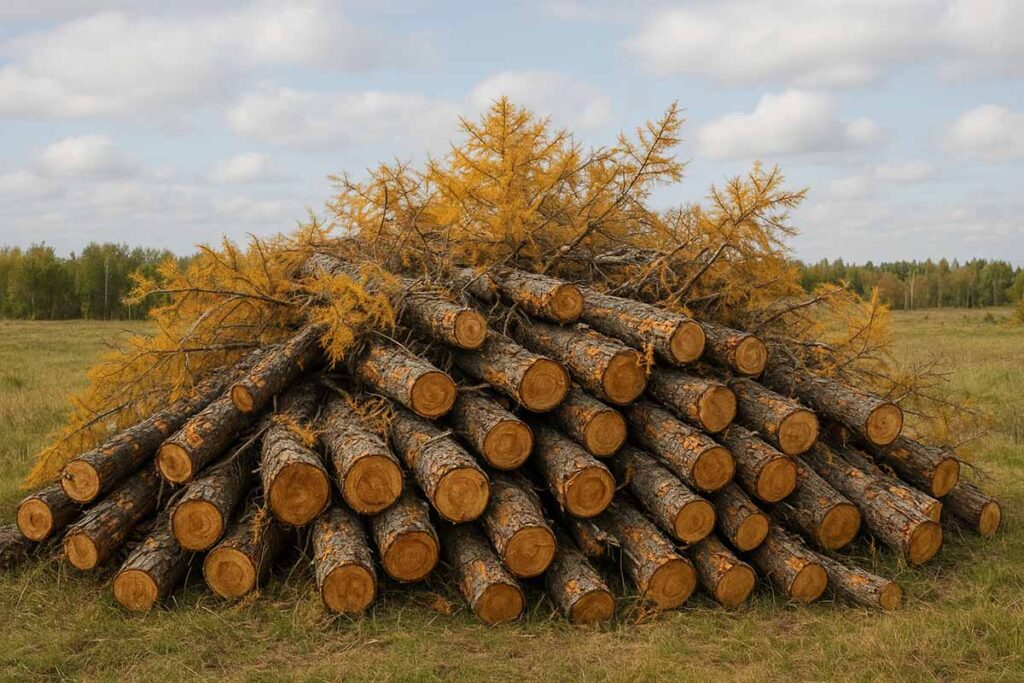
“Whilst larch trees remain vulnerable to the spread of the disease, they represent a minor component of all tree species across Northern Ireland’s woodlands and forests.
“However, the harvesting of disease affected areas can have a significant visual impact at a local level until the woodlands become re-established, usually within five years.
“Forest management plans and operations are developed in conjunction with a wide range of stakeholders and interest groups and include careful consideration of the impacts and opportunities for wildlife species and habitats.”
What species inhabit larch trees and woodland ?
A wide range of birds, animals use larch trees or larch woodland. These species are all present in NI and are commonly associated with coniferous or mixed woodland where larch is included.
Birds
Seed- and cone-eaters
- Siskin
- Lesser redpoll
- Common crossbill – occasionally breeds in NI when cone crops are good.
Insect-feeding woodland birds
- Coal tit – strongly associated with conifer stands.
- Blue tit & great tit – forage among needles for caterpillars and other insects.
- Goldcrest – feeds on tiny invertebrates on larch shoots.
- Treecreeper – hunts insects in larch bark crevices.
- Chaffinch & robin – feed on ground in larch-dominated woods.
Raptors and larger birds
- Buzzard – uses mature larch for perching; occasionally nests in mixed plantations.
- Sparrowhawk – hunts in and around larch stands.
- Tawny owl – will nest in cavities or use older larch as roost cover.
Mammals
- Red squirrel – eats larch cones, particularly in western NI where conifer plantations are common.
- Pine marten – increasingly widespread; hunts in larch woods rich in undergrowth.
- Roe deer – present in many regions (especially Antrim/Down); browse young larch shoots.
- Wood mouse & bank vole – use the ground layer in larch woods for foraging and cover.
- Bats (common pipistrelle, soprano pipistrelle) – use the relatively open canopy structure for feeding on midges.
Insects (especially moths)
Northern Ireland hosts many conifer-associated moths that use or feed on larch:
- Larch pug (Eupithecia lariciata)
- Larch beauty (Semiaspilates aberrata)
- Larch tortrix (Zeiraphera griseana) – occasionally a defoliator
- Pine carpet, grey pine carpet, and other conifer moths that will also use larch
- Case-bearer moths
- Bark beetles (various species) using weakened or dead larch
- Aphids, including larch woolly adelgid
These insect communities help feed tits, goldcrests, bats, and woodpeckers.
Fungi & Lichens
Common in NI’s larch stands:
- Larch bolete (Suillus grevillei)
- Fly agaric (Amanita muscaria) – frequently under larch
- Conifer polypores (bracket fungi on old or fallen stems)
- Various lichens – especially in clean-air upland sites such as the Mournes and Sperrins
Ground Flora Under Larch in NI
Because larch is deciduous in winter and lets in more light, the following plants often thrive beneath it:
- Bilberry
- Heather
- Bracken
- Wood sorrel
- Foxglove
- Moss-rich ground layers that support invertebrates and small mammals.